
Google Applied AI Engineer Interview: DSA, ML Design, FDE Loop
Round by round through Google's Applied AI, ML, and Forward Deployed loops: the DSA bar, the system design centerpiece, and how the committee levels you.
BY ADAM REYES · APPLIEDAIPREP EDITORIAL · UPDATED JUNE 21, 2026 · 9 MIN READ
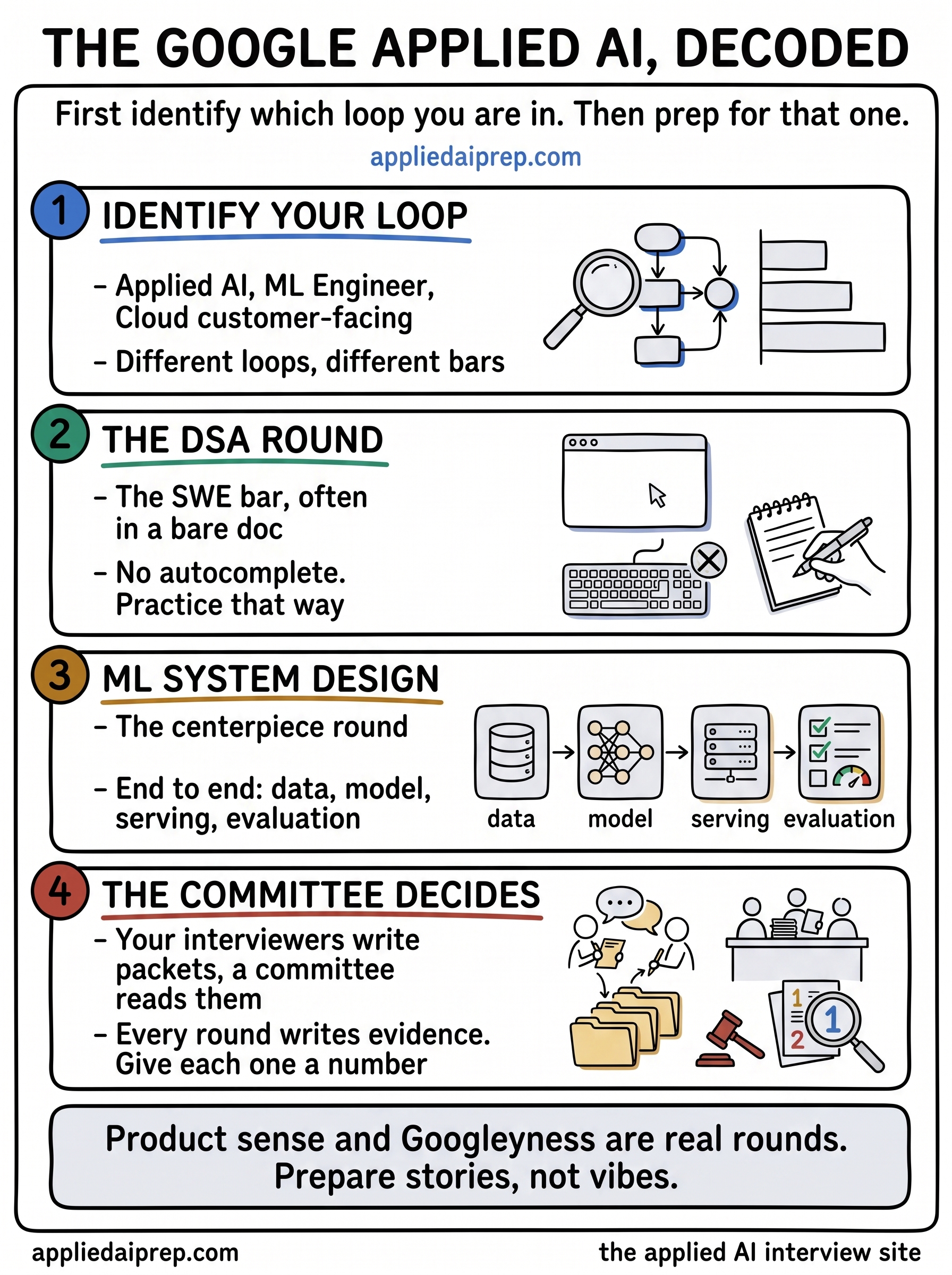
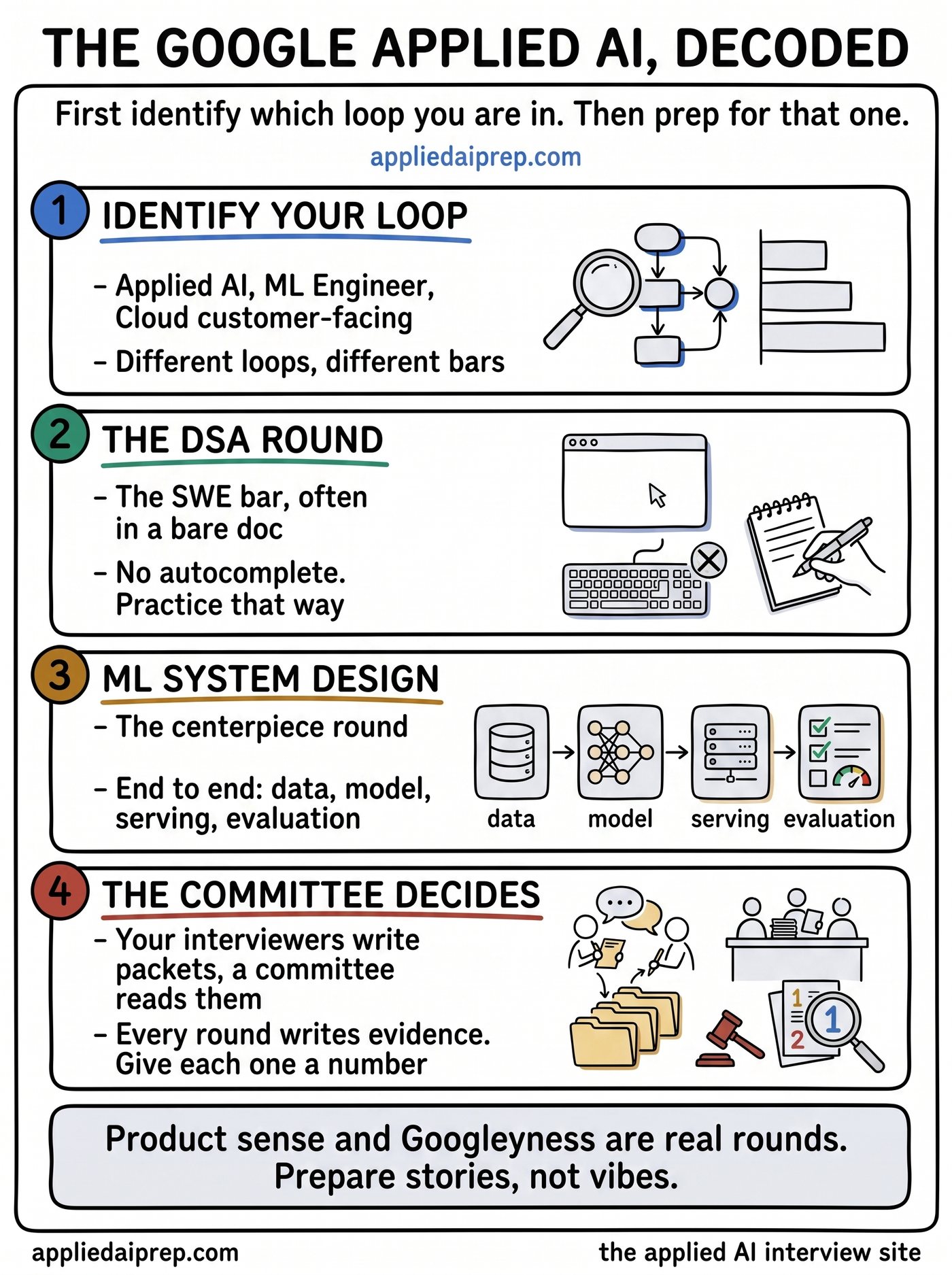
The Google Applied AI Engineer interview is really several loops wearing one label, and the first job is confirming which one you are in. Most ML engineers are hired as software engineers with an ML focus and go through a DSA bar set at the full SWE level, an ML breadth round, an ML system-design round, and a Googleyness behavioral round, then an independent hiring committee decides hire, level, and team. The newer 2026 Forward Deployed Engineer track adds customer-facing rounds (vibe coding, agentic system design) for engineers who ship inside a customer's environment. The Cloud Customer Engineer and Field Solutions Architect path is a separate presales track. All of them still end at a hiring committee that did not interview you. Plan for six to eight weeks and four to six rounds.
First, identify your loop
This matters more at Google than almost anywhere, because the rounds genuinely differ:
- ML Engineer (applied track). Hired through the SWE loop with an ML focus: coding, ML breadth, ML system design, Googleyness. ML system design becomes the centerpiece at L5 and L6.
- Forward Deployed Engineer. A newer customer-facing 2026 format: coding and algorithms, a "vibe coding" session against ambiguous production-style requirements, an agentic and ML system-design round, and Googleyness. Sometimes compressed into as few as two interviews over two days.
- Cloud Customer Engineer / Field Solutions Architect. A presales track scored on role-related knowledge (GenAI, RAG, taking a proof of concept to production) and general cognitive ability, with a customer-scenario round and often a technical demo.
Confirm the track with your recruiter before you prepare. The DSA muscle transfers; the customer-facing and product rounds do not.
The DSA round is the SWE bar, often in a bare doc
Google holds algorithmic coding at the same level as its software engineering loop, and one or two coding rounds is standard. Expect string and array manipulation, tree and graph traversal, and a follow-up that pushes you to optimize a brute-force solution and explain the change. A detail that catches people: it is frequently coded in a plain Google Doc, no autocomplete and no run button, so practice writing correct code by hand and dry-running it.
What they score: how you decompose an unfamiliar problem, clean and correct code, honest complexity analysis, and edge-case handling without prompting. For the FDE track there is also a vibe-coding round where the spec is loosely defined on purpose. There, narrate your assumptions, ask clarifying questions, and ship something that works before optimizing. Drill the patterns against our coding and data-structure questions.
ML system design is the centerpiece
This is the round that decides senior outcomes. You design an ML or agentic system end to end and reason out loud about the full lifecycle, not just the boxes. Classic prompts are recommendation (design YouTube recommendations), spam or fraud detection, and autocomplete. The FDE variant leans agentic: architect a RAG system over a customer's private data, or design an agentic workflow that automates a multi-step enterprise task.
The held-back signal is the lifecycle. A clean architecture diagram caps out mid-level. The interviewer wants the problem framed as an ML task (what are the features and labels), the model choice justified against the given constraints, an offline and online evaluation plan, deployment, and how you catch drift in production. At L5 and up they push hard on tradeoffs: retrieval versus fine-tuning, cost versus latency versus reliability, why this architecture over that one. Google's FDE listings also point to concrete tooling worth knowing, including agent patterns like ReAct and self-reflection, and frameworks such as LangGraph and the Agent Development Kit.
Prepare with the ML and data science set for the modeling and evaluation depth, the RAG and agent system design set for the agentic and retrieval prompts, and the system design questions for scale and reliability patterns.
Product, customer scenario, and Googleyness
The Googleyness round is a behavioral interview on ownership, handling ambiguity, cross-functional collaboration, and humility about failure, and it carries extra weight for the customer-facing tracks. Prepare four to five structured stories covering ambiguity, a project that failed, collaboration, and driving impact without formal authority.
For the FDE and Cloud tracks, the customer-scenario round is the one that separates engineers from solutions people. It tests whether you can scope an ambiguous requirement, ask the right discovery questions, and translate a business goal into a technical plan. Jumping to architecture without discovery loses points exactly where this role lives. Two guides cover this round directly: the Applied AI case-study round for how to scope a vague problem into a plan, and the customer simulation roleplay round for the version where a panel plays your stakeholders and moves the goal mid-conversation. This is the same scoping skill the broader forward-deployed market screens for, covered in what a Forward Deployed Engineer does.
The hiring committee decides, not your interviewers
A structural point that should change how you interview: at Google, an independent committee that never met you reviews the full packet and decides hire, level, and team match after the loop. Your interviewers write notes; the committee reads them. The practical consequence is that every round needs strong, self-contained signal. A round where you struggled and "talked your way out of it" with the interviewer may still read as weak in the notes. Make your reasoning legible, because the people deciding only have the written record.
A prep plan that maps to the rounds
- Confirm your track with the recruiter (ML Engineer, FDE, or Cloud CE/FSA). The rounds differ.
- Practice DSA at the SWE bar, including longhand in a bare doc, against coding questions.
- Go deep on ML and agentic system design, full lifecycle: framing, features, evaluation, deployment, monitoring, tradeoffs.
- Build two project narratives: one agentic or ML system, one classical engineering project.
- Prepare a structured story bank for Googleyness, and for customer-facing tracks, practice scoping an ambiguous customer problem before architecting.
For Google's full stage breakdown, signals, and timeline across the ML and Cloud tracks, see our Google interview process page. When you are ready to pressure-test, start with the must-know question set.
The one-line version
Google tests a real DSA bar, then an ML or agentic system-design round that wants the full lifecycle rather than a diagram, then customer judgment for the deployed and Cloud tracks. A committee you never meet makes the call, so make your reasoning legible in every round. Identify your loop first, and prepare for that one specifically.
Turn it into offers. Work the real questions and concepts this maps to:
FAQ
Confirm with your recruiter, because Google runs several. Most ML engineers are hired as SWEs with an ML focus and go through coding plus ML system design. The Forward Deployed Engineer loop is a newer 2026 customer-facing track (coding, vibe coding, agentic and ML system design, Googleyness). The Cloud Customer Engineer and Field Solutions Architect path is a separate presales track scored on role-related knowledge and a customer scenario. The rounds differ, so prepare for the right one.
Discussion (5)
The thing people get wrong about Google ML system design is treating it like a pure architecture diagram. The interviewer wants the full lifecycle: how you frame the problem as an ML task, what your features and labels are, how you evaluate offline and online, and how you catch drift in production. Skip evaluation and monitoring and you cap out at a mid-level score no matter how clean the diagram is.
Strongly agree. At L5 and up the design round is the centerpiece and they push on tradeoffs hard. Have a real opinion on retrieval versus fine-tuning, and on why you would pick one model architecture over another for the specific constraints they gave you.
Worth flagging for the FDE and Cloud tracks: the customer scenario round is not a softball. They want to see you scope an ambiguous requirement, ask clarifying questions, and translate a business goal into a technical plan. Engineers who jump straight to architecture without discovery lose points exactly where the role lives.
Yes, and on the vibe-coding round the spec is loosely defined on purpose. State your assumptions out loud and build something that works before optimizing. How you handle the ambiguity is half the evaluation.
Do not forget the coding is often in a bare Google Doc. No syntax highlighting, no run button. Practice writing correct code longhand and dry-running it by hand. People who only practice in an IDE feel the difference immediately.