
Applied AI Case Study Round: How to Scope It and Pass
The ambiguous customer case study has the lowest pass rate in Applied AI loops. How to clarify before you architect, scope an MVP, and land on a decision.
BY MEI LIN · APPLIEDAIPREP EDITORIAL · UPDATED JUNE 21, 2026 · 9 MIN READ
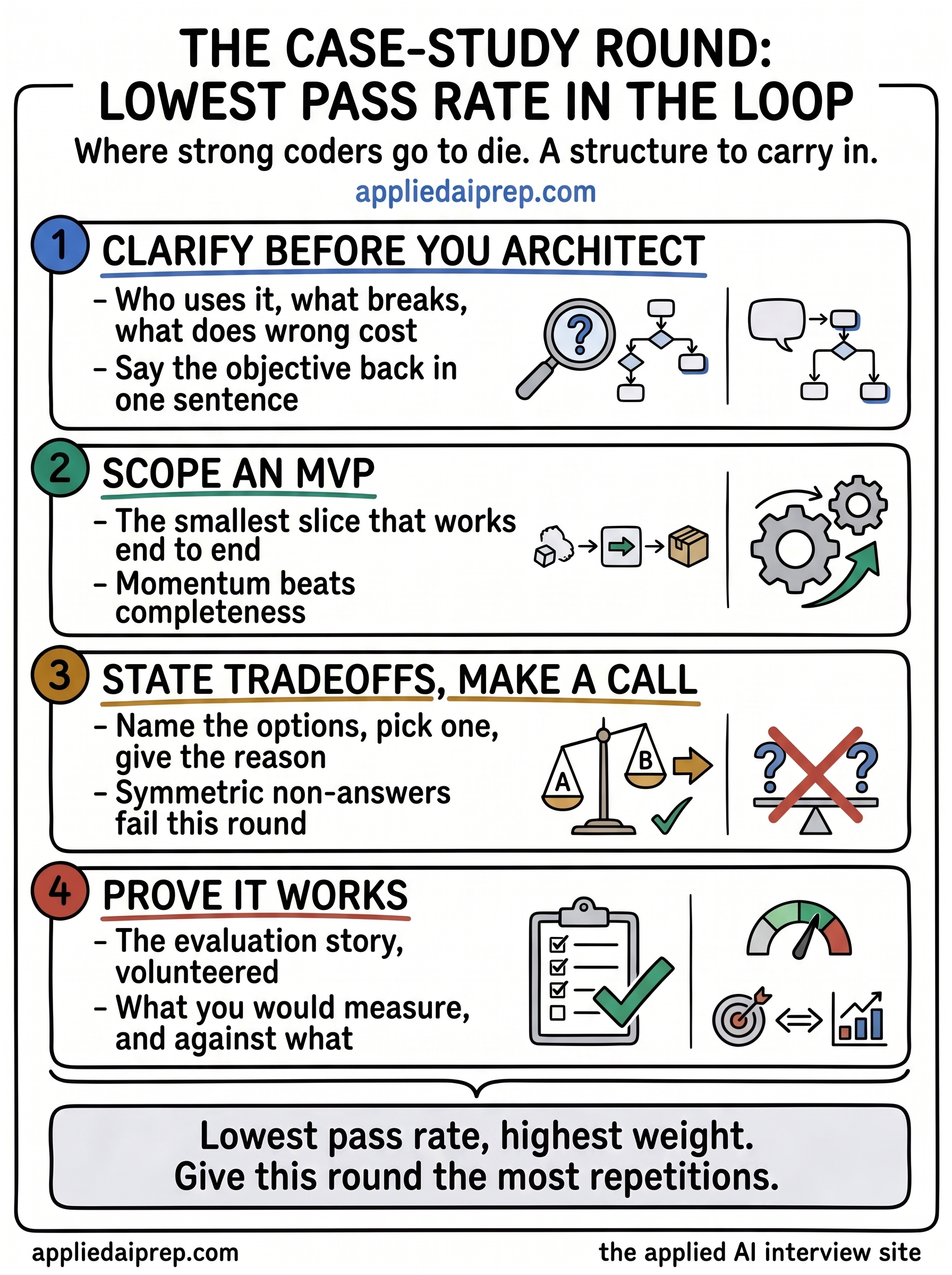
The Applied AI case-study round is the stage that decides your loop, and you pass it by clarifying before you architect. A hypothetical customer hands you a vague problem, and you are scored on how you bound it: who the user is, what decision the output drives, what data exists and where, and what is explicitly out of scope. This round is reported to have the lowest pass rate and the highest weight of any stage, and it is where strong coders most often fail, usually by jumping to a solution before pinning down the objective. The winning shape is simple: clarify the problem, scope a minimal version that works end to end, state the tradeoffs that matter for this customer, and make a call. Everything below expands that.
Why this round, and why it is so hard
Most technical interviews reward a fast path to a correct answer. The case-study round rewards the opposite instinct, which is why it catches people off guard. It exists because the actual Applied AI job is mostly ambiguity: a customer arrives with a business pain and no spec, and the engineer who can turn that into a buildable plan is the one worth hiring. The round is a proxy for week one of a real engagement.
The failure mode is consistent across reported loops. A candidate hears a domain word, "support," "fraud," "search," and starts designing within thirty seconds. The interviewer, who is quietly playing the customer, now has to follow a solution to a problem nobody has defined. That is the moment the round is lost. We cover the broader pattern in why this is the round that decides it across companies, but the cure is the same everywhere: make the problem smaller before you make anything bigger.
Clarify before you architect
Spend your first few minutes shrinking the problem. The questions that matter are about the user and the decision, not the technology. Who actually uses this, and what action does the output trigger. What is the cost of a wrong answer, and what is the volume. What data already exists, who owns it, and what is its quality. What does the customer consider success, and by when. What is explicitly not in scope for a first version.
Ask these out loud, and let the answers reshape your plan. The point is not to perform thoroughness. It is to surface the one or two constraints that will actually drive the design, because a customer with a hard privacy requirement and a customer with a hard latency budget need different systems even if the surface problem sounds identical. Interviewers score the quality of your questions before they score your architecture. This is the same judgment the behavioral and customer rounds probe, and it is the most transferable skill in the loop.
Scope an MVP that works end to end
Once the problem is bounded, propose a minimal version that solves the core need from input to output, then describe how you would extend it. Resist the urge to enumerate every component of an ideal system. A walkable MVP plus a credible sequence of what comes next reads as someone who ships. An exhaustive architecture with no priorities reads as someone who has never had to cut scope under a deadline.
Concretely, pick the smallest thing that delivers the decision the user needs, name the one model or retrieval approach you would start with and why, and say what you would measure to know it works. For a retrieval-heavy problem, that often means a basic pipeline over the customer's documents before any fine-tuning, with an evaluation set you would build from real queries. Leave the scaling, the caching, and the multi-tenant concerns as the "then I would" layer. For the design vocabulary this round expects, work through the system design set.
State tradeoffs, then make a call
The fastest way to sound senior is to name a real tradeoff and resolve it. Pick the two or three options that genuinely apply, retrieval versus fine-tuning, a heavier model versus a cheaper one with guardrails, synchronous versus batched, and tie the decision to the constraint that matters most for this customer. Cost, latency, privacy, and accuracy are usually in tension, and the customer almost never gets to maximize all four.
What loses points is a symmetric list of pros and cons with no recommendation. That is a non-answer dressed as balance. Interviewers want the judgment, not the menu. Say which constraint dominates here, choose accordingly, and state the condition under which you would revisit the choice. "I would start with retrieval because the customer's data changes weekly and they cannot afford a retraining loop, and I would move to fine-tuning only if evaluation showed retrieval could not hit the accuracy bar" is a complete senior answer in one sentence.
Prove it works: the evaluation story
The component that most candidates forget is how they would know the system is correct. A deployed model-backed system is only trustworthy if you can measure it, and interviewers increasingly push on this directly. Describe the evaluation set you would assemble from real customer queries, the metrics tied to the actual decision rather than a generic accuracy number, and how you would catch regressions as the data and the model change.
This is also where you show you understand the customer's risk. If a wrong answer is cheap, a lighter system with spot checks is fine. If a wrong answer is expensive or unsafe, you build in human review and a tighter evaluation loop from day one. Tying the evaluation design back to the cost-of-error you clarified at the start closes the loop on the whole round.
A simple structure to carry in
Under pressure, fall back on a sequence: clarify the user and the decision, bound the scope, propose the MVP end to end, name the dominant constraint and make a tradeoff call, then state how you would evaluate and extend it. Narrate each step so the interviewer can follow your reasoning, and treat their pushback as the customer changing the brief, which is exactly what real customers do.
Then practice it on real problems until the clarify-first reflex overrides the architect-first one. Start with the must-know Applied AI questions, drill the system design set, and rehearse out loud with a partner playing a customer who answers your questions vaguely on purpose. The round is not testing whether you can design a system. It is testing whether you can find the real problem before you do.
Turn it into offers. Work the real questions and concepts this maps to:
FAQ
It is a round where a hypothetical customer hands you a vague business problem and you decompose it into a technical plan. It is reported to have the lowest pass rate and the highest weight in Applied AI and Forward Deployed loops, and it is where strong engineers most often fail by architecting before they clarify the objective.
Discussion (4)
The most useful reframe I give candidates: the interviewer is playing the customer, and the customer does not know what they want yet. Your job in the first five minutes is not to design, it is to make the problem smaller and sharper than it was when they handed it to you. If the problem is not smaller after your questions, you have not started the round.
This. I score the question quality before I score the architecture. A candidate who asks 'what decision does this output drive' has already told me they have shipped to a real user.
A concrete trap: someone hears 'customer support' and immediately says RAG over a knowledge base. Maybe. But ask the volume, the cost ceiling, and the consequence of a wrong answer first. Sometimes the right MVP is a routing classifier and a human in the loop, and proposing the heavy system unprompted is a minus, not a plus.
Practice saying 'I do not have enough information to choose yet, here is what I would need.' Candidates think that sounds weak. It is the opposite. It is exactly what you would say in week one of a real engagement, and interviewers are listening for it.