
APPLIEDAIPREP / APPLIED AI ENGINEER INTERVIEWS
The Applied AI Engineer interview, worked out in full.
854 questions from the loops at OpenAI, Anthropic, Databricks and 50 other companies, each answered the way a senior engineer would answer in the room: the reasoning, the code, the follow-ups, and the mistakes that lose the offer. Under them, 214 concepts and two courses you build your way through.
10 free answers per topic, no account · Premium $25 or ₹2,000 once · 6 months · no subscription
- questions, answered in full
- 854
- concepts with self-check drills
- 214
- course lessons, project-driven
- 76
- company interview guides
- 53
- contributor notes on the answers
- 1,199
THE QUESTIONS MIRROR REAL LOOPS AT
WHAT YOU ARE ACTUALLY BUYING
Not a list of questions. 854 answers with the same six parts, every time.
A question you can look up anywhere. What an interview rewards is the shape of the answer: what to say first, where the depth is, what the interviewer will push on next, and what a weaker candidate gets wrong. So every answer in the bank is built the same way, and nearly all carry a diagram or working code.
Grounded in real Applied AI Engineer loops and written to a senior-engineer editorial bar. Discussion under each answer comes from a badged contributor network, and is labelled as such.
- 01TL;DRThe answer in four lines. What you would say if the interviewer cut you off.
- 02How to approach itThe order to take it in, and the framing that signals seniority.
- 03A strong answerThe full working: trade-offs, numbers where they matter, and the code or diagram.
- 04Key takeawaysWhat to remember when the question shows up in a different costume.
- 05What interviewers probe nextThe follow-ups, so the second question is never a surprise.
- 06Common mistakesThe things that sound right and lose the offer.
HOW THE SITE IS ORGANISED
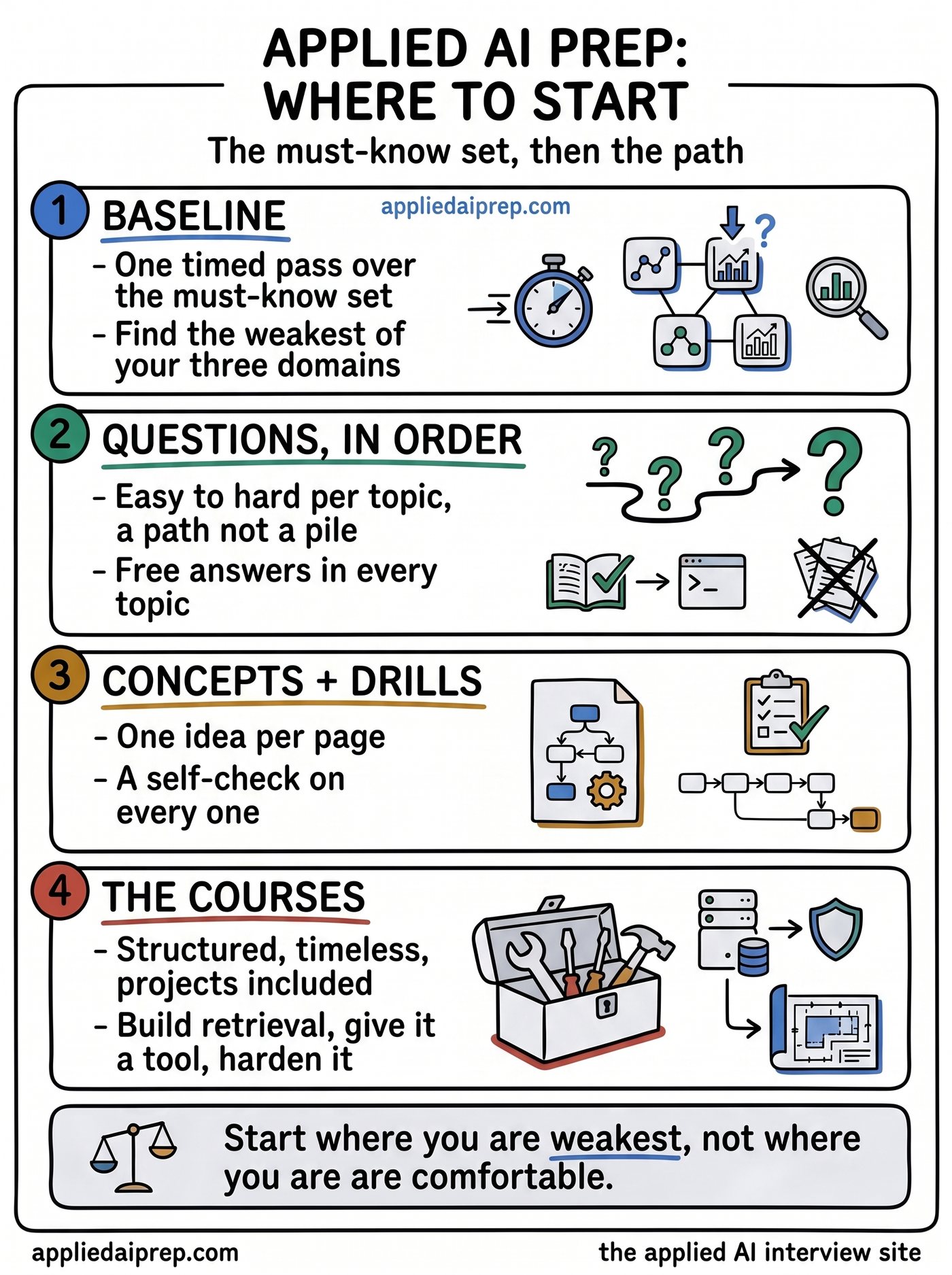
Four stages. Join at the one that matches what you already know.
- 01Start here →
Orient. Find out what the role actually tests.
Four stages of preparation and where to join them given what you already know, plus 53 company guides with 25 loops documented round by round.
- 02Browse the concepts →
Learn. One idea per page, then a drill to prove you have it.
214 concepts across the ten tracks the questions assume. 66 are open to everyone; each ends with a self-check.
- 03Open the bank →
Practise. Work the questions the way the room will ask them.
854 questions ordered by difficulty inside each topic, every one answered in full, with the follow-ups and the mistakes that lose the offer.
- 04See the courses →
Build. Ship the thing the interview is really about.
Two long-form courses, 76 lessons, each with a project you actually run. 30 lessons are free.
THE TEN TOPICS
Where the questions are, and how hard they get.
- LLM & GenAI Fundamentals10410 free · open →
- RAG & Agent System Design9210 free · open →
- Coding & DSA13110 free · open →
- Machine Learning & Data Science12110 free · open →
- SQL & Data Engineering5810 free · open →
- System Design for AI in Production11010 free · open →
- MLOps & ML Engineering5510 free · open →
- ML Infrastructure & GPUs6510 free · open →
- AI Security, Privacy & Governance6110 free · open →
- Behavioral & Project Deep-Dives5710 free · open →
THE COURSES
From “I can program” to “I build with models.”
Long-form and deliberately timeless: no model names to go stale, no invented numbers, and a real project running through each course, because reading about an agent loop and watching your own repeat a failing call are different kinds of knowing. 30 of the 76 lessons are free.
Applied AI Engineering
A structured path from writing normal software to building and shipping systems on top of language models. Assumes you can program and nothing about AI. Eight modules, from what the job actually is through to the interview that gets you it.
Build retrieval over your own documents, give it a tool, then harden it for a bad day.
Agent Engineering
Agents are the most over-applied pattern in applied AI and the hardest to make reliable. This course covers the loop, tool design, memory, multi-agent coordination, and evaluation, with as much attention on when not to build one as on how.
Build an agent loop from scratch, make it survive being killed mid-action, then measure it.
ELSEWHERE ON THE SITE
- Start herethe guided path, if all of this is new
- AI engineer interview questionsthe full set on one indexable page
- AI agent interview questionsthe agent-specific set, collected
- 53 company guidesreal loops, linked to each company's own pages
- The role, explainedwhat an Applied AI Engineer does and is asked
- 214 terms, definedthe vocabulary, one line each
- The concept mapevery idea on the site and how they connect
- The blogarguments and field notes, no sign-in
- Questions about the siteaccess, payment, refunds, and what is free