AI Security, Privacy & Governance
61 questionsDONEUNLOCKEDLOCKED
Prompt-injection defense in depth, PII handling, tenant isolation, abuse and consumption controls, audit trails, and SOC 2 / EU AI Act questions enterprise-facing applied AI work must survive.
Grounded in real Applied AI Engineer interview loops and written to a senior-engineer editorial bar.
You have 10 free answers unlocked here.Sign in free for 10 more · 41 are premium.
01–25Foundationsthe vocabulary every loop assumes you already have0/25 done
26–47Core loopsthe questions every loop actually asks0/22 done
48–61Field scenariosthe messy, half-specified problems from real deployments0/14 done
The concepts behind AI Security, Privacy & Governance
The vocabulary and mental models these questions assume, from our curriculum. Start with the foundations free; the deeper, interview-defining ideas are part of premium.
Foundational
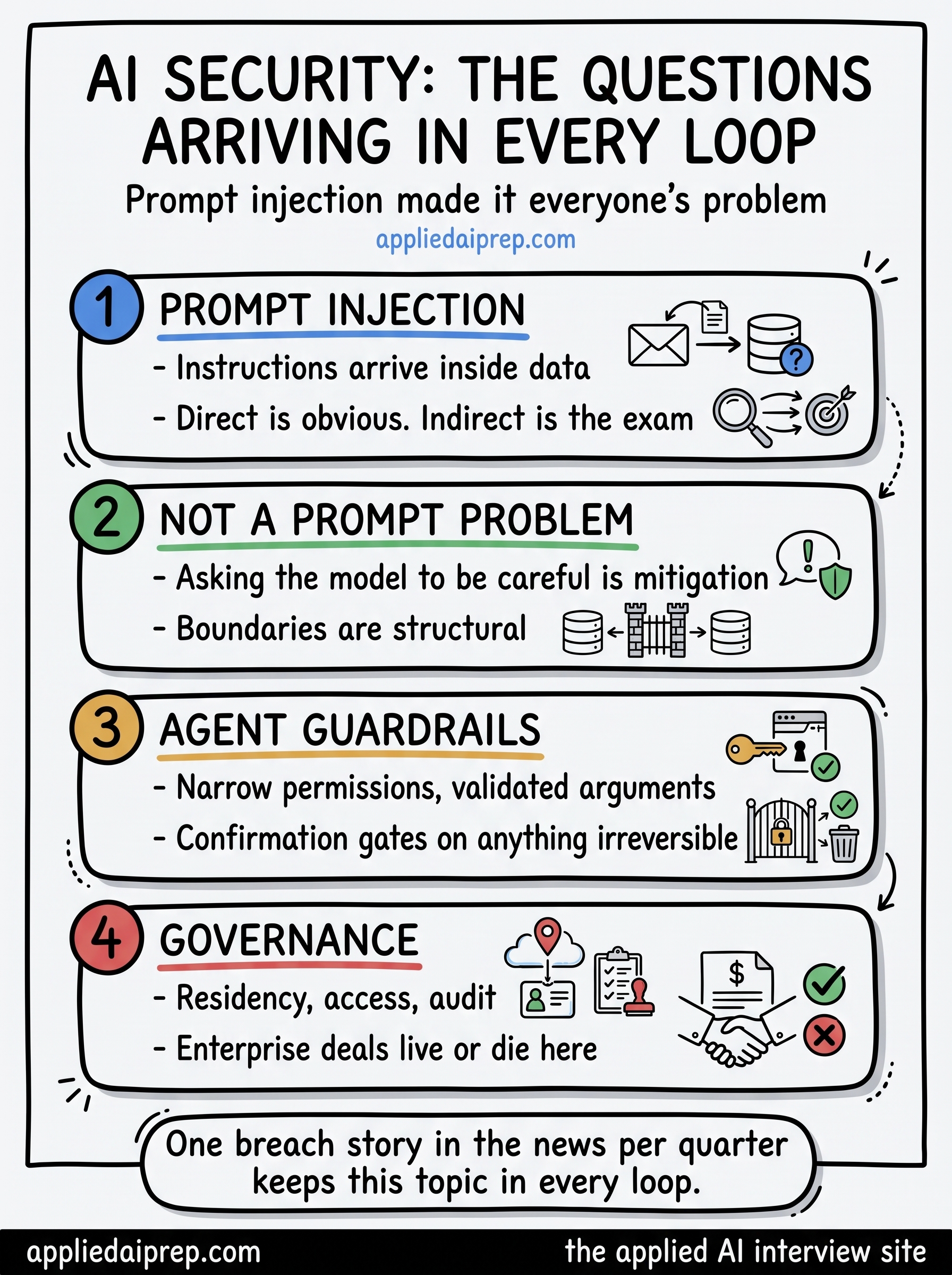
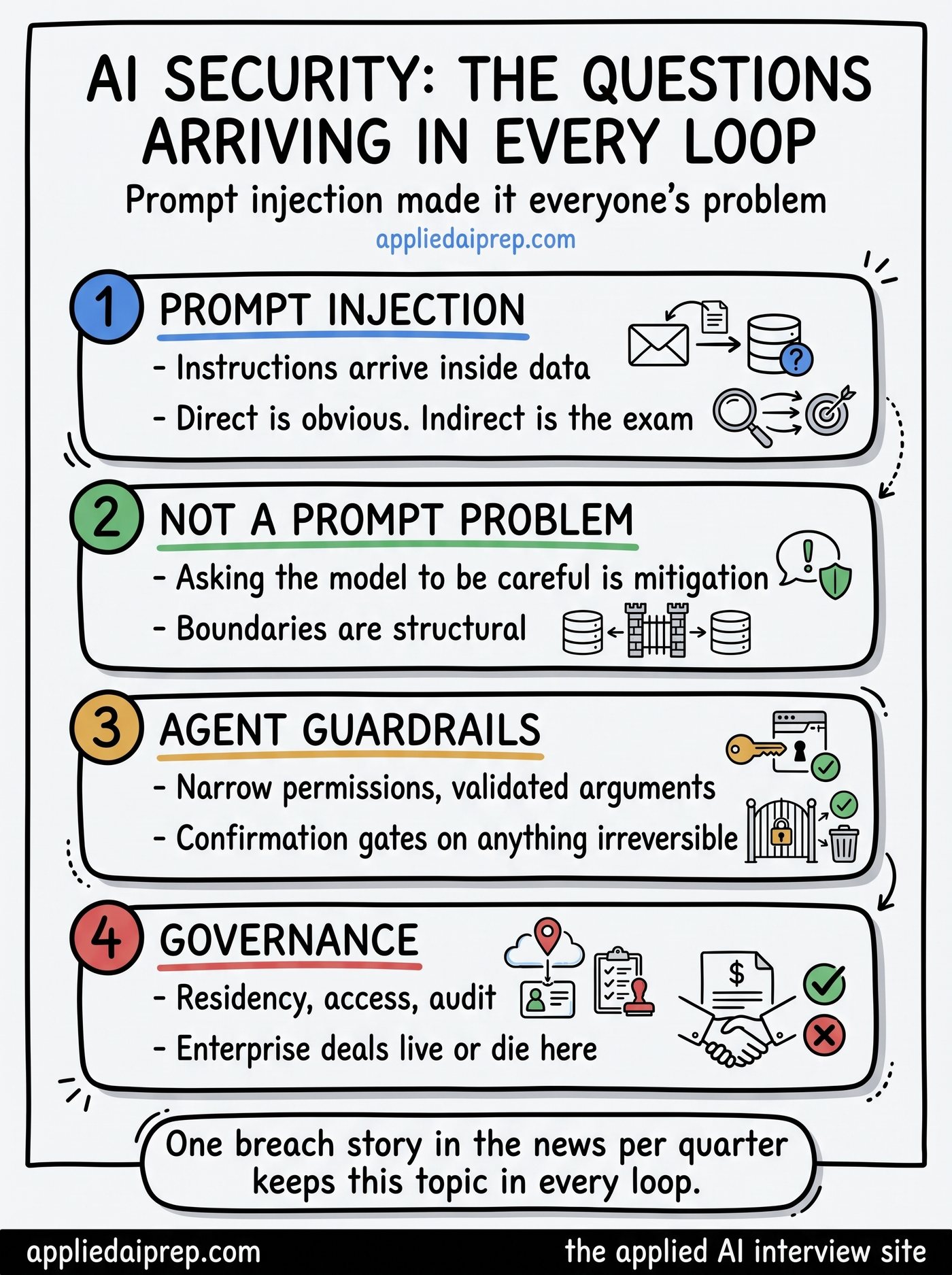
Prompt InjectionPrompt injection is the top security risk for LLM apps: malicious instructions override the model's intended behavior. Direct injection comes from the user; indirect injection hides instructions in content the model retrieves or browses (a web page, a document, an email), so a third party attacks. It is acute for RAG and agents because they ingest untrusted content and agents can take actions. The core defense is to treat all retrieved/tool content as untrusted data, never instructions, plus least privilege and human approval for irreversible actions.Core
Indirect Prompt Injection and the Lethal TrifectaIndirect prompt injection plants attacker instructions inside content an agent retrieves or reads (a web page, a PDF, a support ticket) so a benign user triggers an attack. The lethal trifecta is the combination that turns this into real damage: access to private data, exposure to untrusted content, and a channel to send data out. Applied AI interviews probe it because anyone building RAG or tool-using agents has to reason about blast radius, not just clever filters.Sign in
Foundational
PII HandlingPersonal data in prompts, logs, and training sets is a privacy and compliance risk (GDPR, HIPAA), so you must detect and protect it. Detection is layered (regex for structured PII like emails/SSNs, ML/NER for names and addresses) and imperfect, so it is one layer alongside the strongest control: data minimization, do not collect or log what you do not need. Applied-AI interviews probe it because LLM logs and training data are a major PII surface, and a leak is a legal and reputational disaster.Core
Differential PrivacyDifferential privacy adds calibrated noise to data, queries, or training so the output is provably insensitive to any single individual's record, bounding what can be learned about any one person. In ML, DP-SGD clips and noises gradients to limit memorization and defend against membership-inference attacks. The cost is a privacy-utility trade-off controlled by a parameter epsilon. Applied-AI interviews probe it because it is the rigorous, mathematically-backed privacy tool, and because models can otherwise memorize and leak training data.Sign in
Foundational
Audit TrailsAn audit trail logs enough to reconstruct and explain any AI decision: the input, retrieved context, model and prompt version, output, and who/when, plus human overrides and guardrail events. It is the backbone of debugging, incident response, compliance (the EU AI Act and regulated domains require traceability), and accountability. The tension is privacy: logs are a sensitive surface, so you redact PII, control access, and set retention. Applied-AI interviews probe it because 'why did the model decide that?' must be answerable in serious deployments.Core
Federated LearningFederated learning trains a shared model across many devices or organizations without moving their raw data to a central server: each party computes updates locally and only the updates are aggregated. It trades communication cost, data heterogeneity, and privacy leakage against the benefit of training on data that legally or practically cannot be pooled. Applied AI interviews probe it to see whether you can distinguish the genuine fit (mobile keyboards, multi-hospital models) from the cases where centralizing data or using differential privacy alone is simpler.Sign in
Core
Multi-Tenancy and IsolationWhen one AI system serves many customers (tenants), the cardinal rule is that no tenant can see another's data, ever. In RAG this means every retrieval is filtered by tenant so the vector search cannot return another tenant's documents; it extends to caches, logs, fine-tunes, and rate limits. The dangerous failure is a cross-tenant leak. Applied-AI interviews probe it because enterprise deployments are multi-tenant, and a leak between customers is a catastrophic, trust-destroying breach.Sign in
Advanced
Mechanistic Interpretability: Features, Circuits, and SAEsReverse-engineering what a network computes: features as directions, circuits that combine them, superposition, and sparse autoencoders that unpack it.🔒 Premium
THE ONE-PAGE VERSIONDownload ↓