LLM & GenAI Fundamentals
104 questionsDONEUNLOCKEDLOCKED
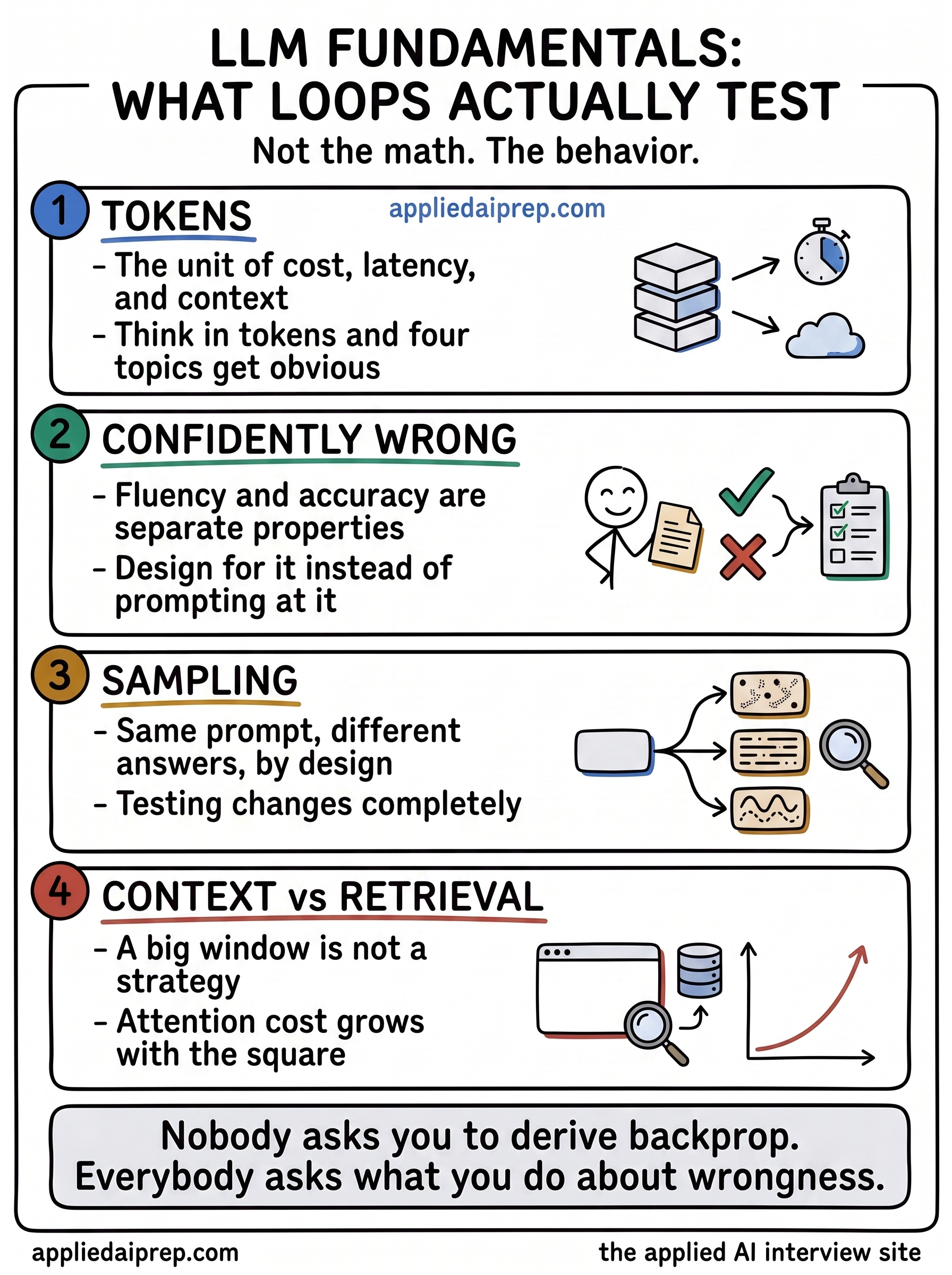
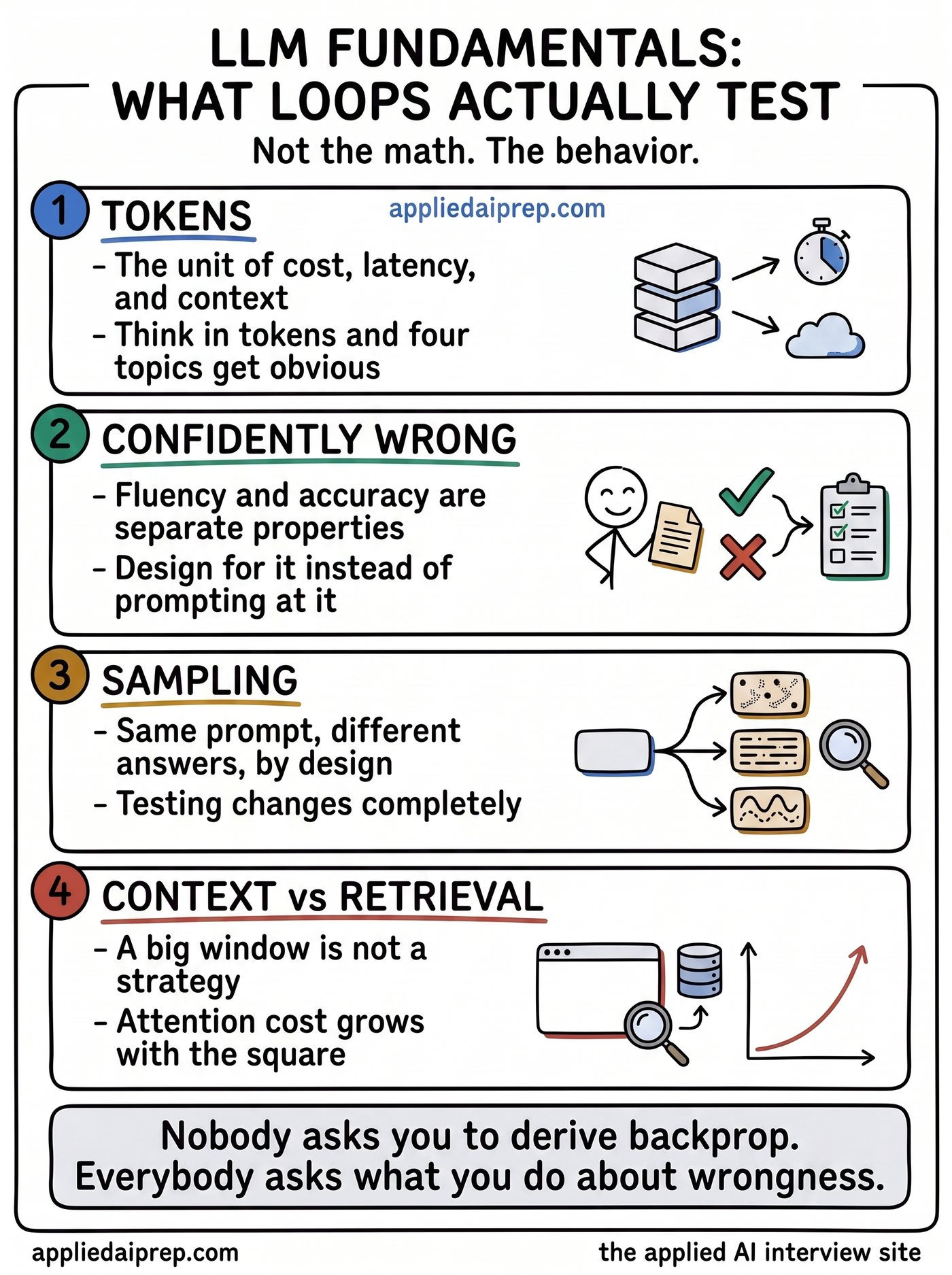
Tokens, attention, context windows, sampling, prompting vs RAG vs fine-tuning, hallucinations, evals, cost and latency: the conceptual core every Applied AI loop opens with.
Grounded in real Applied AI Engineer interview loops and written to a senior-engineer editorial bar.
You have 10 free answers unlocked here.Sign in free for 10 more · 84 are premium.
COURSES COVERING THIS TOPIC
Structured lessons that teach this material from the beginning, rather than testing it.
01–42Foundationsthe vocabulary every loop assumes you already have0/42 done
43–79Core loopsthe questions every loop actually asks0/37 done
80–104Field scenariosthe messy, half-specified problems from real deployments0/25 done
The concepts behind LLM & GenAI Fundamentals
The vocabulary and mental models these questions assume, from our curriculum. Start with the foundations free; the deeper, interview-defining ideas are part of premium.
Foundational
From RNNs to Transformers: RNN, LSTM, Seq2SeqRecurrent networks process sequences one step at a time through a hidden state, which makes them principled but slow and bad at long-range dependencies because gradients vanish across many steps. LSTMs and GRUs add gates to carry information further, and seq2seq encoder-decoder models with attention removed the single-vector bottleneck, which is the idea transformers then took to its conclusion. Applied-AI interviews probe this because it explains why attention exists and why we abandoned recurrence for parallelism.Foundational
Classic NLP: Bag-of-Words, TF-IDF, and Word2VecBefore learned embeddings, text was turned into sparse high-dimensional vectors with bag-of-words and TF-IDF, which count words and weight them by how distinctive they are but ignore meaning and order. Word2Vec and GloVe replaced counts with dense vectors trained so that words in similar contexts land near each other, which captures semantic similarity. Applied-AI interviews probe this because sparse methods still win as cheap baselines and as the lexical half of hybrid retrieval, and because they explain what dense embeddings actually fixed.Foundational
TokenizationModels do not read characters or words; they read tokens, subword chunks produced by an algorithm like BPE that maps text to integer IDs. Tokenization decides how many tokens a piece of text costs (driving price, latency, and context usage), why models miscount letters or fumble rare words, and why non-English text is more expensive. Applied-AI interviews probe it because token accounting is the first thing that bites a production LLM bill.Foundational
The Context WindowThe context window is the maximum number of tokens a model can attend to at once, prompt plus generation. It is bounded by attention's quadratic cost, the KV cache's linear memory growth, and the length the model was trained on. A bigger window is not free or uniformly useful (models lose information in the middle), which is why retrieval often beats stuffing everything into context. Applied-AI interviews probe it because it shapes cost, latency, and the RAG-vs-long-context decision.Foundational
EmbeddingsAn embedding maps text (or an image) to a dense vector so that semantic similarity becomes geometric closeness, similar meanings land near each other, measured by cosine similarity. Embeddings power semantic search, retrieval, clustering, recommendation, and the vector index behind RAG. Applied-AI interviews probe them because they are the bridge between unstructured content and everything you can compute over it, and because their failure modes (domain mismatch, drift, the wrong similarity metric) quietly degrade retrieval.Core
The Transformer ArchitectureThe transformer is the architecture behind modern LLMs: stacked blocks that each mix information across tokens with self-attention and then transform each token with a feed-forward network, wrapped in residual connections and normalization. Understanding the two sub-layers (attention mixes across tokens, the feed-forward processes each one) explains where parameters live, why Mixture-of-Experts scales the feed-forward, and why decoder-only models dominate. Applied-AI interviews probe it because it is the mental scaffold for everything else, attention cost, KV cache, MoE, and serving.Sign in
Core
Attention and Self-AttentionAttention turns each token into a query, key, and value, scores every query against every key, softmaxes those scores into weights, and returns the weighted sum of values, so each token pulls in information from the others. Self-attention does this within one sequence. The all-pairs scoring is why cost grows with the square of sequence length, which in turn explains context limits, long-prompt expense, and the KV cache. Applied-AI interviews probe it because it links architecture to cost and latency in one mental model.Sign in
Advanced
Policy Optimization: PPO and GRPOPPO and GRPO are the reinforcement-learning algorithms that optimize an LLM against a reward, the RL step in RLHF and in training reasoning models. PPO is the established workhorse, updating the policy in small, clipped steps to stay stable; GRPO (used by DeepSeek-R1) drops PPO's separate value network and instead normalizes rewards within a group of samples, which is simpler and cheaper for LLMs. Applied-AI interviews probe it because it explains how alignment and reasoning training actually run, and why RL on verifiable rewards scales.🔒 Premium
THE ONE-PAGE VERSIONDownload ↓