MLOps & ML Engineering
55 questionsDONEUNLOCKEDLOCKED
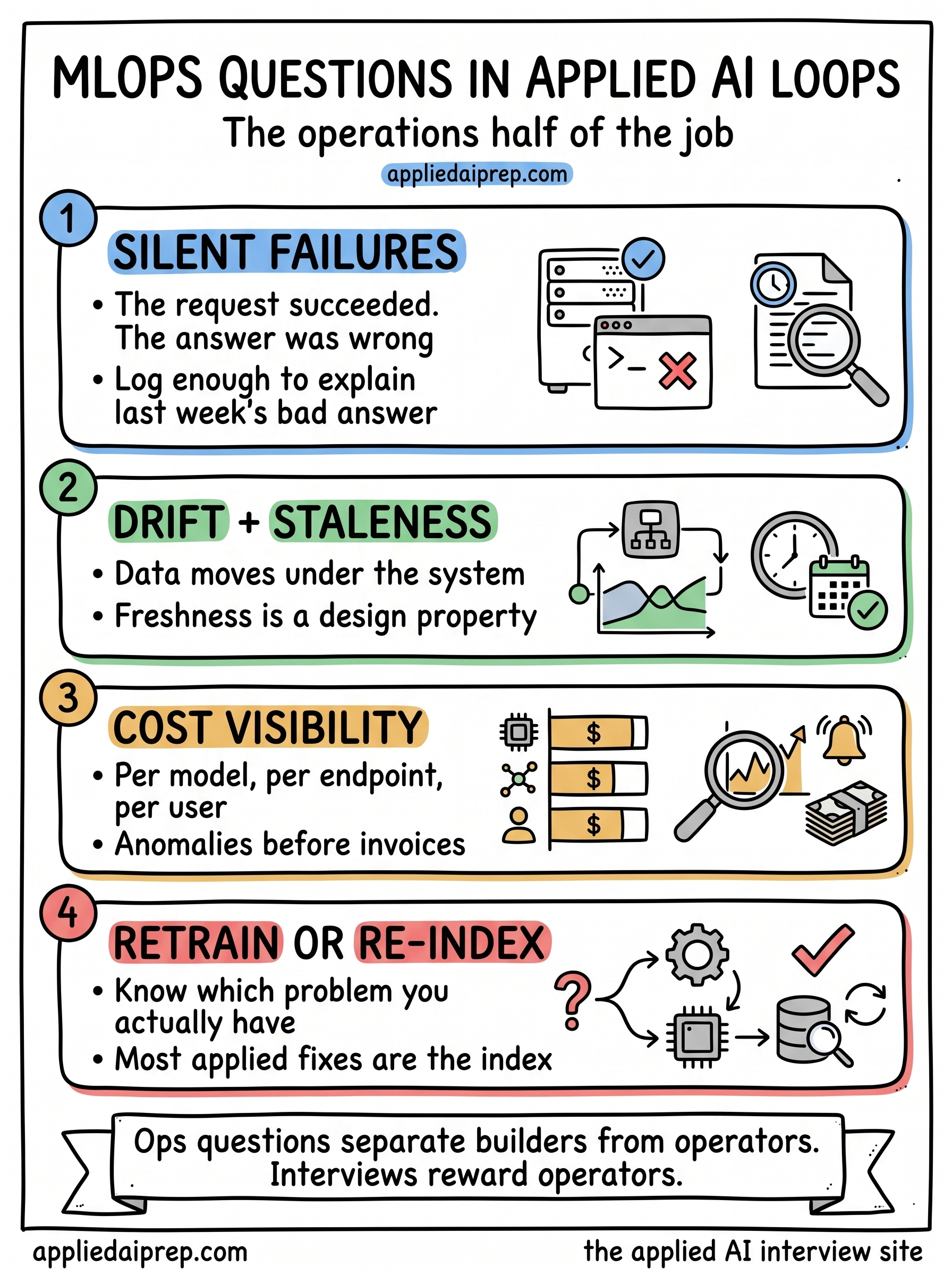
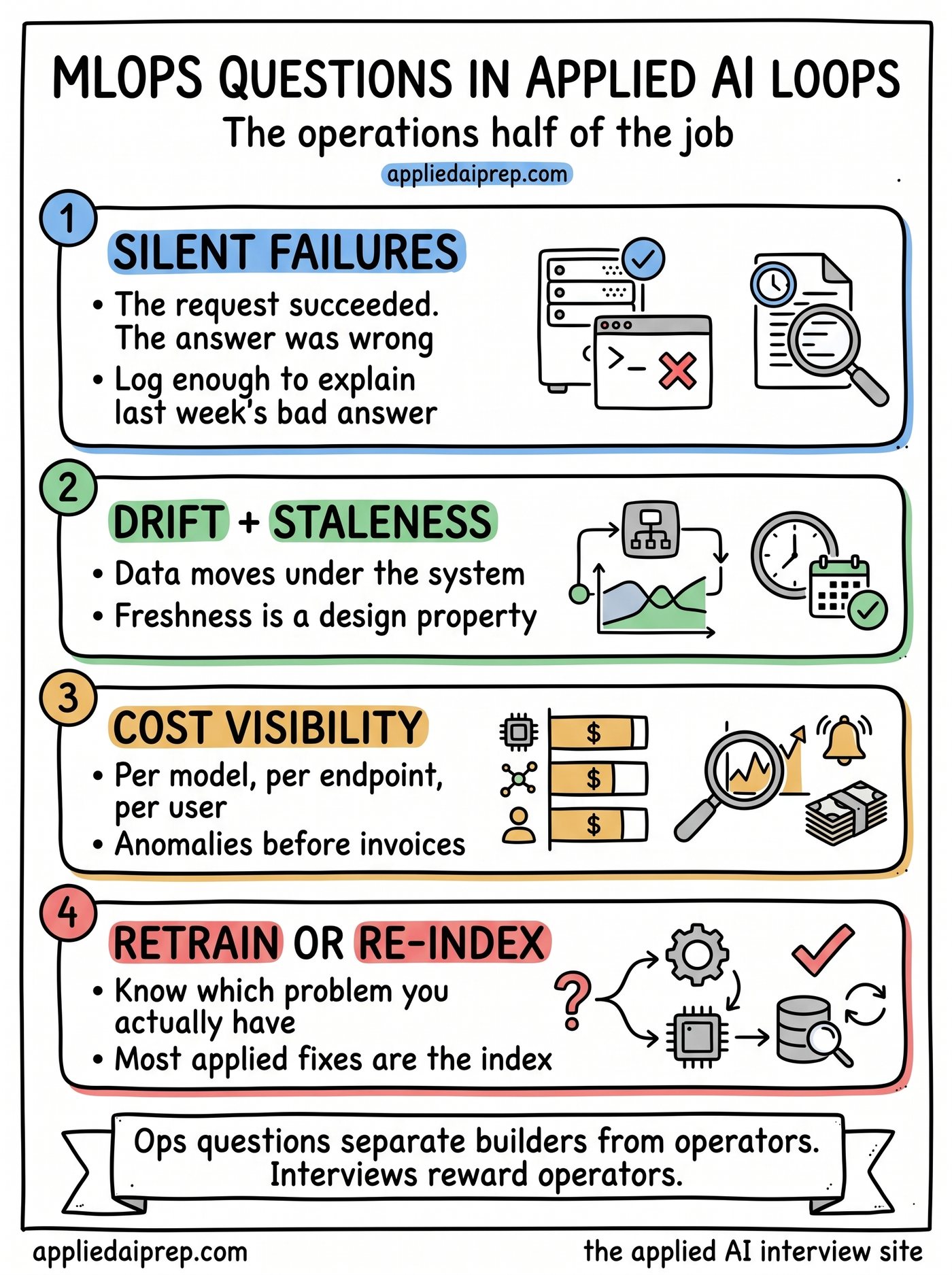
CI/CD for models, drift detection and retraining, model registries, Kubernetes inference, feature stores, and staging-to-production promotion: what every ML-platform loop drills.
Grounded in real Applied AI Engineer interview loops and written to a senior-engineer editorial bar.
You have 10 free answers unlocked here.Sign in free for 10 more · 35 are premium.
COURSES COVERING THIS TOPIC
Structured lessons that teach this material from the beginning, rather than testing it.
01–22Foundationsthe vocabulary every loop assumes you already have0/22 done
23–42Core loopsthe questions every loop actually asks0/20 done
43–55Field scenariosthe messy, half-specified problems from real deployments0/13 done
The concepts behind MLOps & ML Engineering
The vocabulary and mental models these questions assume, from our curriculum. Start with the foundations free; the deeper, interview-defining ideas are part of premium.
Core
Drift DetectionModels decay because the world changes. Data drift is a shift in the input distribution (detectable without labels by comparing live features to a training reference with PSI or KS tests); concept drift is a change in the input-to-output relationship (usually needs labels, which often lag). The discipline is monitoring inputs and predictions as leading indicators, alerting on sustained shifts, and triggering retraining. Applied-AI interviews probe it because 'the model was great at launch and quietly got worse' is a top production failure.Sign in
Core
Model Debugging MethodologyModel debugging is the systematic process of root-causing why a model underperforms: deciding whether the cause is the data, the features, the labels, model capacity, or the evaluation itself, rather than blindly tuning hyperparameters. The method leans on error analysis over slices and the train/val/test gap ladder to localize the failure before fixing it. Applied AI interviews probe it because most candidates jump to bigger models or more tuning when the real bug is a leaky feature, a noisy label set, or a broken eval.Sign in
Core
Model Registry, Lineage, and PromotionA model registry is the versioned source of truth for trained models: each model has a version, lineage (the data, code, config, and run that produced it), and a stage (staging, production, archived). It enables reproducibility, safe promotion through gates, instant rollback, and audit. Lineage is what lets you reproduce a model and debug a regression by diffing against the last good version. Applied-AI interviews probe it because shipping models without versioning and lineage makes rollback and debugging guesswork.Sign in
Core
Reproducible and Deterministic PipelinesA reproducible pipeline produces the same model and metrics from the same inputs, achieved by pinning seeds, dependencies, data versions, and code together. Determinism on GPU is a separate, harder problem because many CUDA kernels are nondeterministic by default. Interviews probe this because without it you cannot debug a regression, pass an audit, or trust an A/B result.Sign in
Foundational
CI/CD for ModelsShipping a model safely needs more than software CI/CD because the model depends on data, not just code. The pipeline tests data (schema, distributions, no leakage), tests the model (meets a metric threshold and beats the baseline, per-slice), and runs behavioral tests, then gates deployment on all of them, with canary/shadow rollout and rollback. Applied-AI interviews probe it because 'we tested the code' is insufficient for ML, and the data and model gates are what catch the failures users would otherwise hit.Foundational
Model Monitoring in ProductionMonitoring an ML model means more than uptime and latency, because a model can be healthy and silently wrong. You monitor four layers: operational (latency, errors, cost), data/input (schema, missing values, drift), prediction (output distribution, confidence), and model quality (accuracy and business metrics, once labels arrive, which lag). Inputs and predictions are leading indicators; labels confirm later. Applied-AI interviews probe it because silent model decay is invisible to ordinary service monitoring.Core
Feature Store: Online vs Offline and Training-Serving SkewOne feature definition materialized to an offline store for training and an online store for serving. The fix for training-serving skew and leakage.Sign in
THE ONE-PAGE VERSIONDownload ↓