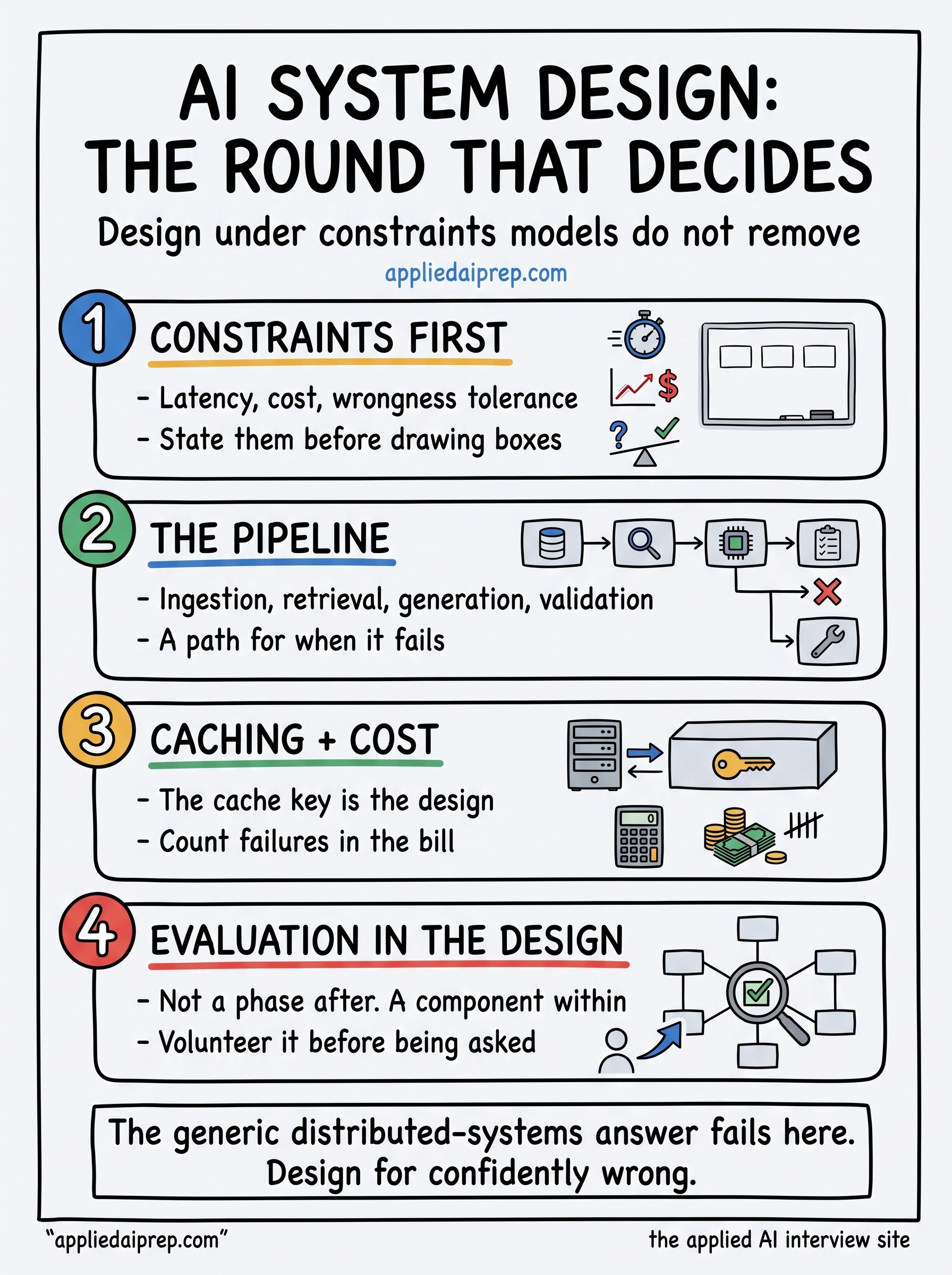
System Design for AI in Production
110 questionsDONEUNLOCKEDLOCKED
Productionizing a POC: latency and throughput budgets, idempotency and retries, caching, observability for non-deterministic systems, and private or air-gapped deploys.
Grounded in real Applied AI Engineer interview loops and written to a senior-engineer editorial bar.
You have 10 free answers unlocked here.Sign in free for 10 more · 90 are premium.
COURSES COVERING THIS TOPIC
Structured lessons that teach this material from the beginning, rather than testing it.
Applied AI Engineering·The interviewPremium14mDriving the design conversationA design round is a conversation you are expected to lead, not a question you answer. This lesson is the shape that works, the four moments that decide the outcome, and the two classic ways strong candidates lose one.Applied AI Engineering·The interviewPremium12mTurning this course into a study planA concrete four-week plan mapping the seven modules onto the question bank, plus what to do differently if your interview is next week rather than next month.
01–44Foundationsthe vocabulary every loop assumes you already have0/44 done
45–83Core loopsthe questions every loop actually asks0/39 done
84–110Field scenariosthe messy, half-specified problems from real deployments0/27 done
The concepts behind System Design for AI in Production
The vocabulary and mental models these questions assume, from our curriculum. Start with the foundations free; the deeper, interview-defining ideas are part of premium.
Foundational
The LLM GatewayAn LLM gateway is a single proxy layer between your application and one or more model providers. It centralizes the cross-cutting concerns every LLM app needs: routing and fallback across models/providers, caching, rate limiting, authentication, cost tracking, observability, and guardrails. It also prevents vendor lock-in by abstracting providers behind one interface. Applied-AI interviews probe it because it is the backbone of a production LLM platform and the place most operational controls live.Foundational
Latency Budgets and StreamingLLM latency is not one number: time-to-first-token (set by prefill and queueing) and inter-token latency (set by decode) feel very different to users. Streaming tokens as they generate hides total latency by showing progress immediately. Designing to a latency budget means allocating time across retrieval, model, and tools, measuring TTFT and tokens-per-second (not just end-to-end), and using streaming, caching, and routing to hit it. Applied-AI interviews probe it because perceived latency makes or breaks LLM UX.Foundational
GuardrailsGuardrails are the runtime safety layer wrapping an LLM: input checks (detect prompt injection, off-topic or disallowed requests, PII) before the model, and output checks (content safety, schema/format validation, grounding, PII/secret leakage) before the user. They are built from rules, classifiers, judge models, and validators, with a defined fail-safe action when one trips. Applied-AI interviews probe it because 'add guardrails' is hand-wavy, and the concrete input/output checks plus fail-safe behavior are what make a deployment safe.Foundational
Rate Limiting, Retries, and BackoffLLM systems depend on rate-limited, sometimes-failing providers, so resilient design is essential. Rate limiting (token bucket) protects your service and enforces per-tenant quotas; retries with exponential backoff and jitter handle transient failures without hammering a struggling dependency; circuit breakers stop sending requests to a failing service to let it recover. Applied-AI interviews probe it because LLM calls are slow, expensive, and flaky, and naive retry logic turns a blip into an outage.Foundational
Idempotency and Exactly-Once EffectsIn a distributed system, calls fail and get retried, so the same request can arrive more than once. Idempotency means processing a request twice has the same effect as processing it once, achieved with idempotency keys and deduplication. It is the foundation of safe retries: without it, a retried payment charges twice or a retried pipeline double-counts. Applied-AI interviews probe it because LLM/data pipelines are full of flaky, retried steps, and 'exactly-once' is really 'at-least-once delivery plus idempotent processing'.Foundational
Observability for LLM SystemsYou cannot operate or improve an LLM system you cannot see. Observability means logging every request end to end, inputs, retrieved context, prompt and model version, output, tokens, latency, and cost, plus tracing multi-step agent/RAG flows and tracking quality signals. It is the basis of debugging, cost attribution, evaluation, and incident response. Applied-AI interviews probe it because LLM systems fail silently (a plausible-but-wrong answer throws no error), so visibility is what makes them debuggable and trustworthy.Foundational
LLM Cost OptimizationLLM systems get expensive fast, and the cost model is mostly tokens and number of model calls. The levers, in rough order of impact: route easy queries to cheaper/smaller models, cache repeated and similar requests, trim context (fewer, better chunks), use cheaper retrieval/reranking, and for agents cut unnecessary steps. The discipline is measuring cost per request and attacking the dominant contributor. Applied-AI interviews probe it because cost is a primary production constraint and most teams overspend by defaulting to the biggest model on everything.Core
Prompt and Semantic CachingCaching is one of the cheapest, highest-impact LLM optimizations. Prefix (prompt) caching reuses the computed attention state for a shared prompt prefix (a long system prompt or document), cutting prefill cost and latency. Semantic caching serves a stored answer for a query that is similar (not identical) to a past one, by embedding the query and matching nearest neighbors. Applied-AI interviews probe it because repetitive traffic is everywhere, and caching turns expensive recomputation into near-free lookups, with a correctness caveat for semantic caching.Sign in
THE ONE-PAGE VERSIONDownload ↓