
Applied AI Engineer vs Software Engineer: Comp, Day-to-Day, and Which to Choose
An honest comparison of Applied AI Engineer and Software Engineer roles: who owns what, how customer-facing each is, what the comp really looks like, and the career risk and upside on each path.
BY LUKAS HOFFMANN · APPLIEDAIPREP EDITORIAL · UPDATED JUNE 21, 2026 · 9 MIN READ
Pick Applied AI Engineering if you want to own customer outcomes and sit on the revenue, and pick Software Engineering if you want to go deep on a system and be judged mainly on the quality of what you build. Both are strong engineering careers. The honest difference is not the code, which overlaps heavily, but the accountability: an Applied AI Engineer is on the hook for whether a specific customer succeeds with the product, while a software engineer is on the hook for whether the product itself is sound. That single difference cascades into comp, daily rhythm, career risk, and the kind of person who thrives in each. This piece compares them on the dimensions that actually decide it, and stays honest about the trade-offs.
For the structural version of how these titles relate, our role comparison guide maps Applied AI against solutions engineering, ML engineering, and product engineering. This post goes deeper on the career decision itself.
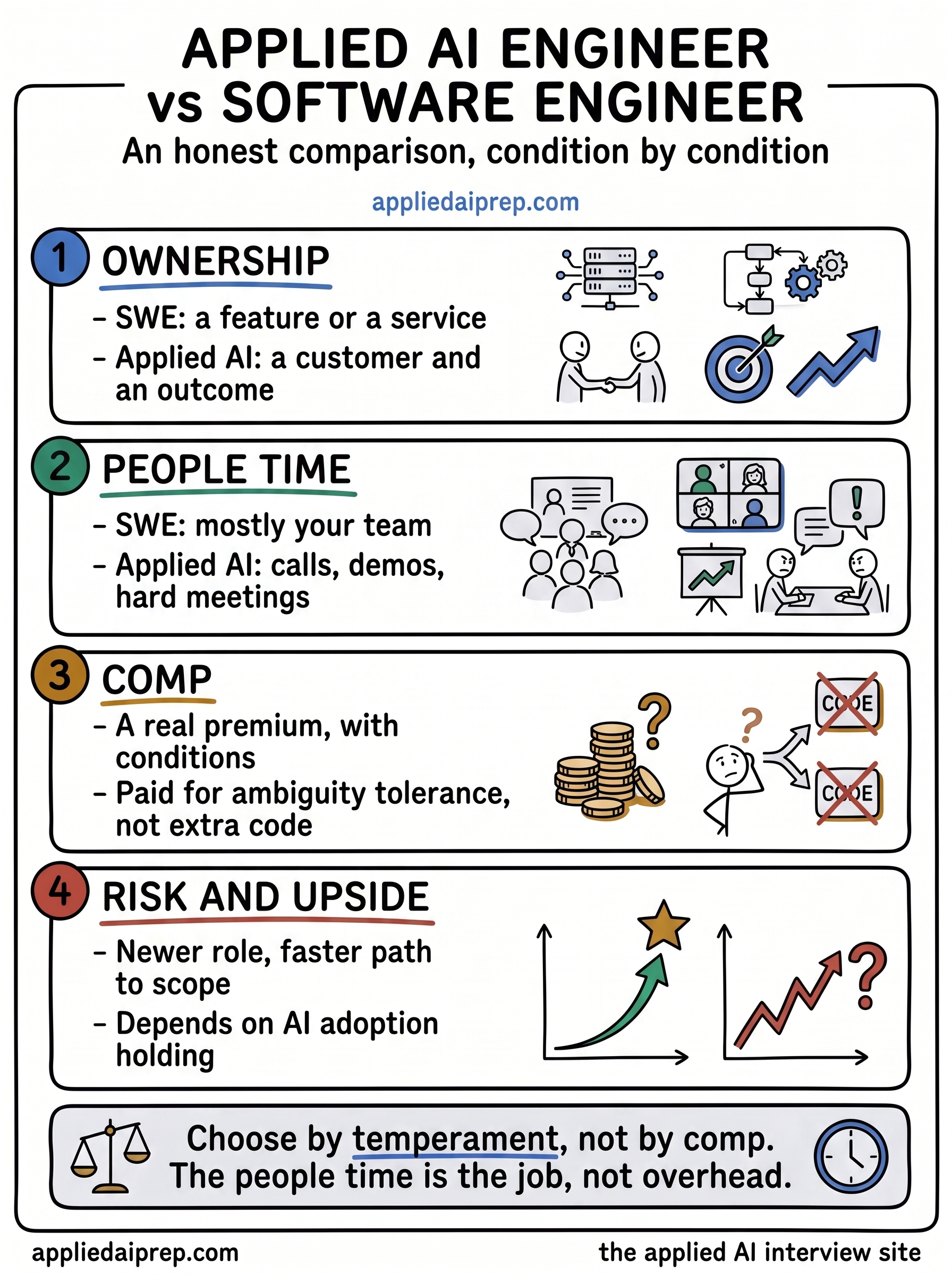
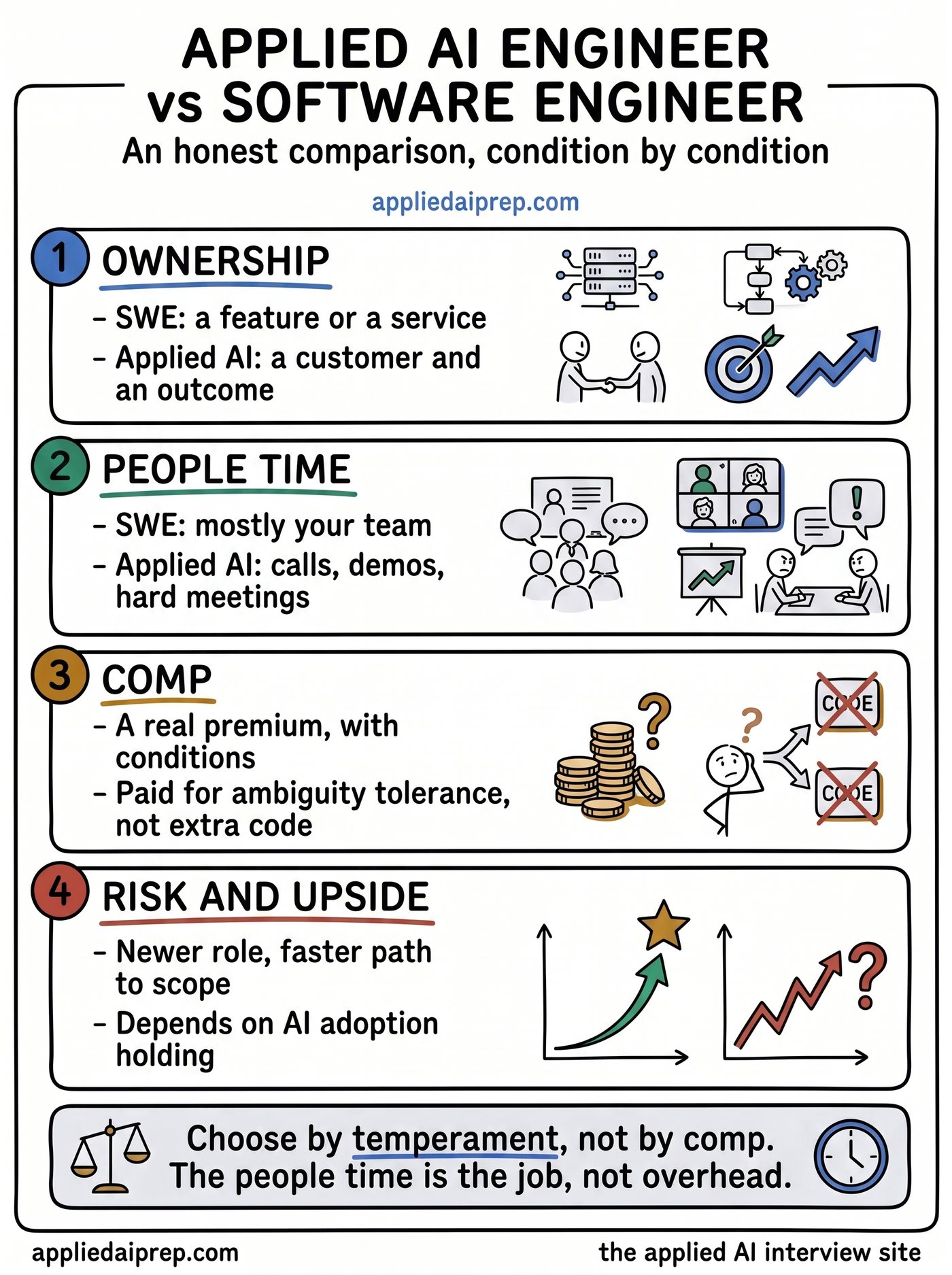
Ownership: a feature versus a customer
The starkest split is what you are responsible for. A software engineer owns a feature, a service, or a system. Success means the thing is correct, fast, maintainable, and shipped. The customer is usually an abstraction reached through a product manager.
An Applied AI Engineer owns a deployment inside a named customer's environment. Success means that customer's workflow now runs on your system and keeps running. You write production code, but you also decide what to build based on watching the customer struggle, and you carry the outcome when an integration breaks at 9pm before a board demo. The work includes the parts a pure engineering role hands off: scoping a vague problem, designing the evaluation that proves it works, and explaining a trade-off to someone non-technical.
This is why the two roles screen so differently. The Applied AI loop weights an ambiguous case-study round heavily, because the job is decomposing a fuzzy customer problem under uncertainty, not implementing a clean spec.
Customer-facing: how much of the job is people
A software engineer can have a great career with very little direct customer contact. Plenty of excellent ones spend their week with code, design docs, and a handful of teammates.
Applied AI is the opposite by design. A representative week includes customer calls, a working session with the customer's engineers, and at least one conversation where someone is frustrated and you have to hold the relationship while solving the technical problem underneath it. If that sounds draining, the role will wear you down. If it sounds energizing, it is one of the few engineering jobs where being good with people is a core technical advantage rather than a nice-to-have. For a concrete walk-through of that rhythm, see what an Applied AI Engineer actually does day to day.
Comp: a real premium, with conditions
The headline is that Applied AI usually pays a premium at the same level, roughly 10 to 20 percent on total compensation, but the premium is uneven and worth interrogating. All figures below are reported and approximate.
- At the AI labs, senior Applied AI total packages are commonly cited in the 350k to 550k USD range including equity, with the top end higher. A senior software engineer at the same lab might sit closer to 280k to 450k.
- At AI scaleups, the premium holds but compresses, often single-digit to low-double-digit percent over the SE band.
- At mid-size or non-AI companies, the applied title sometimes pays the same or slightly less than SE, because it gets bucketed with solutions engineering rather than core engineering.
The premium exists because the role is hard to hire for: you need a genuinely strong engineer who is also a high-empathy communicator who can carry a large customer relationship without dropping the technical thread. That combination is scarce, so it is expensive. The full picture, including how base, bonus, and equity split, is in our salary guide.
The practical lesson: read the leveling, not the title. Ask in the interview who owns the code after go-live. If the answer is the Applied AI Engineer, you are usually in the engineering band with the premium. If the code hands off to a product team, you may be in a go-to-market band that pays differently.
Career risk and upside
Software Engineering is the lower-variance bet. The role is standardized, the ladder is well understood, and the skills transfer cleanly across companies. The risk is commoditization at the bottom of the ladder: routine implementation work is exactly what coding assistants now draft, so the floor is rising and mechanical roles are getting squeezed. The durable SE path is depth, owning hard distributed-systems, performance, or reliability problems that do not reduce to a prompt.
Applied AI Engineering is the higher-variance bet with more visible upside. You sit on the revenue and the moat, which gets you in front of leadership and accelerates recognition. The risk is standardization, or the lack of it. Because the title is newer, a weak team can quietly turn it into pre-sales with no real shipping, which stalls your engineering growth. The mitigation is diligence: confirm the team ships production code and owns outcomes before you accept.
There is also a skills-durability argument in Applied AI's favor right now. As models improve, the value of whoever can deploy them inside a messy real company goes up, while the value of routine coding goes down. That is a tailwind for the deployment-owning role and a headwind for purely mechanical implementation work in either title.
Which to choose
Choose Software Engineering if you want to go deep on a system, prefer being judged on craft over outcomes, and would rather minimize customer contact. Choose Applied AI Engineering if you want to own a customer result end to end, enjoy ambiguity, and see being good with people as an edge rather than a tax.
A useful gut check: imagine an integration breaking the night before a customer's big demo. If the thought of owning that moment, the technical fix and the relationship at once, makes you lean in, Applied AI is likely your role. If it makes you want to hand it to an account manager and get back to your code, stay in core engineering and go deep.
Either way, the applied skills are worth building, because they increasingly show up in standard engineering loops too. Start with the must-know Applied AI questions, then go deep on RAG and agent system design, which is the design round most applied loops are built around. If you are weighing the switch, the role comparison guide is the fastest way to see where you would actually land.
The one-line version
Same code, different accountability. Software Engineering judges you on whether the system is good. Applied AI judges you on whether the customer succeeds. The premium pays for the second job, and so does the risk.
Turn it into offers. Work the real questions and concepts this maps to:
FAQ
Usually yes at the same level, by roughly 10 to 20 percent on total compensation, because the role bundles strong engineering with customer ownership that is hard to hire for. Reported senior total packages at the AI labs commonly land in the 350k to 550k USD range including equity, against a more typical 280k to 450k for a senior software engineer at the same company. The gap narrows or flips at companies where the AI role is a thin solutions-engineering layer rather than real production ownership.
Discussion (5)
The cleanest way I have heard a hiring manager put it: a software engineer is judged on whether the code is good, an Applied AI Engineer is judged on whether the customer succeeds. Those are correlated but not the same thing, and the second one is harder to fake in an interview, which is why the loops feel so different.
This matches what I saw switching over. My old SE reviews were about code quality and velocity. My applied reviews are half technical, half whether three named accounts renewed. The incentives reach all the way into your calendar.
Counterpoint on comp: at a lot of mid-size companies the applied AI title pays the same as SE or slightly less, because it gets bucketed with solutions engineering. The premium is real at the labs and the AI scaleups, less so elsewhere. Check the leveling, not the title.
Right, and the tell is ownership. If the role ships production code the customer depends on, it tends to land in the engineering band with the premium. If it mostly supports a sale and hands off, it lands in the GTM band. Ask in the interview who owns the code after go-live.
One career-risk angle people miss: the Applied AI role makes you legible to the business in a way pure SE rarely does. You show up in renewal conversations and QBRs. That visibility is an asset for promotion and a liability if you dislike being accountable for things outside your code. Know which kind of person you are before you choose.