
Customer Simulation Round: Scoping, Trade-offs, Composure
A panel plays your customer's stakeholders while you scope a vague problem live. How to find the business objective, price trade-offs, and hold steady.
BY LUKAS HOFFMANN · APPLIEDAIPREP EDITORIAL · UPDATED JUNE 21, 2026 · 9 MIN READ
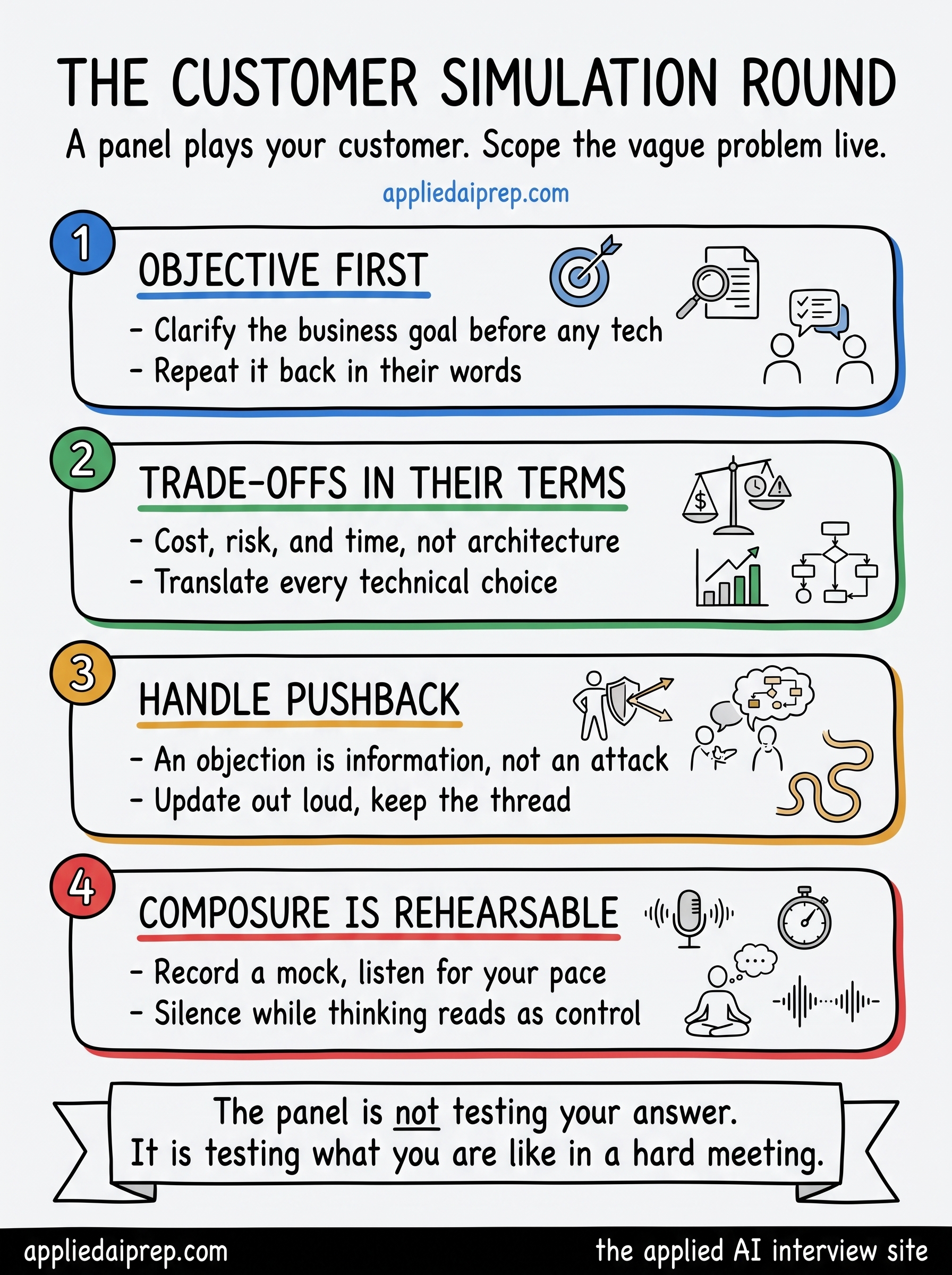
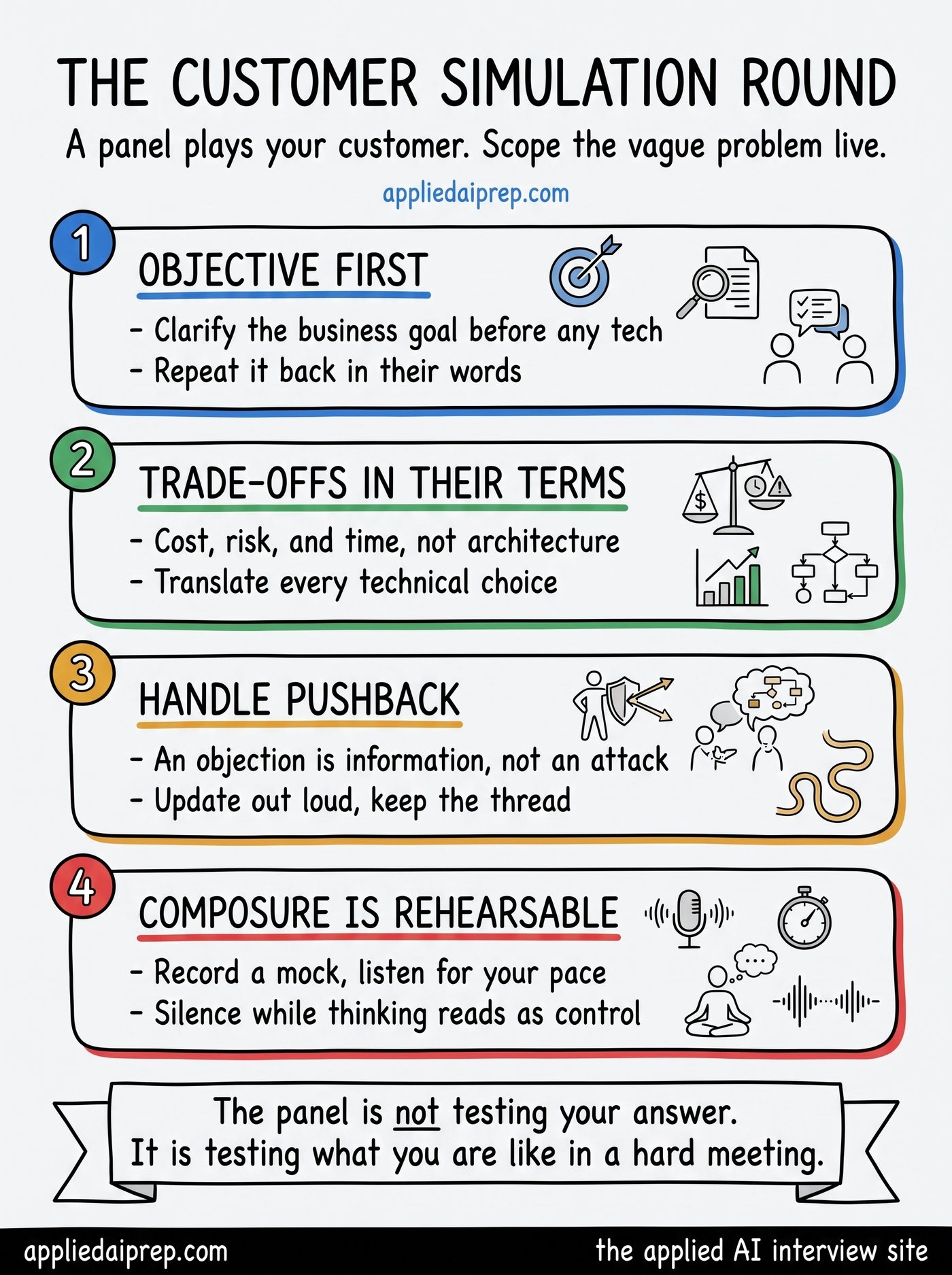
The customer simulation round is a live roleplay where a panel plays your customer's stakeholders and hands you a deliberately vague problem. You pass it by clarifying the business objective before you design anything, communicating technical trade-offs in language a non-engineer can act on, and holding composure when a stakeholder pushes back or quietly moves the goal. It is testing whether you can run a real customer conversation, not whether you know the right architecture. The most common way strong engineers fail is jumping to a solution before they understand what success even means. This piece breaks down how to scope first, frame trade-offs, and stay steady under pressure.
What the round is really measuring
Treat this as a structured roleplay, not a quiz. There are usually two to four interviewers. Often one plays a business owner who cares about the outcome, the cost, and the timeline, and another plays a technical or security counterpart who probes feasibility and risk. Sometimes they disagree with each other on purpose, because the most useful signal comes from watching you navigate stakeholders who want different things.
What they are grading is judgment under ambiguity and pressure: do you surface the real objective, do you make trade-offs legible to a decision maker, and are you someone a customer would trust in a room. This is the same muscle the rest of the loop probes in the case study, but here it is live and interpersonal. To see the family of scenarios it draws from, the behavioral and customer questions are the closest practice set, and the interview process overview shows how this round connects to the rest of the loop.
Clarify the business objective first
The discipline that decides this round is scoping before solving. When you get the vague prompt, resist the urge to look smart by proposing something fast. Spend the first few minutes understanding what success actually looks like.
A small, memorized kit of clarifying questions keeps you from going blank:
- Who actually uses this, and what does their day look like now?
- What does success look like in a number, and by when?
- What matters more here, accuracy, speed, or cost, if you had to rank them?
- What is the constraint that worries you most: data, compliance, integration, or budget?
- What happens if we do nothing?
Then do the move that carries most of the score: restate what you heard. "So the real goal is to cut review time, accuracy matters more than latency, and the data cannot leave your environment. Did I get that right?" That single sentence, repeated at each turn, proves you listen, keeps you from solving the wrong problem, and quietly puts you in charge of the meeting. A crisp solution to the wrong objective scores worse than a slower path to the right one.
Communicate trade-offs in the customer's terms
Once you understand the objective, the test shifts to whether you can make engineering choices legible to someone who does not write code. The failure mode is hiding behind jargon. Saying you will "add a reranker to improve retrieval precision" means nothing to a business owner. Saying "we can make the answers more accurate, which costs us a bit of speed and some extra compute, and for your use case I think that is the right swap" is a trade-off they can actually decide on.
Frame every significant choice as a decision with a cost, and let the customer own it. The phrase that works is "we can do that, and here is the cost of doing it that way." You are not blocking and you are not blindly complying. You are pricing the decision so the stakeholder makes it with full information. That is exactly the behavior a real account depends on, and the panel is watching for it.
This matters most when a stakeholder wants something technically unwise. The score is not whether you agree or refuse. Pure refusal reads as inflexible, pure compliance reads as careless. The win is explaining the risk in their terms and offering a path that protects them while still moving toward their goal.
Handle pushback without losing the thread
Pushback is information, not an attack. When an interviewer challenges your idea, the worst response is defensiveness, because it signals you will be hard to work with on a real customer. The reliable pattern is three steps: acknowledge the concern, ask a question to understand it, then either adjust your approach or explain the trade-off you are knowingly accepting and why.
Sometimes the pushback is really a changed requirement. The customer "remembers" a new constraint or shifts the goal mid-conversation. This is frequently deliberate. Do not pretend it did not happen and do not silently absorb it. Name the change out loud, restate the new objective, and note how it affects scope or timeline. Calmly making the moving target visible is the exact skill the round checks, because it is what you do on a live engagement when a client's priorities drift.
Composure is a skill you can rehearse
Composure is not a personality trait you either have or do not. It is structure plus practice. Three things help most.
First, slow down on purpose. A short pause after your own question looks confident, not lost, and it gives you room to think. Silence is your tool, not your enemy. Second, lean on your memorized clarifying kit so you are never empty when nerves hit. Structure beats panic. Third, narrate your thinking. Saying "let me make sure I understand the goal before I sketch an approach" tells the panel exactly what you are doing and buys you time while scoring points for process.
The only durable fix is reps. Run mock versions out loud with a friend playing an unreasonable stakeholder, and practice restating, pricing trade-offs, and absorbing pushback until it is reflex. Working through realistic scenarios in the full question bank builds the same instincts, and the must-know set is the fastest way to find your weak spots before the loop.
The one-line version
The customer simulation round is not asking for the right architecture. It is asking whether you can sit across from a stakeholder, find the real objective before you design, turn engineering choices into decisions they can own, and stay steady when they push. Scope first, price the trade-offs in their language, treat pushback as data, and you will look like someone who already runs customer accounts, which is exactly who they are trying to hire.
Turn it into offers. Work the real questions and concepts this maps to:
FAQ
Whether you can run a real customer conversation: surfacing the business objective before designing, framing technical trade-offs in terms a non-engineer can decide on, and staying steady when a stakeholder pushes back or changes the goal mid-conversation. It is closer to a structured roleplay than a Q and A, and the panel is graded on signal, not on tripping you up.
Discussion (6)
The thing people underweight: this round rewards the boring discipline of restating what you heard. 'So the real goal is to cut review time, and accuracy matters more than speed, did I get that right?' That one sentence, repeated at each turn, is most of the score. It proves you listen and it stops you solving the wrong problem.
This matched my experience. The candidates who do well sound like they are running the meeting, not surviving it. Restating is how you take the wheel without being pushy.
A trap worth naming: the panel will sometimes give you a stakeholder who wants something technically unwise. The score is not 'agree' or 'refuse.' It is whether you can explain the risk in their terms and offer a path that protects them. Pure refusal and pure compliance both lose.
Exactly. The phrase that works is 'we can do that, and here is the cost of doing it that way.' You are not blocking, you are pricing the decision so they own it with full information.
I freeze when there is silence after I ask a question. Any advice on composure specifically?
Slow down on purpose. A short pause after your own question is fine and even looks confident. Have a small kit of clarifying questions memorized so you are never empty: who uses this, what does success look like, what is the constraint that scares you most. Structure beats nerves.