
How to Answer 'Why Applied AI Engineering?' (and Actually Stand Out)
The motivation round looks like a softball and decides more loops than people expect. Here is how to answer 'Why Applied AI Engineering?' in a way that signals fit, not flattery, and the weak answers that quietly sink strong candidates.
BY EMILY CARTER · APPLIEDAIPREP EDITORIAL · UPDATED JUNE 21, 2026 · 8 MIN READ
When an interviewer asks "Why Applied AI Engineering?", they are not checking your enthusiasm. They are checking whether you understand that this job is half engineering and half owning an outcome for a customer, and whether you actually want that combination rather than tolerating it on the way to something else. A strong answer names a specific reason you are drawn to the deployment problem, backs it with one piece of evidence from your own history, and connects to what the role does on a normal Tuesday. A weak answer praises the company or the models and never explains why this role. This piece covers the framing that lands, what interviewers reward, and the common answers that quietly sink strong candidates.
Why the question carries more weight than it looks
The motivation round feels like a warmup, so people prepare for it last. That is a mistake. The role has a real attrition risk: engineers join expecting frontier research or clean product work, discover they are on customer calls scoping a vague problem, and leave. Hiring managers have watched it happen, so the "why" question is a filter against it. They are trying to find out, early and cheaply, whether you have understood the actual job.
That is also why the answer cannot be generic. Wanting to work on AI, wanting to work with strong models, wanting impact: every candidate for every AI role says these. None of them explain why you want the specific job where the model is the easy part and the customer's environment is the hard part. If you are still mapping how this role differs from a research or platform position, Applied AI versus other engineering roles is the cleanest reference for the distinction.
The framing that lands: the model is a commodity, the deployment is the moat
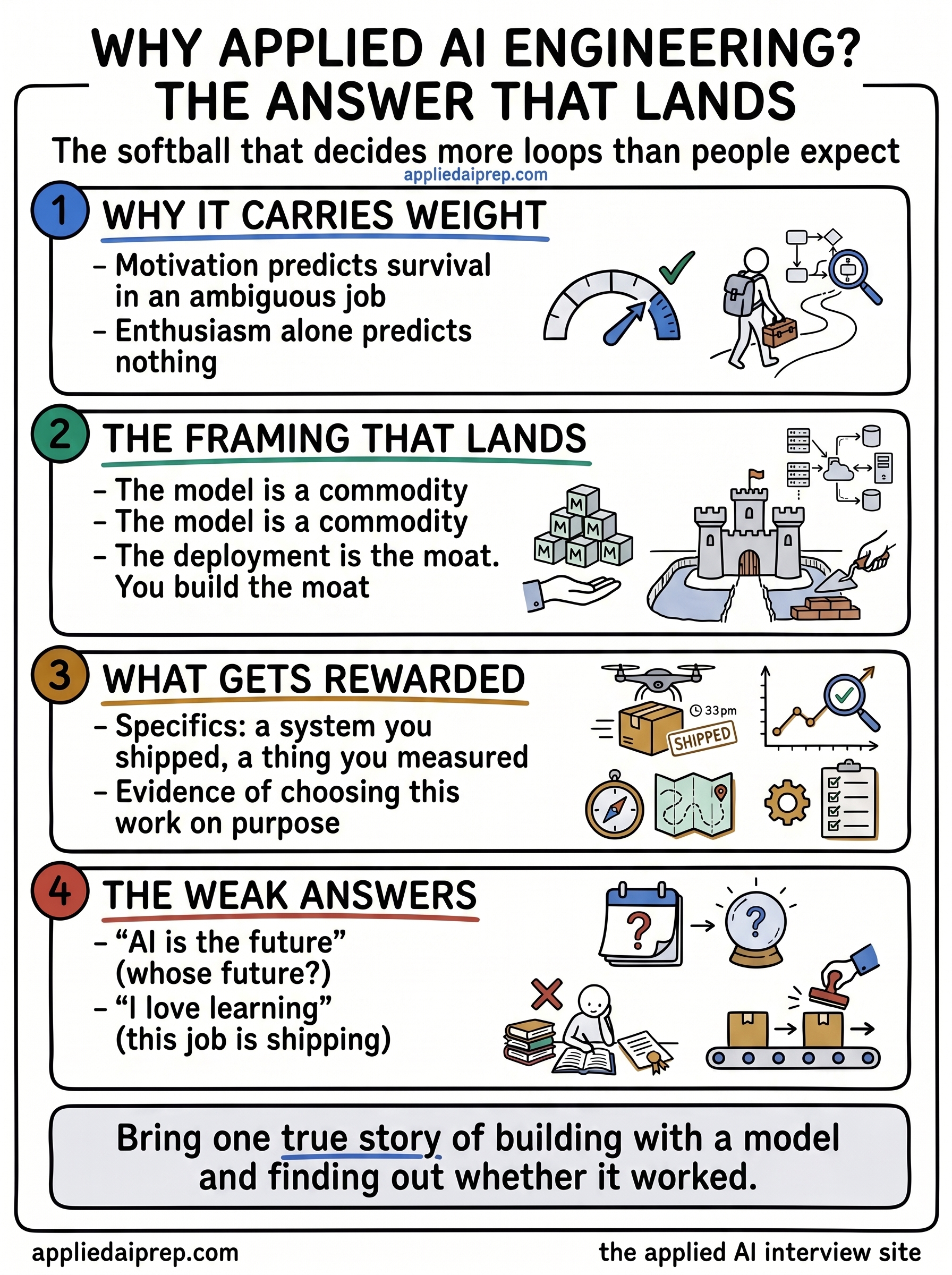
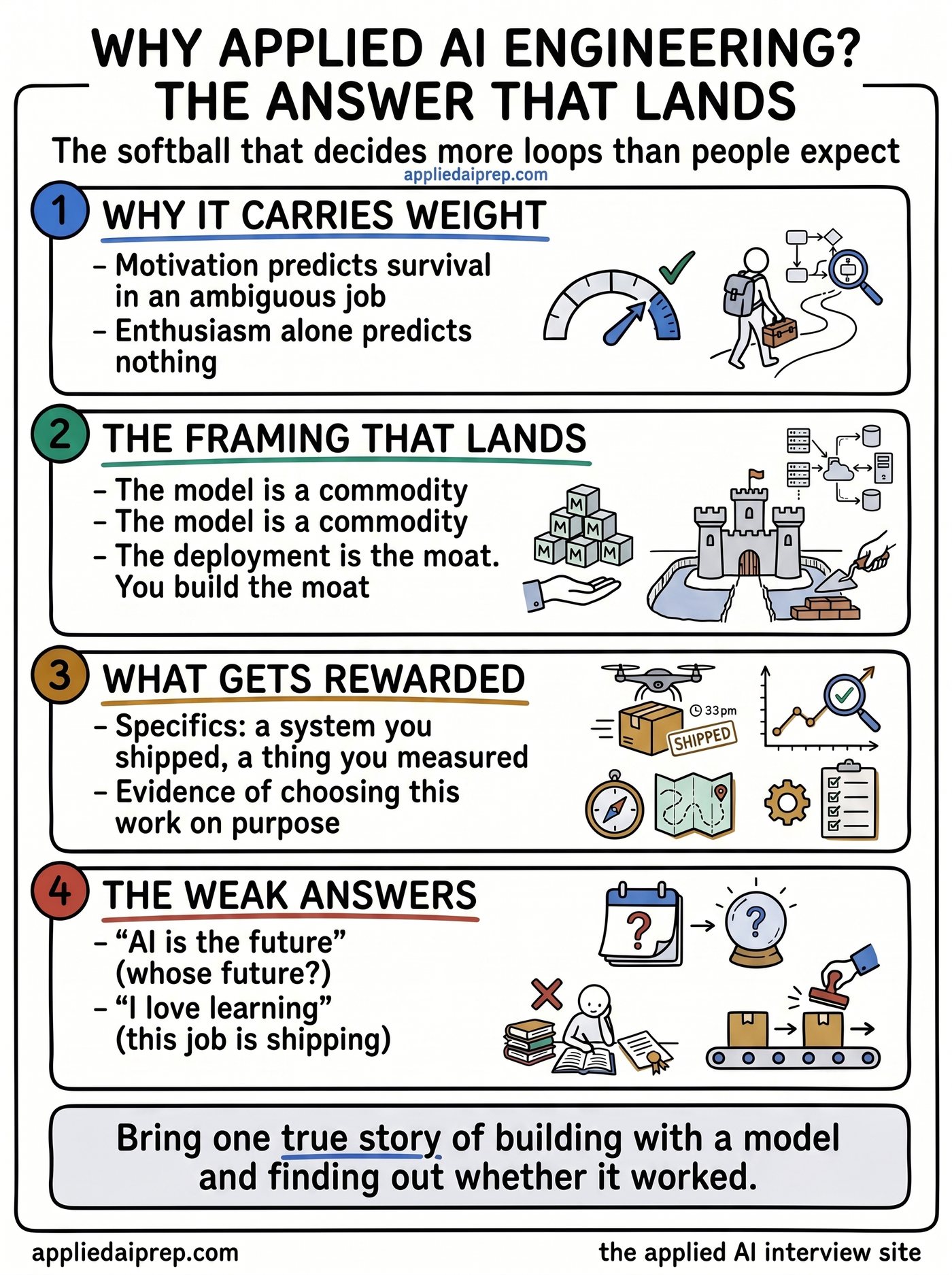
The sharpest single idea you can bring to this answer is that the model is increasingly a commodity and the deployment is the moat. The frontier models have been good enough for most enterprise use cases for a while. What is still genuinely hard, and therefore still valuable, is making one work inside a specific company: their data that nobody fully documented, their permission model, their compliance reviewers, their latency budget, and the gap between what a stakeholder asked for and what they actually need.
If your motivation is rooted there, you are describing exactly the job. You are not saying "I like AI." You are saying "I want to own the part where a capable model meets a real customer's constraints, because that is the part that decides whether any of it ships." That framing signals you have understood the value chain. It is also defensible, because it is true: an Applied AI Engineer earns a premium precisely for closing that last mile, not for prompting a model.
The move that makes it credible is evidence. Pair the framing with one concrete moment from your past where you enjoyed exactly this kind of work. Maybe you took a model or feature that worked in a notebook and fought it into production against real data and real reviewers. Maybe you owned an integration where the hard part was a stakeholder's unstated requirement. One specific story turns a thesis into a fit signal.
What interviewers actually reward
Across reported loops, the answers that score well share a few traits:
- Role-specific, not company-specific. They explain why this kind of work, then optionally why this company. They never confuse the two.
- Grounded in evidence. They reference a real thing the candidate did and liked, so the motivation is observed behavior, not a stated preference.
- Honest about the customer half. They show the candidate knows the job involves people, ambiguity, and trade-off conversations, and they want that, not just the code.
- Connected to the day to day. They land on what the role does normally: scoping with a customer, designing under constraints, proving the system works.
Notice what is missing: passion language, mission worship, and model fandom. Interviewers reward a candidate who sounds like they have already been doing a smaller version of this job and want more of it. If you want to calibrate against the kind of judgment these rounds probe, work through the behavioral and customer questions, which is where the motivation answer gets stress tested with follow-ups. It also helps to know where this round sits in the wider loop, which the interview process overview lays out stage by stage.
The common weak answers, and why they fail
"I want to work with the most capable models." This is a reason to join any AI company. It says nothing about why you want the customer-facing, deployment-heavy version of the work. It often signals you are aiming at research and treating this role as a side door.
"I love your mission." Mission fit is necessary but it answers "why this company," not "why this role." Plenty of mission-aligned people would be miserable on customer calls. Interviewers have learned to discount it.
"I am a strong engineer and want impact." True of most candidates and still generic. Impact is the output of every engineering role. It does not explain the choice of this one.
The polished pitch with no evidence. A fluent, confident answer that references no actual experience reads as rhetoric. The follow-up, "tell me about a time you did that," will expose it instantly, so a pitch you cannot back is worse than a plainer answer you can.
How to build your own answer
Spend an hour before the loop doing three things. First, write the one deployment problem you have genuinely enjoyed and why, in plain language. Second, find the single best story from your history that proves you have done that kind of work and liked it, with enough detail to survive follow-ups. Third, rehearse the connection out loud: the framing, the evidence, then a sentence on what the role does daily that you are looking forward to.
If you lack literal customer-facing experience, use the closest proxy: mentoring, leading a cross-team integration, supporting internal stakeholders, or any time you negotiated scope with a non-engineer. The role runs on owning an outcome for someone else, and a story where you did that counts for more than a job title with "customer" in it. To see where this answer sits in the full loop and what comes after it, the must-know question set is the fastest first pass.
The one-line version
"Why Applied AI Engineering?" is not asking whether you are excited. It is asking whether you understand that the model is the easy part and the deployment is the moat, whether you have already chosen to work on that hard part, and whether you can prove it with one real story. Answer the role, back it with evidence, and the softball turns into your strongest round.
Turn it into offers. Work the real questions and concepts this maps to:
FAQ
Because the role has a high attrition risk when people join expecting pure research or pure product work and then find themselves on customer calls. The question is a filter for whether you understand and actually want the customer-facing, deployment-heavy reality of the job, not a check on your enthusiasm.
Discussion (6)
The single most common miss I see: the candidate answers 'why this company' when asked 'why this role.' Those are different questions. You can love the mission and still be a bad fit for a job that is half on customer calls. Answer the role first, then the company.
Strongly agree. The cleanest answers I have heard name a specific deployment problem the candidate already enjoyed solving, then connect it to what the role does every day. It reads as fit, not as a pitch.
A tactical add: prepare for the immediate follow-up 'tell me about a time you did that.' If your motivation answer references owning a messy delivery and you cannot then produce one story with real detail, the answer was rhetoric and the interviewer will know.
Yes. Motivation and evidence are the same question split across two minutes. Treat them as one.
Is it a red flag to admit the customer-facing part scares me a little? I came from a backend team.
Honesty about the stretch is fine and often lands well, as long as you pair it with why you want the stretch and a small example of moving toward it. What sinks people is pretending the customer work does not exist, then visibly dreading it in the roleplay round later.