
How to Break Into Applied AI Without a FAANG Resume
You do not need a big-tech pedigree to land an Applied AI Engineer role. Why early-stage, founder, and mentoring experience often beats FAANG, how to build a deployment artifact that proves it, and how to pick a vertical.
BY ADAM REYES AND HANNAH BRYANT · APPLIEDAIPREP EDITORIAL · UPDATED JUNE 21, 2026 · 9 MIN READ
You do not need a FAANG resume to break into Applied AI Engineering, and a pure big-company background can even work against you. The teams hiring for this role weight comfort owning ambiguous outcomes over brand-name pedigree, which is good news if your experience is early-stage, founder, or customer-facing rather than famous. The fastest path in is not collecting credentials, it is proving you can do the actual job: build one real deployment artifact, get fluent in the applied stack, and go deep on a vertical where you have an edge. This piece lays out exactly how, and why the unglamorous resume often wins. For the formal skill checklist that loops screen against, see the skills guide. This goes deeper on the candidate without the pedigree.
Why early-stage and founder experience beats pedigree
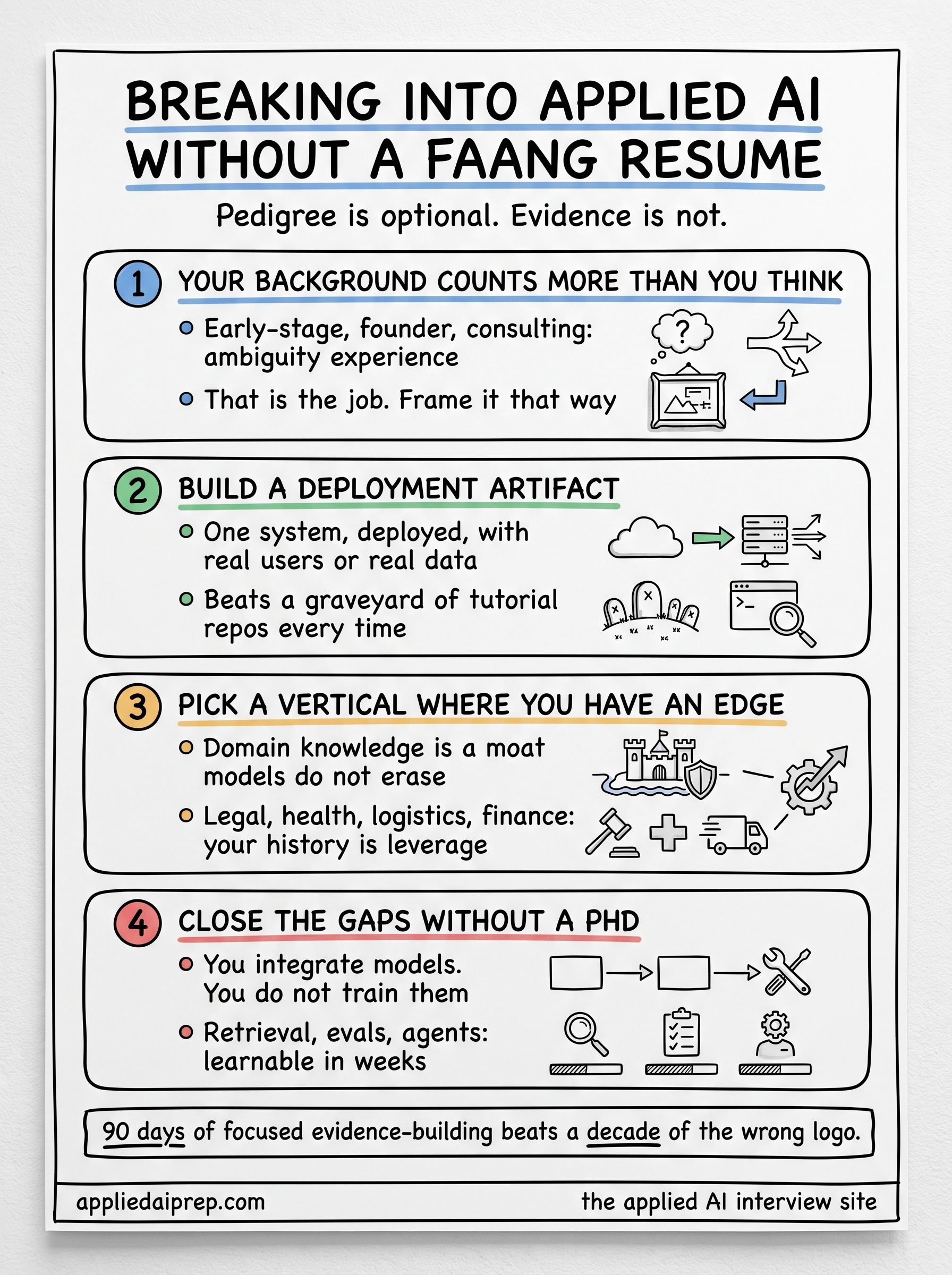
The Applied AI loop is built to find people who can own a vague problem end to end, and that is precisely what a famous-logo resume does not predict. Big-company environments are good at many things, but they often train a wait-for-the-spec reflex: someone else scopes the problem, someone else owns the customer, and your job is to implement a well-defined ticket. The Applied AI role punishes that reflex, because the job starts before the spec exists.
This is why hiring managers consistently weight founder, early-stage, and customer-facing experience higher than pedigree. A founder whose startup failed has usually shipped to real customers, owned outcomes with no clean spec, and made hard trade-offs under uncertainty. On a real loop, that can beat two FAANG resumes on the same panel. The one condition: you have to tell the story as ownership and learning, not as a list of things that went wrong. Same facts, very different signal.
There is a second underrated signal: teaching and mentoring. The role runs on customer empathy, and explaining a hard technical trade-off to a non-technical person is half the job. If you have taught, tutored, or run a cohort, that is direct evidence of the communication skill the role needs, so name it on the resume and connect it explicitly to customer work.
Build a deployment artifact, not a tutorial graveyard
The highest-return thing a no-pedigree candidate can do is build one real deployment artifact and be able to speak to it in depth. This beats a long LeetCode record and a pile of half-finished tutorials, because it demonstrates the exact judgment the role tests.
A strong artifact is a small but real AI system built end to end:
- It ingests genuinely messy real data, not a clean benchmark set. The entire role is the gap between a tidy demo and a real environment, so if your project never touched ugly data, you have not shown the skill being screened.
- It does retrieval over that data, using sensible chunking and embeddings, and you can defend why you made those choices.
- It does something actually useful, ideally an agent or a workflow a real person would run.
- It has an eval that proves it works. This is the part interviewers gravitate to, because evaluation separates a deployment from a science project.
A good source of messy real data is a domain you already know: public filings from an industry you worked in, support tickets, legal documents, internal-style wikis. The mess is the point. When the eval section is the thing every interviewer wants to discuss, you have built the right artifact. To calibrate what good looks like, work through the RAG and agent design questions and the system design for production material, which mirror the design rounds your artifact will be judged against.
Pick a vertical where you have an edge
A generalist is useful everywhere and indispensable nowhere. The candidates who break in fastest pick a vertical and go deep enough to know its failure modes, not just its happy path.
Choose a vertical on two criteria. First, where you have some unfair context: an industry you worked in, a regulatory domain you understand, a workflow you have lived. Second, where deployment is genuinely hard, which is where the role is most valued. Regulated industries like financial services, healthcare, and legal have some of the fastest-growing demand precisely because their deployment complexity, compliance, legacy integration, data sensitivity, is exactly what a generalist cannot solve.
When you know why a specific regulated customer cares about a specific control, you become the person a deal cannot close without. That depth, paired with one strong artifact in the same vertical, is a far stronger application than a generic resume with a better logo on it. The AI security and governance material is a fast way to get fluent in the constraints these verticals actually care about.
Close the technical gaps without an ML PhD
Many of the strongest Applied AI Engineers came from backend or infrastructure, not research. You do not need to train models from scratch. You need working fluency in the applied stack: retrieval, evals, agent design, and the production concerns, latency budgets, idempotency, retries, that make a deployment survive a real network.
For a working engineer, a focused 8 to 12 weeks is a realistic ramp to hireable: build the artifact, get fluent in the applied stack, and practice scoping ambiguous problems out loud, because the signature round of the loop is an ambiguous case study, not an algorithm puzzle. Start with the must-know questions to find your gaps quickly, then drill the skills the role screens for until you can defend each one in an interview.
Putting it together: a 90-day plan
A concrete sequence that has worked for career switchers:
- Weeks 1 to 2: Pick your vertical and source a messy real dataset from it. Skim the essentials to map your gaps.
- Weeks 3 to 8: Build the deployment artifact end to end, with a real eval. This is the centerpiece, so do not rush it.
- Weeks 6 to 10: In parallel, drill the design and behavioral rounds. Practice scoping a vague customer problem out loud until clarifying-before-architecting is a reflex.
- Weeks 9 to 12: Tighten your story. Reframe early-stage, founder, or teaching experience explicitly as ownership and customer empathy, and connect your artifact to your chosen vertical.
The throughline is that you are not trying to look like a FAANG candidate. You are proving you can already do the job, which is a different and, for this role, stronger claim.
The one-line version
Pedigree is not the moat here, ownership is. Build one real deployment artifact against messy data, go deep on a vertical you understand, and frame your founder, early-stage, or teaching experience as the customer ownership the role actually runs on.
Turn it into offers. Work the real questions and concepts this maps to:
FAQ
Correct, and a pure big-company resume with no early-stage exposure can even count against you. Hiring managers for this role weight comfort owning ambiguous outcomes over brand-name pedigree, and big-company environments often train a wait-for-the-spec reflex the role punishes. Founder, early-stage, and customer-facing experience are stronger signals than a famous logo.
Discussion (5)
The single highest-return move I tell people: build one artifact against genuinely messy real data, not a clean Kaggle set. The whole role is the gap between a clean demo and a real environment. If your project never touched ugly data, you have not actually shown the skill the interview is screening for.
This got me my offer. I built a retrieval system over my old company's public filings, which were inconsistent and badly formatted, and the eval section was what every interviewer wanted to talk about. The mess was the point.
On pedigree: I have sat on loops where the strongest candidate was a former early-stage founder whose startup failed. They had shipped to real customers, owned outcomes with no spec, and could scope ambiguity cold. That beat two FAANG resumes on the same panel. Failure that taught ownership is a feature here, not a flag.
Agree, with one caveat: you have to tell the failure as a story about what you owned and learned, not as a list of things that went wrong. Same facts, completely different signal depending on how you frame the ownership.
Underrated tactic for no-pedigree candidates: mentoring or teaching experience. The role runs on customer empathy, and being able to explain a hard technical trade-off to someone non-technical is half the job. If you have taught, tutored, or run a bootcamp cohort, put it on the resume and connect it explicitly to customer communication.