
OpenAI Applied AI Engineer Interview: The Full Loop (2026)
A round-by-round breakdown of the OpenAI Applied AI Engineer and Forward Deployed loop: the practical coding screen, LLM system design at scale, the project deep dive, and how leveling gets decided. With sample question types and a prep plan.
BY LUKAS HOFFMANN · APPLIEDAIPREP EDITORIAL · UPDATED JUNE 21, 2026 · 9 MIN READ
The OpenAI Applied AI Engineer interview is a compressed loop, roughly a month and five to seven touchpoints, that tests three things at once: can you write production-grade code under time pressure, can you design an LLM-backed system that survives real scale, and can you turn a vague customer goal into a shipped plan. It pairs a coding and system-design bar set against OpenAI's own applied and research engineers with a customer-facing evaluation that most big-tech loops skip entirely. Expect a recruiter and hiring-manager screen, one or two technical phone screens, sometimes a paid work trial, then a virtual onsite of four to five rounds. Leveling is decided after the loop. Decisions move fast, often within a couple of days of the final round.
The shape of the loop
The role shows up under a few titles. You will see Applied AI Engineer, Solutions Engineer, and Member of Technical Staff, with Forward Deployed Engineer as the customer-embedded variant. The variants share a core engineering loop and differ at the edges: the forward-deployed track leans harder on customer empathy and on-site delivery, the Solutions Engineer track may swap the work trial for an NDA-gated task and a demo.
A representative loop:
- Recruiter and hiring-manager screen. Background, motivation, and AI fluency. Mission and AGI-safety alignment is assessed here, not treated as small talk.
- Technical phone screen. Around an hour of practical coding in CoderPad. A second stage may be a system-design screen, a take-home, or an async exercise depending on the team.
- Work trial (sometimes). A practical, often paid project tied to real workflows, scored on reliability, code quality, and tests.
- Virtual onsite. Four to five rounds: coding, one or two system-design rounds, a project deep dive, and behavioral or values.
The recruiter screen carries more weight than a scheduling call. The recruiter calibrates the difficulty of your later rounds and writes notes every interviewer reads. A specific, defendable point of view on AI moves you forward; a generic "I love the mission" answer does not.
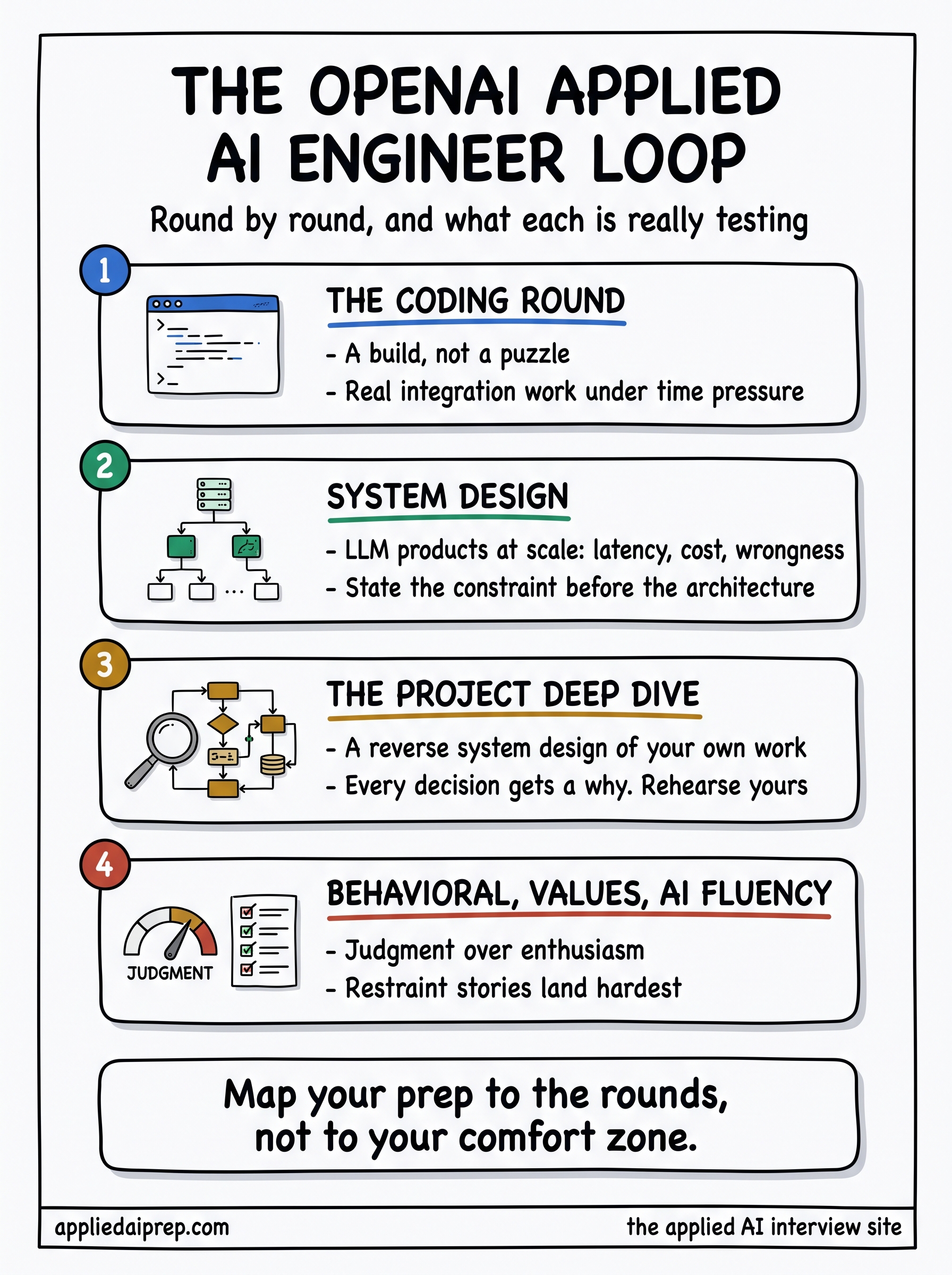
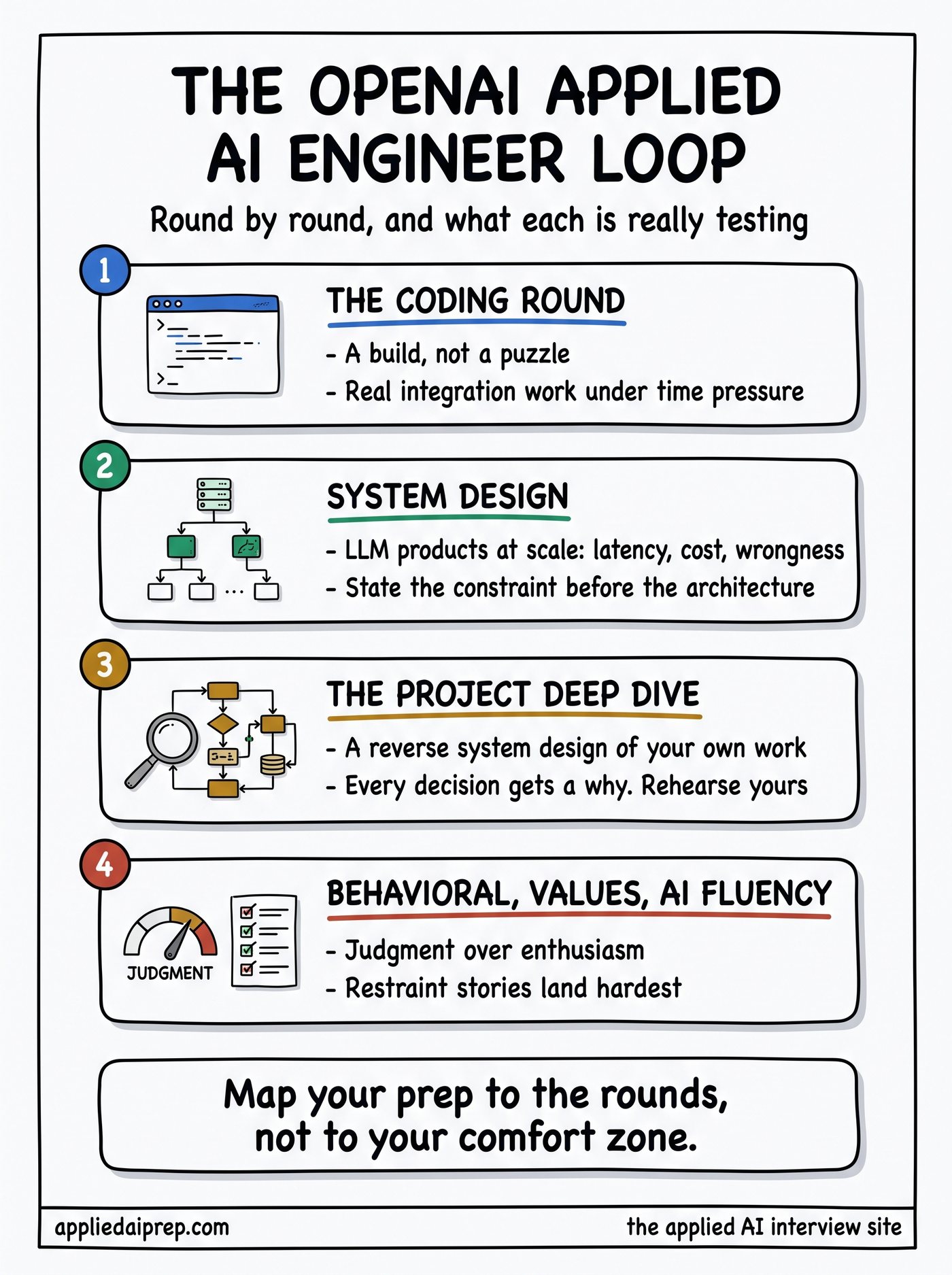
The coding round is a build, not a puzzle
This is where LeetCode grinders get caught off guard. The coding round is one large, practical implementation, sometimes split into sequential parts, where you build a working solution and then extend it as new requirements arrive. A recurring example is a GPU credit management system that tracks allocation and usage, which has appeared at both the phone screen and onsite. Another reported pattern: store and retrieve key/value state efficiently given byte-conversion helpers. A common onsite variant hands you messy working code to refactor and extend without breaking its existing tests.
What they score: a correct working solution before any optimization, edge cases reasoned out early, clean structure and naming, and fluency with your language's internals (iterators, generators, async, concurrency). One real quirk worth knowing in CoderPad: candidates have reported that "Run Main" shows no output, so use "Run Test Case" instead. AI assistants are generally permitted here, so share your screen and narrate. The signal is how you think, not whether you can prompt.
For drilling the practical-build muscle and the refactor-without-breaking-tests pattern, work through coding and data-structure questions until building-then-extending feels routine.
System design at LLM-product scale
The system-design rounds are the differentiator, and they are where most of the failures happen. Standard infrastructure prompts show up (design a payment system that stays correct under retries and failures, which is really an idempotency question), but so do prompts pitched at extreme scale, like designing ChatGPT-style infrastructure for 100M users, and prompts that are explicitly about building on top of a model.
Interviewers are listening for production thinking: retries, idempotency, failure recovery. Then scale: how the architecture holds when usage grows 100x to 1000x. Then LLM judgment: when to reach for retrieval versus fine-tuning versus prompting, and crucially, how you would prove the system works once it is live. That last point is the held-back follow-up. If you design a retrieval pipeline for a customer's private data and never describe the evaluation suite that confirms it meets accuracy and cost targets, you have answered half the question.
This is the modal Applied AI design round, and it leans on retrieval, agents, and evals. The fastest way to calibrate is the RAG and agent system design set, then the broader system design questions for the scale and idempotency patterns.
The project deep dive is a reverse system design
You pick one technically complex system you built, walk the architecture, and defend every decision under rapid follow-up. Treat it as a reverse system-design round: same rigor, your own work as the prompt. Ownership depth matters (what did you personally build and decide), as does design justification on storage, model, and architecture choices, and an honest account of how you measured quality.
The trap is the prepared narrative. Interviewers push past it on purpose, and scale is a recurring theme. If the work was not high scale, prepare a precise answer for how it would scale rather than improvising one in the room.
Behavioral, values, and AI fluency
The behavioral round runs in two halves: a motivation and AI-fluency conversation, then standard questions on conflict, ownership, and cross-functional work. The first half wants a genuine, specific view on where AI is going and where it could go wrong, not a rehearsed mission statement. Expect heavy follow-up; most of the evaluation lives in the questions after your first answer. For safety-track roles there may be an additional red-team round defending containment and alignment strategies, and the FDE variant can add a customer-empathy simulation.
A prep plan that maps to the rounds
- Build one production-grade project you can defend end to end, including exactly how it scales past the happy path. This feeds both the deep dive and your design answers.
- Practice large, multi-part coding tasks (build, then extend) and refactoring messy code without breaking its tests. Drill against coding questions.
- Prepare an LLM-deployment design story: retrieval, evaluation, idempotency, plus cost and latency under scale.
- Form a specific point of view on AI and on how customers will actually use it. Bring a real opinion to the screen.
- Be ready to design the eval suite that proves a model-backed system hits its accuracy and cost targets. This is the most common differentiator across reported loops.
For the full breakdown of OpenAI's stages, signals, and timeline, see our OpenAI interview process page. For how the forward-deployed loop compares across companies, read the FDE interview process guide. When you are ready to pressure-test yourself, start with the must-know question set.
The one-line version
OpenAI is not checking whether you memorized algorithms. It is checking whether you can ship a model-backed system into a real customer environment, prove it works with evals you designed, and defend every decision when someone pushes past your prepared answer. Prepare for that, and the loop stops feeling random.
Turn it into offers. Work the real questions and concepts this maps to:
FAQ
Plan for five to seven touchpoints over roughly a month: a recruiter and hiring-manager screen, one or two technical phone screens (coding, sometimes a system-design screen or take-home), then a virtual onsite of four to five rounds covering coding, one or two system-design rounds, a project deep dive, and behavioral or values. Some teams add a paid work trial. Leveling is decided after the loop, not before.
Discussion (5)
The single most common reason strong engineers stall here is the system-design round. They design a clean component diagram and never say the words idempotency, retry, or evaluation. The interviewer is waiting to hear how you would prove the deployed system actually works once a customer is relying on it. If you do not bring evals up yourself, that is a miss.
Agree. The eval-design question is almost a gate now. I would add: have a concrete answer for cost and latency under load, not just correctness. Throughput math on a model-backed endpoint comes up more than people expect.
Quick question on the work trial. Is it always paid, and how long does it run? Trying to plan around it.
It varies by team and by candidate. When it appears it is often a practical, scoped task tied to real workflows, and the paid versions are usually a few days of effort rather than weeks. Solutions Engineer candidates sometimes get an NDA-gated task plus a customer demo instead. Ask your recruiter to confirm scope before you commit time.
For the project deep dive: pick something you actually owned end to end, even if it was not high scale, and prepare the scaling story precisely. The follow-ups go past your prepared narrative on purpose. If your honest answer to 'how would this hold at 1000x' is a guess, they will find it.