
The AI Skills Every Applied AI Engineer Must Master in 2026
The six AI skills that decide Applied AI Engineer loops in 2026: retrieval, evaluation, agents and tool use, prompting with structured output, inference and serving, and security. What each is and why it matters.
BY LUKAS HOFFMANN AND HANNAH BRYANT · APPLIEDAIPREP EDITORIAL · UPDATED JUNE 21, 2026 · 9 MIN READ
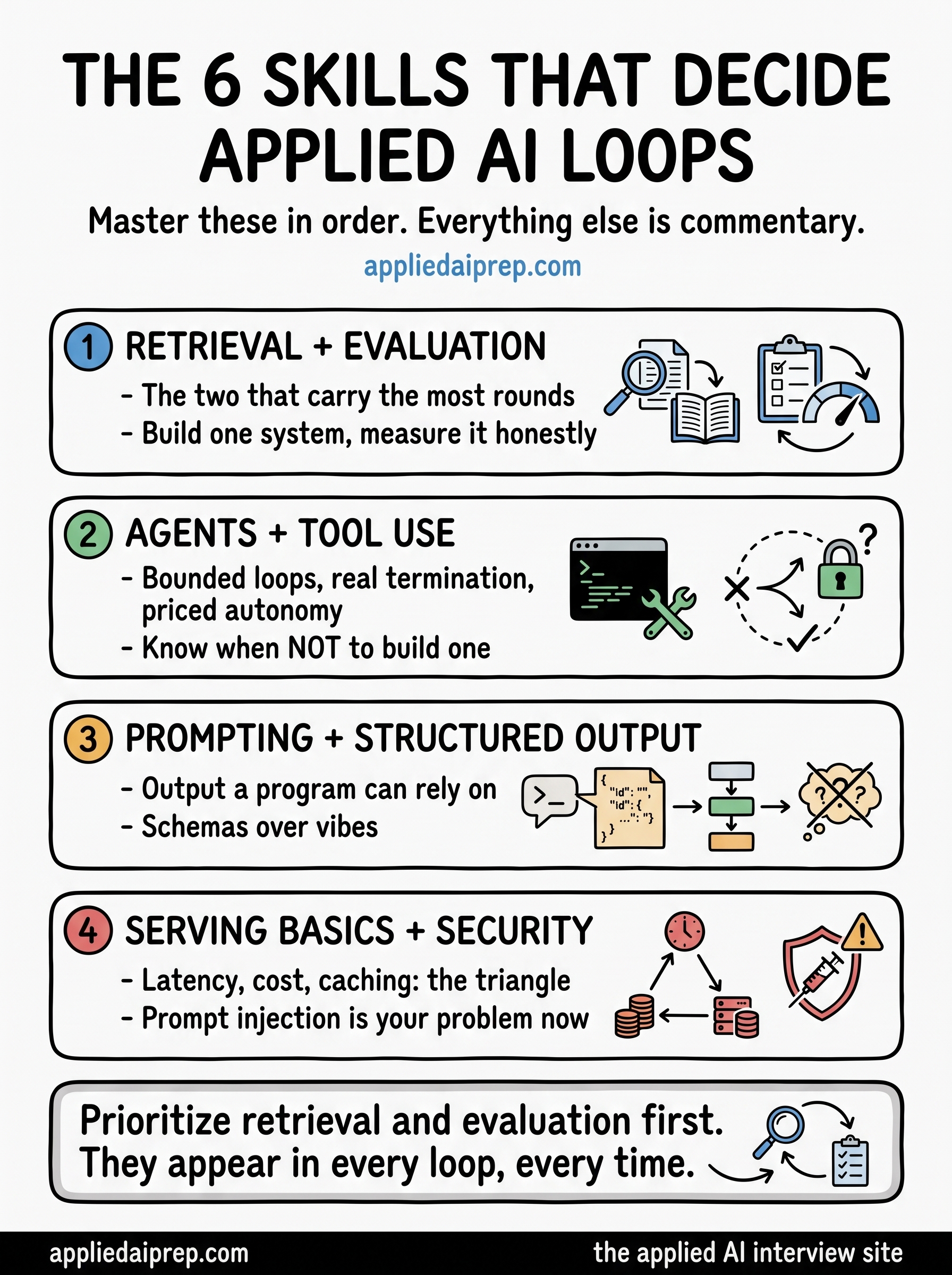
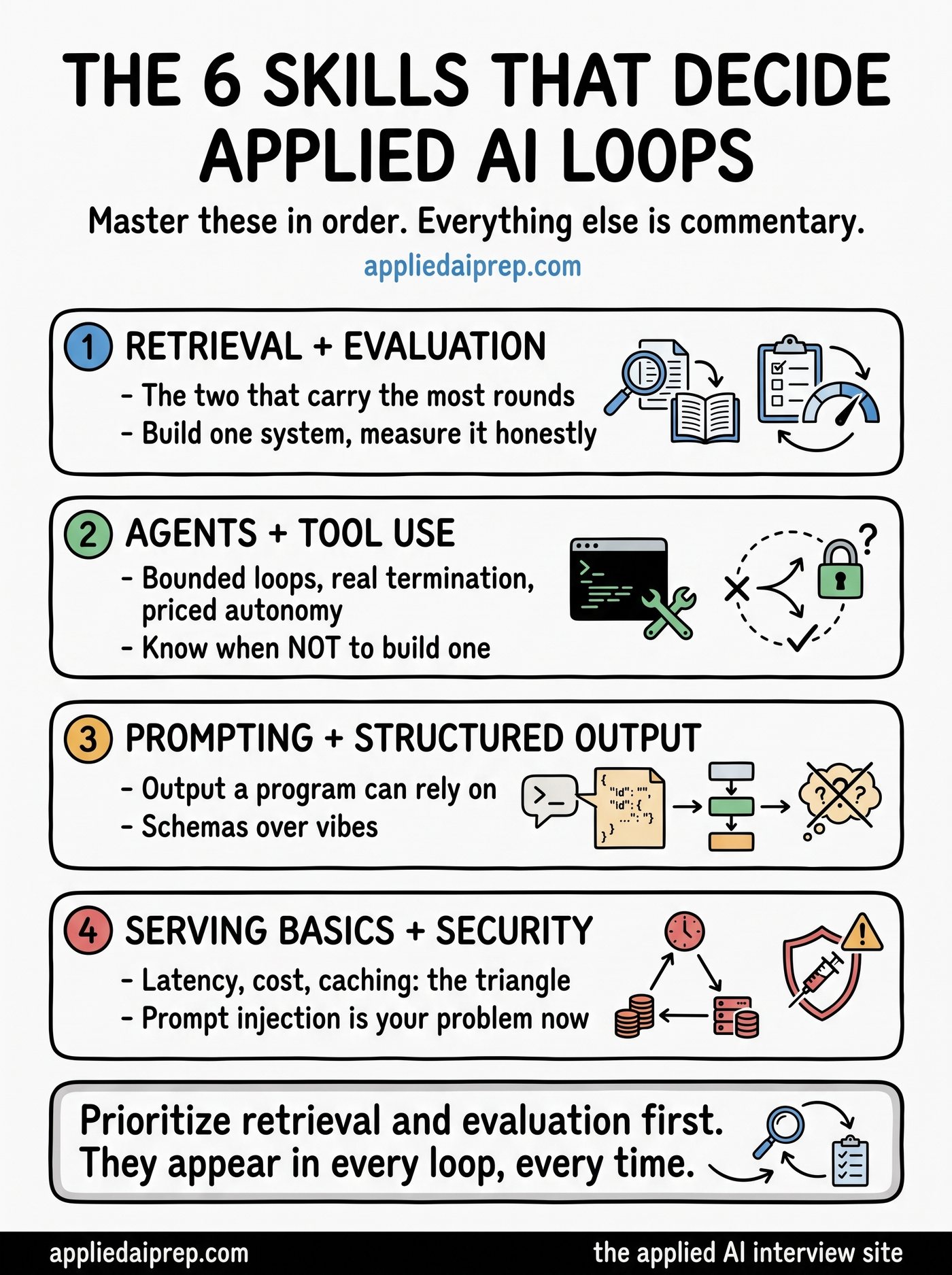
The six AI skills that decide Applied AI Engineer loops in 2026 are retrieval, evaluation, agents and tool use, prompting with structured output, inference and serving, and security. None of them require training a model from scratch. All of them are about taking a strong off-the-shelf model and making it work, provably and safely, inside a customer's production environment. Below is each skill, the page where you can practice it, and the honest reason it matters in the interview and on the job.
Retrieval (RAG)
Retrieval is the backbone skill, because the modal Applied AI design round is some version of a RAG system: ground a model in a customer's documents so it answers from their reality instead of its training data. You need to reason fluently about chunking, embeddings, a vector database, reranking, and how to keep the index fresh as the underlying data changes.
Why it matters: almost every enterprise deployment is a grounding problem before it is anything else. The customer does not want a general model. They want answers from their own knowledge, with citations. Practice the design and trade-off questions in RAG and agent system design, and make sure you can defend a specific chunking and retrieval choice rather than naming options.
Evaluation
Evaluation is the skill that separates candidates who have shipped from candidates who have only demoed. It is the ability to define what correct means for a given system, assemble a labeled set, measure, and act on the result. It pairs with retrieval so tightly that you should never present one without the other.
Why it matters: proving the system works is the core of the job, and it is the follow-up interviewers probe hardest. A candidate who designs a clean pipeline but cannot describe how they would measure correctness, catch hallucination, or handle a regression is signaling the exact gap the role exists to close. Work the evaluation and failure-analysis questions inside RAG and agents, and ground the underlying concepts through the core concepts reference.
Agents and tool use
Agents are tested, but with a deliberately skeptical framing. You should understand tool calling, multi-step planning, when a loop adds value, and how to keep an agent bounded so it does not spiral in cost or take an unsafe action. Just as important, you should know when not to reach for one.
Why it matters: reaching for an agent where a single model call would do is treated as a red flag, because it signals chasing the exciting pattern over the right one. The strongest answer names the trade-off out loud: a loop buys flexibility and costs latency, cost, and reliability. Practice this judgment in RAG and agent system design.
Prompting and structured output
This is the unglamorous skill that quietly decides integrations. You need to write reliable prompts and, more importantly, get a model to return structured output, usually JSON, that downstream code can trust. That means schema validation, a repair or retry path, and a sane fallback when the model returns malformed output.
Why it matters: a real integration depends on the model output being machine-readable and reliable, not just impressive in a chat window. The interview tell is the follow-up "what happens when the output is malformed?" Have a concrete answer. Build the underlying intuition through LLM and GenAI fundamentals, where prompting, context windows, and output reliability live.
Inference and serving basics
You will rarely train a model, but you will constantly reason about running one. This skill covers latency budgets, throughput, batching, context length, caching, quantization at a conceptual level, and the cost math of tokens. It is the difference between a design that works in a notebook and one that holds up under a real load and a real budget.
Why it matters: Applied AI design rounds come with hard constraints like a tight latency target or a fixed cost ceiling, and you have to spend that budget deliberately. The fundamentals here sit in LLM and GenAI, and the production and serving framing connects to the broader concepts reference.
Security and governance
Security is the skill that closes deals in regulated verticals. You should be able to reason about prompt injection, data exfiltration through tool use, permission propagation so the model never returns data a user should not see, data residency, and what must stay inside a customer's VPC.
Why it matters: in financial services and healthcare loops, the candidate who raises data residency and permission models unprompted signals they have actually deployed inside a regulated customer, not built a toy. This is often the difference between a deal closing and stalling. Go deep on the AI security and governance questions, because the depth expected here keeps rising.
How to prioritize the six
If you cannot master all six before a loop, weight them by how often they decide rounds. Retrieval and evaluation come first, because they show up in nearly every design discussion and pair into the strongest single signal: a grounded system you can prove works. Agents, structured output, and inference fundamentals come next as the surrounding craft. Security ranks higher than its frequency suggests if you are targeting a regulated vertical.
Do one timed pass over the must-know set to find which of the six is weakest, then spend your hours there. The job is not building a new model. It is taking a strong one and making it work, provably and safely, in someone else's production environment. These six skills are how you demonstrate you can.
Turn it into offers. Work the real questions and concepts this maps to:
FAQ
Retrieval combined with evaluation. The modal design round is a retrieval system, and the candidates who pass can prove it works rather than just draw it. If you master one pairing, make it the ability to build a grounded retrieval pipeline and measure whether it answers correctly.
Discussion (5)
If you only have time to go deep on two of these six, make them retrieval and evaluation. They show up in nearly every design round, and a candidate who can ground a system and prove it works is already past most of the field.
Strong agree. I would add that evaluation is the one most people skip and the one interviewers probe hardest, because it is the clearest tell for whether someone has shipped versus just demoed.
On security: in financial services and healthcare loops, the candidate who brings up data residency and permission propagation unprompted stands out immediately. It signals you have actually deployed inside a regulated customer, not just built a toy.
Worth saying plainly: structured output is underrated as an interview signal. Asking a model to return JSON and then validating and repairing it is exactly the kind of unglamorous production detail that separates a real integration from a demo.
Yes, and the follow-up is always 'what happens when the model returns malformed output?' Have a real answer: schema validation, a retry, and a fallback path.