
The Applied AI Coding Interview Is Not LeetCode. Practice This Instead.
Applied AI and Forward Deployed coding rounds test integration work, not algorithm puzzles: parsing messy data, rate limiting, building a RAG pipeline, and refactoring under changing requirements. Here is what actually gets asked and how to prepare for it.
BY ADAM REYES AND HANNAH BRYANT · APPLIEDAIPREP EDITORIAL · UPDATED JUNE 21, 2026 · 9 MIN READ
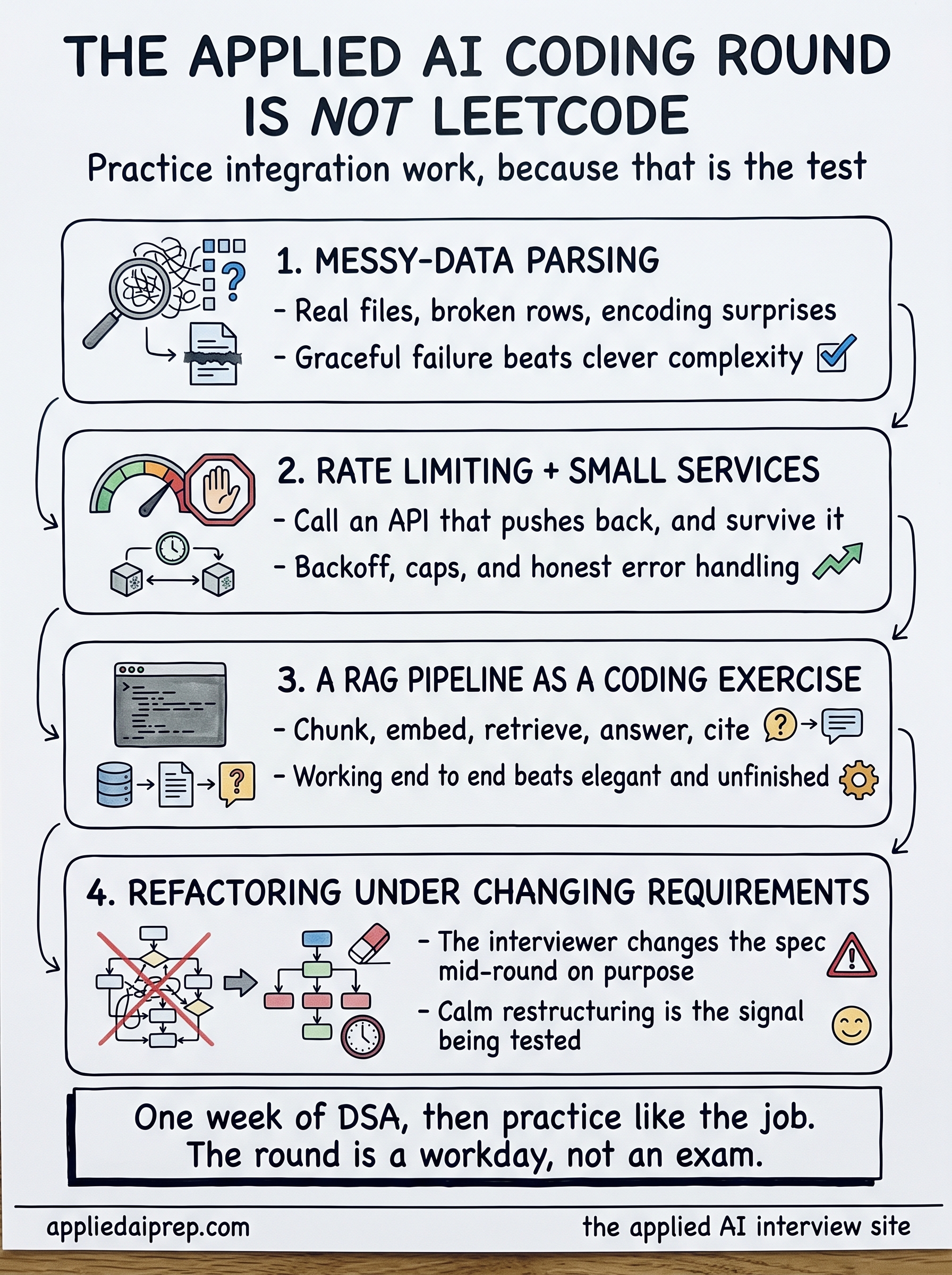
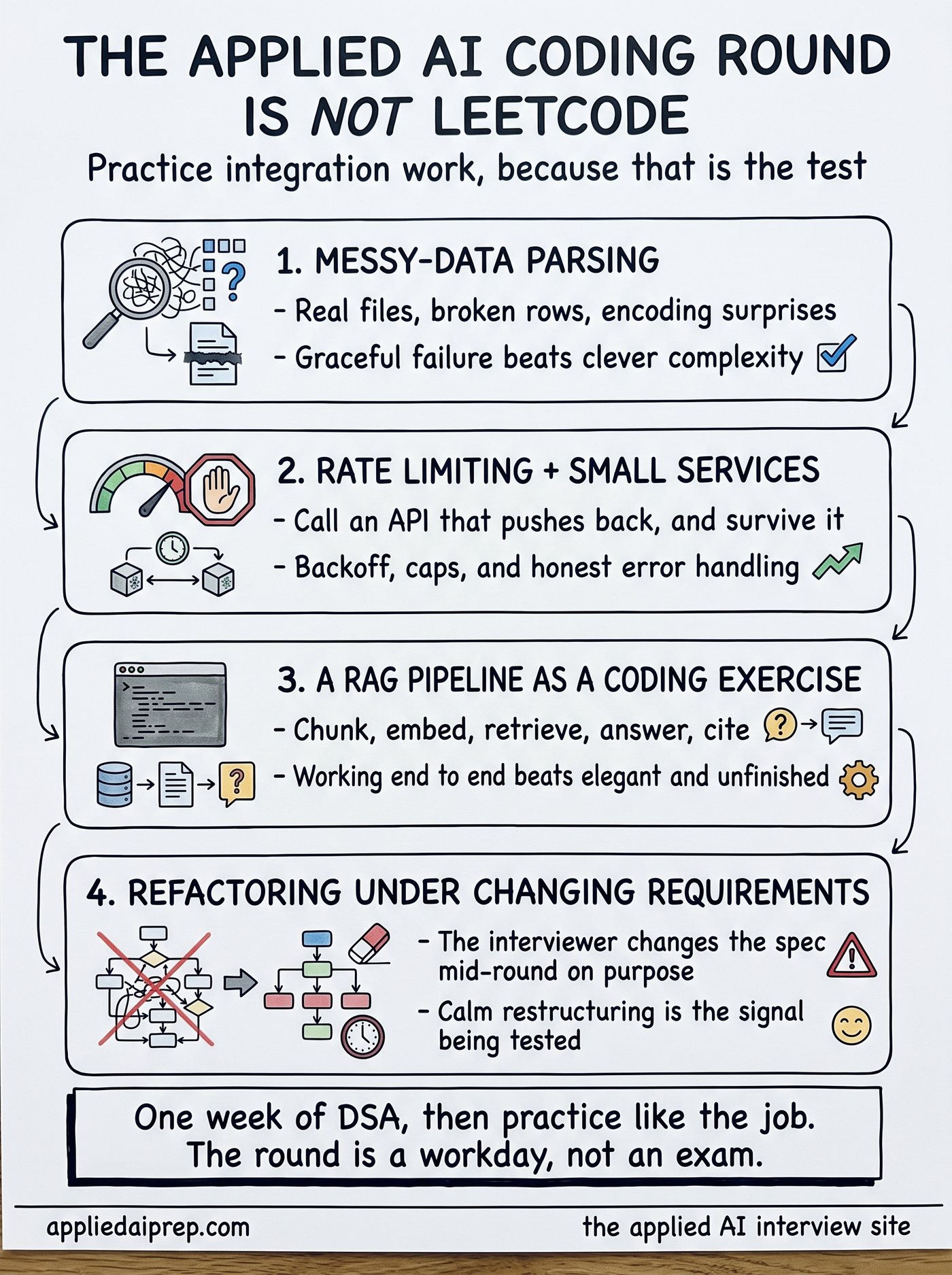
The Applied AI coding interview is not LeetCode, and preparing for it like a traditional algorithm gauntlet is the most common way strong engineers underperform. These rounds test integration work: parsing messy data, building a small service, rate limiting an API, assembling a retrieval pipeline, and refactoring code as the requirements change underneath you. The problems are practical, often multi-stage, and graded on correct, readable, extensible code rather than the optimal trick. You still need the fundamentals, hashing, queues, complexity reasoning, but they are the means, not the point. Below is what actually gets asked and how to practice it.
Why the format is different
The Applied AI and Forward Deployed job is closing the gap between a model that demos and a system that works inside a customer's environment. That work is integration, plumbing, and reliability, not competitive programming. So the coding round looks like the job. Interviewers want to see the code you would actually write when wiring a model into a customer's systems, which means they care about how you handle a malformed input, an evolving requirement, and a latency or rate constraint far more than whether you remember a specific graph algorithm.
This is consistent across the labs and the deployment-heavy shops. Reported problems include an LRU cache extended stage by stage, a token rate limiter, a streaming-response parser, a request batcher, transforming sampled stack data into execution traces, and resource-allocation systems such as GPU credit tracking. None of those are puzzles. All of them are small pieces of real production code. To drill the practical version, work through the coding and data-structures set with that lens.
Messy-data parsing is a real round
A common opener hands you a file or a stream and asks you to make sense of it, and the data is deliberately dirty: inconsistent date formats, missing fields, duplicate rows, mixed encodings. The mistake is to code the happy path and move on. The signal interviewers look for is whether you notice the mess and handle it on purpose.
Decide explicitly what happens to a bad row, drop it, log it, default it, or fail loudly, and say why. State your assumptions about the schema out loud, validate them as you parse, and keep the transformation readable so the next person can extend it. This is exactly the instinct the job runs on, because customer data is never clean, and a candidate who treats malformed input as the main event rather than an afterthought reads as someone who has shipped against real systems.
Rate limiting and small services
A second staple is building a small, correct service under a real constraint. A token rate limiter is the canonical version: implement a limiter that allows N requests per window per key, then extend it. These problems reward clean state management and clear complexity reasoning. You need a sensible structure, a hash of keys to counters or timestamps, a window strategy you can defend, fixed window, sliding window, or token bucket, and an honest account of the tradeoffs between them.
Production thinking earns points here. What happens under concurrency, what happens when the key space grows, what happens at the window boundary. You are not expected to build a distributed system in forty minutes, but you are expected to know where the simple version breaks and to say so. Naming the next failure mode before the interviewer asks is the difference between a passing answer and a strong one.
RAG pipelines as a coding exercise
Increasingly the coding round is a small retrieval pipeline, because that is the modal Applied AI deliverable. You might be asked to take a set of documents and answer questions over them. The weak version jumps straight to naming a vector database and calling it done. The strong version starts upstream: how do you chunk the documents, what makes a result relevant for this use case, how do you retrieve, and crucially, how do you know the answer is good.
Treat retrieval quality and evaluation as part of the problem, not a footnote. Build the smallest pipeline that works end to end, ingest, embed, retrieve, generate, then talk about where it would fail: stale data, poor chunk boundaries, retrieval that returns plausible but wrong context. The judgment about what to retrieve and how to measure it matters more than the specific library. For the design patterns and follow-ups this round leans on, see the RAG and agent set, where retrieval, embeddings, and evaluation come up constantly.
Refactoring under evolving requirements
The most distinctive format is the multi-stage problem that grows. You solve a simple version, then the interviewer adds a constraint, then another, each one stressing whether your first design was clean enough to extend. This directly tests the real job, where the customer changes the brief mid-build, and it is graded as much on your refactoring as on your initial code.
The way through is discipline. Get a correct, working version before you optimize anything, because a clever early structure is the thing that shatters at stage two. When the new requirement lands, narrate the refactor: state what your current design assumes, why the new rule breaks that assumption, and the small change you will make before adding behavior. Premature optimization is the most common rejection on these rounds. Clean and correct, then extend, beats clever and brittle every time.
How to prepare
Stop grinding abstract algorithm sets as your main prep and start building small, realistic things. Write a rate limiter three ways and know the tradeoffs cold. Parse a deliberately dirty CSV and handle every bad row on purpose. Stand up a minimal retrieval pipeline over your own notes and then break it. Take a problem you solved, add a requirement, and refactor without rewriting from scratch. Keep the fundamentals sharp, but practice them inside tasks that look like the job.
Then calibrate against real questions. Start with the must-know Applied AI set, then go deep on practical coding and retrieval and agents. The bar is not whether you can find the optimal solution to a puzzle. It is whether you can write code a customer could run on Monday and you could extend on Tuesday.
Turn it into offers. Work the real questions and concepts this maps to:
FAQ
Mostly no. There is usually a coding stage, but it is practical and integration-flavored: parsing messy data, building a small service, rate limiting, or a retrieval pipeline, often extended across stages as new requirements are added. Pure graph and dynamic-programming puzzles are far less common than in a traditional SWE loop.
Discussion (4)
The single most common rejection on these rounds is not a wrong answer. It is a candidate who optimizes prematurely. They reach for the clever data structure before they have a correct, working version, and then the stage-two requirement breaks it. Get it correct and clean first, every time, then optimize only if asked.
Agreed. And when the requirement changes at stage two, narrate the refactor. 'My current design assumes one key per request, the new rule breaks that, so I am going to pull this into its own method first.' Interviewers score that reasoning, not just the final diff.
On messy data: the trap is assuming the input is clean. A real parsing prompt has inconsistent date formats, missing fields, and duplicate rows on purpose. Handle the malformed row explicitly and say what you do with it, drop, log, or default. Candidates who only code the happy path read as people who have never touched production data.
For the RAG-pipeline style question, do not start by naming a vector database. Start with chunking and what a relevant result even means here, then retrieval, then how you would evaluate it. The judgment about what to retrieve and how to measure it matters more than which library you pick.