
Why Applied AI Engineering Is the Hottest Role of 2026
Applied AI Engineer and Forward Deployed roles are growing faster than almost any title in tech and pay above standard engineering bands. Here is what is driving the surge, who is hiring, and how to break in.
BY ARJUN MEHTA · APPLIEDAIPREP EDITORIAL · UPDATED JUNE 21, 2026 · 8 MIN READ
The Applied AI Engineer is the hottest role of 2026 because it sits exactly where the value is stuck: the gap between a model that demos well and a system that actually works inside a customer's messy production environment. Postings for the role have grown sharply year over year while standard software listings stayed close to flat, and pay runs above equivalent engineering bands. The reason is plain. Enterprises have decided they need AI but cannot deploy it on their own, and the Applied AI Engineer is the person who closes that last mile. This piece covers what is driving the surge, who is hiring, and how to break in.
The role exists because demos are easy and deployments are hard
For two years the industry sold individual productivity. A model wrote your email or finished a function. Useful, but not the kind of change a CFO budgets around. Real value shows up only when an AI system reads from the tools a company already runs, respects a permission model nobody fully documented, survives a compliance review, and still works next quarter.
That work is not a model problem. The frontier models have been good enough for it for a while. It is a deployment problem: the customer's data, their identity and access rules, the integration with systems that were never meant to talk to each other, and an honest way to prove the thing works. The Applied AI Engineer owns all of it. For the concrete version of the day to day, read what an Applied AI Engineer actually does.
The market signal: faster growth and premium pay
A few numbers, all reported and approximate, that explain the heat:
- Applied AI and Forward Deployed listings have grown much faster than standard software listings, which have been roughly flat.
- Compensation runs about 10 to 15 percent above the equivalent software band, and senior base salaries are often cited around 250k to 300k USD.
- At the AI labs, total packages are commonly cited in the 350k to 550k range including equity, with higher numbers at the top.
The pay is high for an unglamorous reason. You have to be a strong engineer and a high-empathy communicator who can carry a large customer relationship without losing the technical thread. That combination is rare, so it is expensive.
Who is hiring
The market splits into three buckets, each with a different trade-off.
AI vendors like OpenAI and Anthropic embed engineers with a small set of high-value customers and push model capability to its edge. These loops are the most selective and pay the most.
B2B scaleups such as Glean, Sierra, and Harvey hire Applied AI Engineers to own enterprise integrations end to end, where the solution generalizes across the customer base. This is often the best place to compound skills.
Deployment-heavy shops in the Palantir lineage offer the highest client exposure and the largest hiring volume as the old systems-integrator model gets disrupted. For a current view, see which companies hire for this.
What actually gets tested, and where to practice
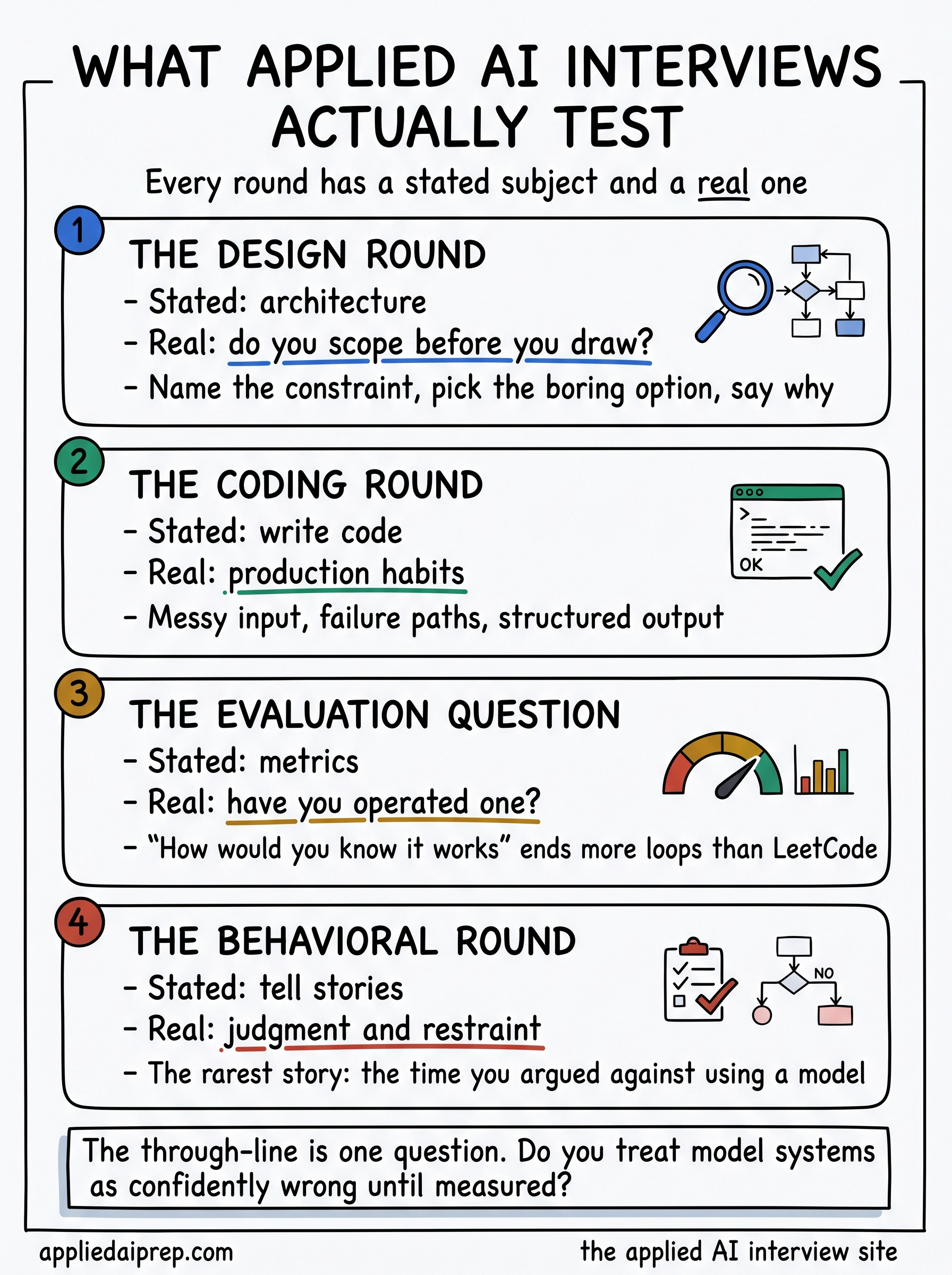
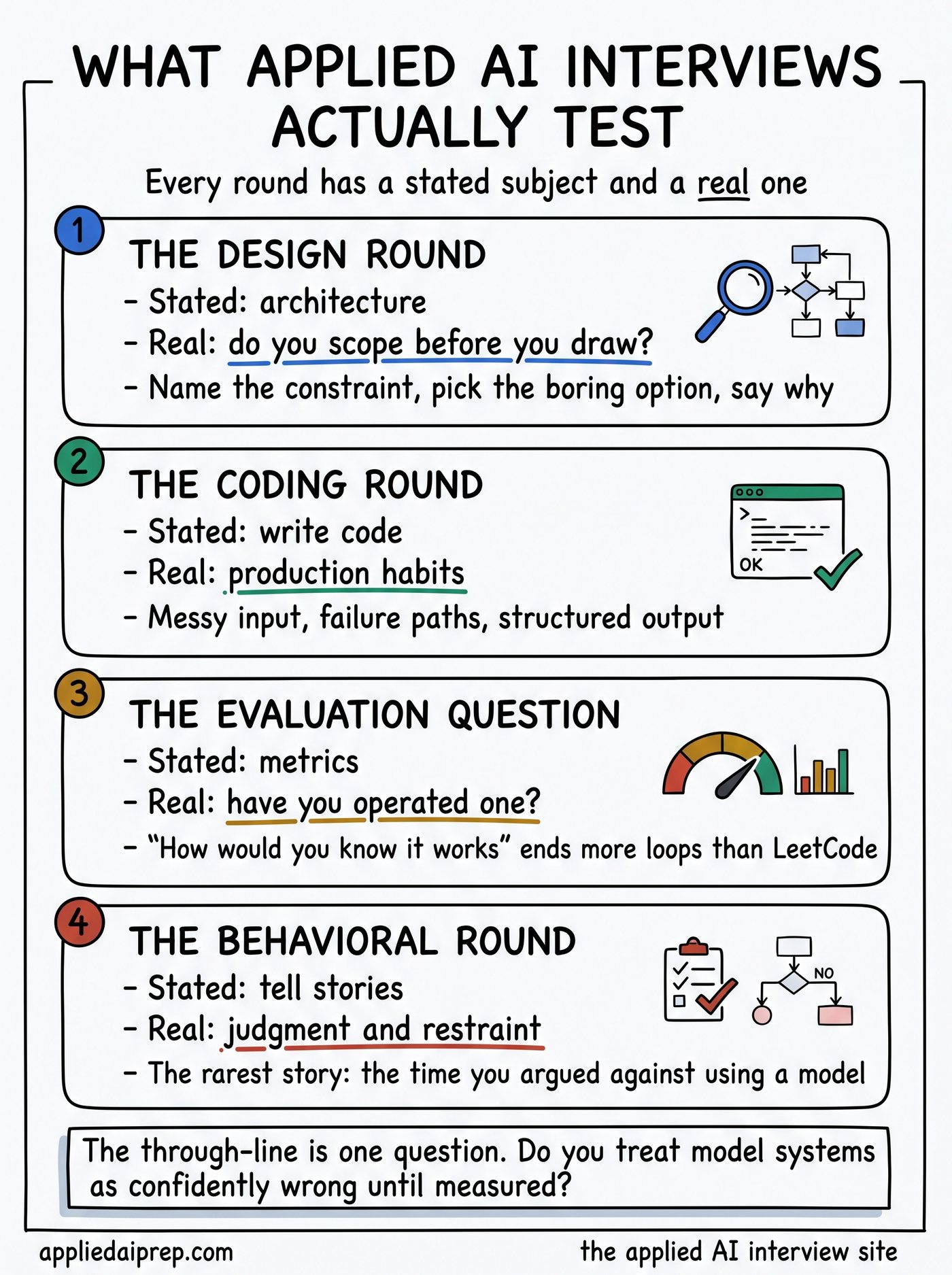
The loop is roughly half technical and half customer judgment. The signature round is an ambiguous case study where a hypothetical customer hands you a vague problem and you decompose it into a plan. It has the lowest pass rate and the highest weight of any stage, and it is where strong coders most often fail, usually by diving into a solution before clarifying the business objective.
The rest rewards production thinking over algorithm trivia: practical coding that looks like real integration work, system design under constraints like a private VPC or a hard latency budget, and an evaluation story that proves the system works. The skills that compound across all of it are retrieval, evaluation, and agent design, plus the communication to defend a trade-off to a non-technical executive.
The fastest way to calibrate is to work real questions. Start with the must-know set, then go deep on RAG and agent system design, which is the modal Applied AI design round.
How to break in
The signals that predict success here are not the ones a big-company resume optimizes for. Founder or early-stage experience beats pedigree, because it predicts comfort owning an outcome instead of a ticket. A teaching or mentoring background is a strong proxy for the customer empathy the role runs on. And the yellow flag, stated plainly by people who hire for this, is a pure big-company background with no early-stage exposure, because that environment trains a wait-for-the-spec reflex that the role punishes.
If you are targeting the role, pick a vertical and go deep enough to understand its failure modes, not just its happy path. A generalist is useful everywhere. A specialist who knows why a regulated customer cares about a specific control becomes the person a deal cannot close without.
The one-line version
The model is the easy part, and it has been for a while. The Applied AI Engineer owns the hard part: the customer's data, permissions, people, and the distance between what they asked for and what they need. That is why the role is exploding, and why it is worth preparing for properly.
Turn it into offers. Work the real questions and concepts this maps to:
FAQ
No. A solutions or sales engineer mainly supports the sale, then hands off the build. An Applied AI Engineer writes and ships production code inside the customer's environment and owns whether it works, which is why the bar and the pay sit closer to a senior or staff engineer than a pre-sales role.
Discussion (5)
One thing this understates: the role is partly a hedge for the labs. When a frontier model plateaus, the differentiator becomes who can deploy it best inside a real company, and that is the Applied AI Engineer. Candidates who say that out loud in the motivation round tend to stand out.
Seconding this. It is also why scaleups, not just the labs, are hiring for this now. The model is a commodity, the deployment is the moat.
Honest question: is the case-study round really harder than the coding? I keep grinding LeetCode and feel behind on it.
Yes. Across reported loops the ambiguous case study has the lowest pass rate and the highest weight. LeetCode is necessary but rarely the reason strong engineers get rejected. Practice scoping a vague customer problem out loud, and clarify before you architect.
If you are picking a vertical, regulated industries like financial services and healthcare have the fastest-growing demand, because the deployment complexity (compliance, legacy integration) is exactly what a generalist cannot solve. Learn one domain's failure modes cold.