
Anthropic Applied AI Engineer Interview: The Loop, the Coding Assessment, and the Values Round (2026)
A round-by-round guide to the Anthropic Applied AI Engineer and Forward Deployed loop: the CodeSignal coding assessment, the Claude deployment and MCP rounds, enterprise system design, and the AI-safety values round that fails the most candidates.
BY MEI LIN AND HANNAH BRYANT · APPLIEDAIPREP EDITORIAL · UPDATED JUNE 21, 2026 · 9 MIN READ
The Anthropic Applied AI Engineer interview is a five-stage loop, roughly four to six weeks, that weighs three things in near-equal measure: practical engineering, reliable Claude deployment inside a customer's environment, and an honest, specific point of view on AI safety. The technical rounds give you live access to Claude and a Model Context Protocol scenario, where reasoning toward a reliable production workflow matters more than a clean algorithm. The values round counts as much as the technical stages and is the most common reason candidates fail. Expect a recruiter screen, a Python-heavy CodeSignal coding assessment, a hiring-manager deep dive, a technical loop with live coding and enterprise system design, and a behavioral and values round. There is no salary negotiation; equity is in PPUs.
The loop, stage by stage
A representative process:
- Recruiter screen. Non-trivial. Mission alignment is tested here and you can fail it. References are treated as real evaluation and may be requested early.
- Coding assessment. A multi-part CodeSignal, graded by a black-box evaluator, with near-perfect correctness to advance.
- Hiring-manager call. A deep dive on one project: why you chose an approach, how it scaled, when an LLM fit and when it did not.
- Technical loop. Live coding in a shared Python environment, an enterprise system-design round, and for applied roles an LLM-practical round (prompting, multi-step reasoning, LLM APIs, guardrails).
- Values round on AI safety. Constitutional AI principles, the Responsible Scaling Policy, and your honest critique. The highest-failure stage.
The recruiter screen is heavier than most. It covers Anthropic's status as a Public Benefit Corporation and tests whether your interest is grounded in actually using the products. "Which Claude models have you used, and what stood out" is a real opener, and a vague answer reads as a red flag.
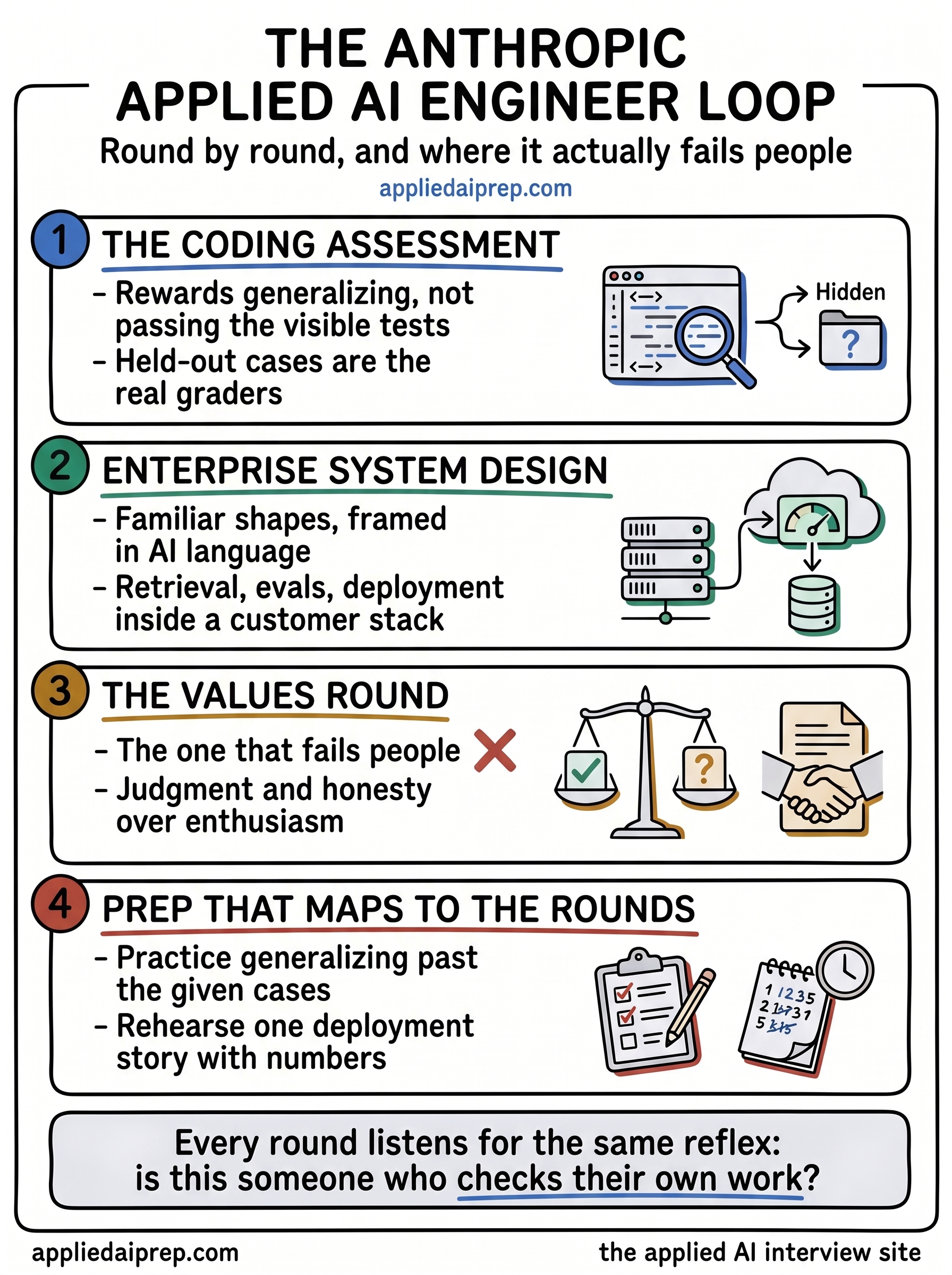
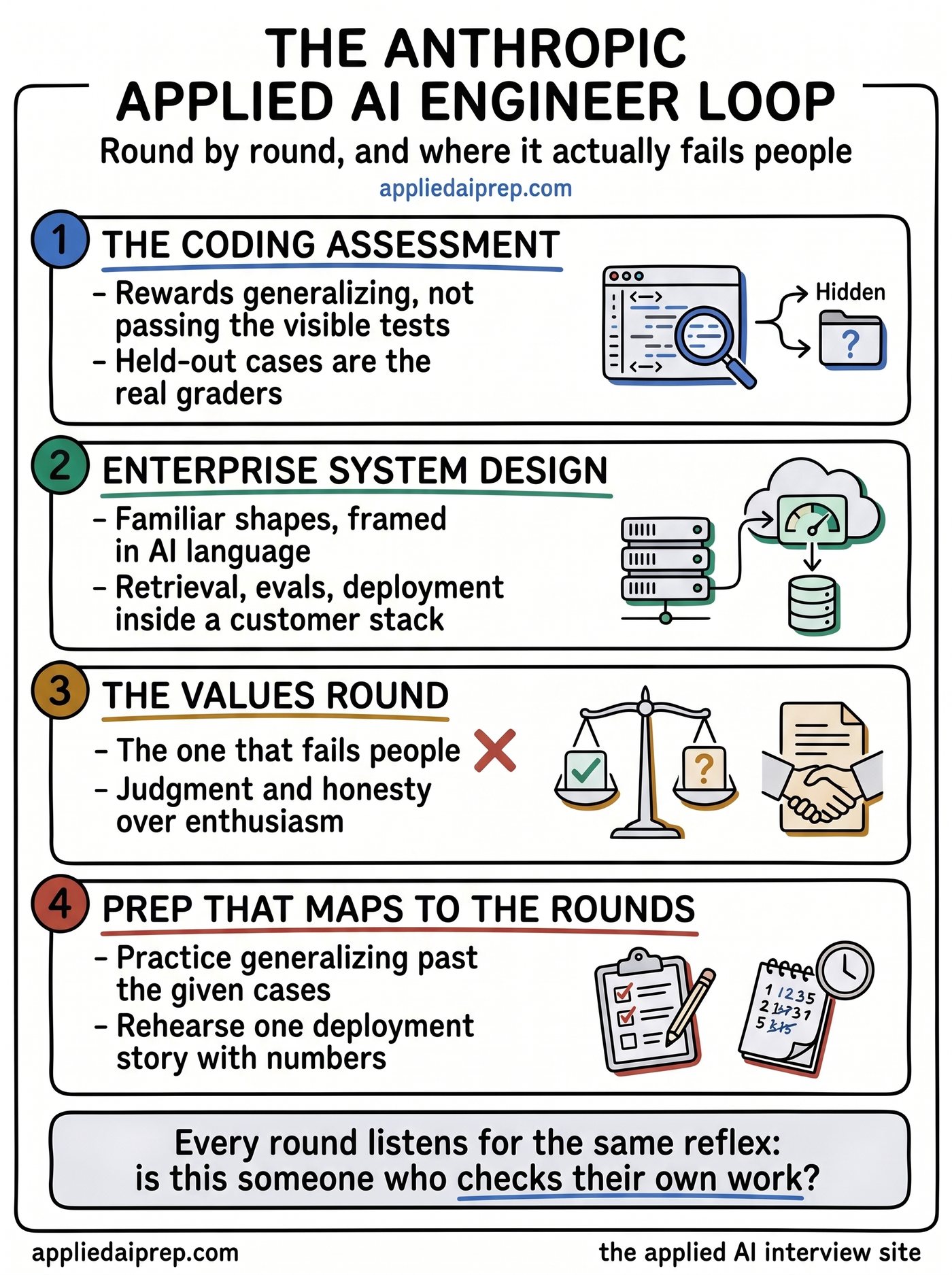
The coding assessment rewards generalizing, not passing the visible tests
The coding assessment is a roughly 90-minute, Python-heavy CodeSignal (a 60-minute live version exists). It is multi-part and builds progressively: each stage layers a new requirement that forces you to refactor your earlier code. The grading is against a black-box evaluator, so solutions that only satisfy the examples you can see tend to fail. A widely reported problem is a bank transaction system; an LRU cache extended stage by stage is another common shape.
What carries the round: code that adapts cleanly as constraints accumulate, speed and correctness under time pressure, passing tests including edge cases, and clear narration of your decisions. The held-back signal is generalization. Anthropic explicitly screens for first-principles, robust code over LeetCode recitation, and for solutions that would survive inputs the visible tests never showed. Drill the build-then-refactor pattern against our coding and data-structure questions.
Enterprise system design, framed in AI language
The system-design round is grounded in a customer scenario: exposing an API that lets a customer sample from large generative models, batching that API efficiently, or handling security and compliance when deploying Claude for a regulated customer like a government contractor. Anthropic frames these prompts in AI language, but the underlying challenge is often a practical infrastructure or orchestration question (LLM serving, sharding, inference scaling, hybrid search over a billion documents).
You are expected to drive. Scope the prompt yourself, name failure modes before you are asked, and make tradeoffs explicit. Waiting for the interviewer to narrow the problem reads as a weakness at this level, because customer discovery is part of the job. That clarify-before-you-architect habit is graded on its own in the labs' ambiguous case study, which we break down in the Applied AI case-study round guide. Security and compliance in regulated environments is a recurring theme, so the AI security and governance set and the system design questions are the right preparation. For the applied-LLM round, the modal material is retrieval, agents, MCP tooling, and context management, covered in the RAG and agents set.
The values round is the one that fails people
This is the round that most distinguishes Anthropic, and the one where strong technical candidates most often get deselected. Nontechnical interviewers often run the values portion. It opens with "why Anthropic" and moves into moral conflict, executive pressure, and tough feedback, probing your reasoning and how you felt during past conflicts. The questions reach into personal territory a standard behavioral screen never covers: a time you built something that went against your values, your honest critique of Anthropic's direction, a time you received hard feedback and a time you had to give it.
The mistake is treating it as an enthusiasm check. Anthropic invites genuine skepticism about its mission, so an honest, critical answer holds up better than a polished one with no real position underneath. A dismissive attitude toward AI safety is an immediate disqualifier. Read Anthropic's published views on AI safety, form a real opinion including where you would push back, and bring structured stories about gray areas and times you were wrong. Be ready to name how you felt, not just narrate the actions.
A prep plan that maps to the rounds
- Ship a production-style Claude workflow (MCP tooling, sub-agents, agent skills) and be ready to explain your reliability and context-management choices.
- Practice incremental, multi-stage coding where each round adds a constraint, focusing on clean refactoring and generalizing past the visible tests.
- Prepare enterprise design scenarios: security, compliance, and API orchestration for regulated customers.
- Read Anthropic's AI-safety views and form an honest opinion, including where you disagree.
- Prepare emotionally honest stories about moral conflict, executive pressure, tough feedback, and times you were wrong.
For the full breakdown of Anthropic's stages, signals, tool policy, and timeline, see our Anthropic interview process page. When you are ready to pressure-test the technical side, start with the must-know question set.
The one-line version
Anthropic wants robust code that generalizes, reliable Claude workflows inside a real customer environment, and a genuine, defendable point of view on AI safety. The technical bar is high, but the values round is where the loop is most often won or lost. Prepare for honesty, not performance.
Turn it into offers. Work the real questions and concepts this maps to:
FAQ
The values round on AI safety. It is widely reported as the highest-failure stage of the loop, and strong technical candidates get deselected there. It probes honest engagement with Anthropic's mission, ethical reasoning under pressure, and how you felt during past conflicts. A rehearsed, enthusiastic answer fails it. A specific, critical, genuine one passes.
Discussion (5)
The values round is not a culture-fit formality and it is not asking you to recite the Responsible Scaling Policy. It wants to see you reason honestly about a hard tradeoff, including where you disagree with Anthropic. Candidates who treat it as a final-boss enthusiasm check fail. Bring a real, structured story about a moral gray area and be ready to name how you felt, not just what you did.
This matches what I have seen. The tell is when someone gives a polished STAR story with no emotional content and no genuine point of view. A dismissive attitude toward safety is an instant no. So is a fully rehearsed answer with nothing real underneath.
On the coding assessment: people underestimate how much the black-box grader punishes solutions that only pass the visible cases. It rewards generalizing the problem, not hardcoding to the examples. Practice the kind of multi-stage problem where stage three forces you to refactor stages one and two.
Right. And narrate as you go even on the async assessment if there is a recording. Clean, adaptable structure beats a clever one-liner that breaks the moment a new constraint arrives.
For the technical loop, the MCP and long-context reliability piece is real and specific. Have a concrete answer for managing the context window on a large document and for making a long-running task survive a timeout. Generic 'I would use RAG' is not enough at this bar.