
The 6-Week Applied AI Interview Prep Plan
A concrete week-by-week plan to prepare for an Applied AI Engineer interview across the three things that decide it: handling ambiguity, production engineering, and customer communication.
BY MEI LIN · APPLIEDAIPREP EDITORIAL · UPDATED JUNE 21, 2026 · 9 MIN READ
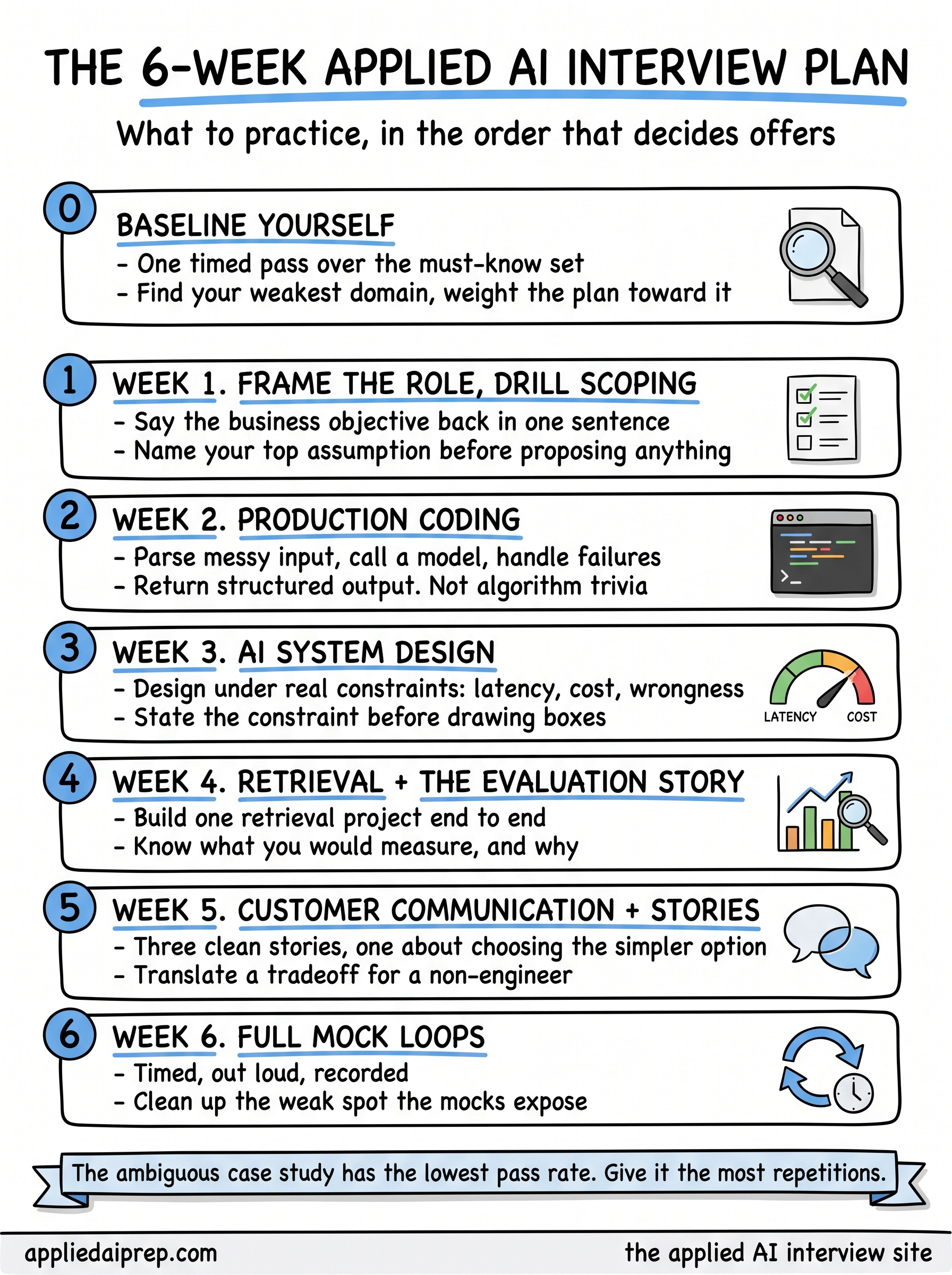
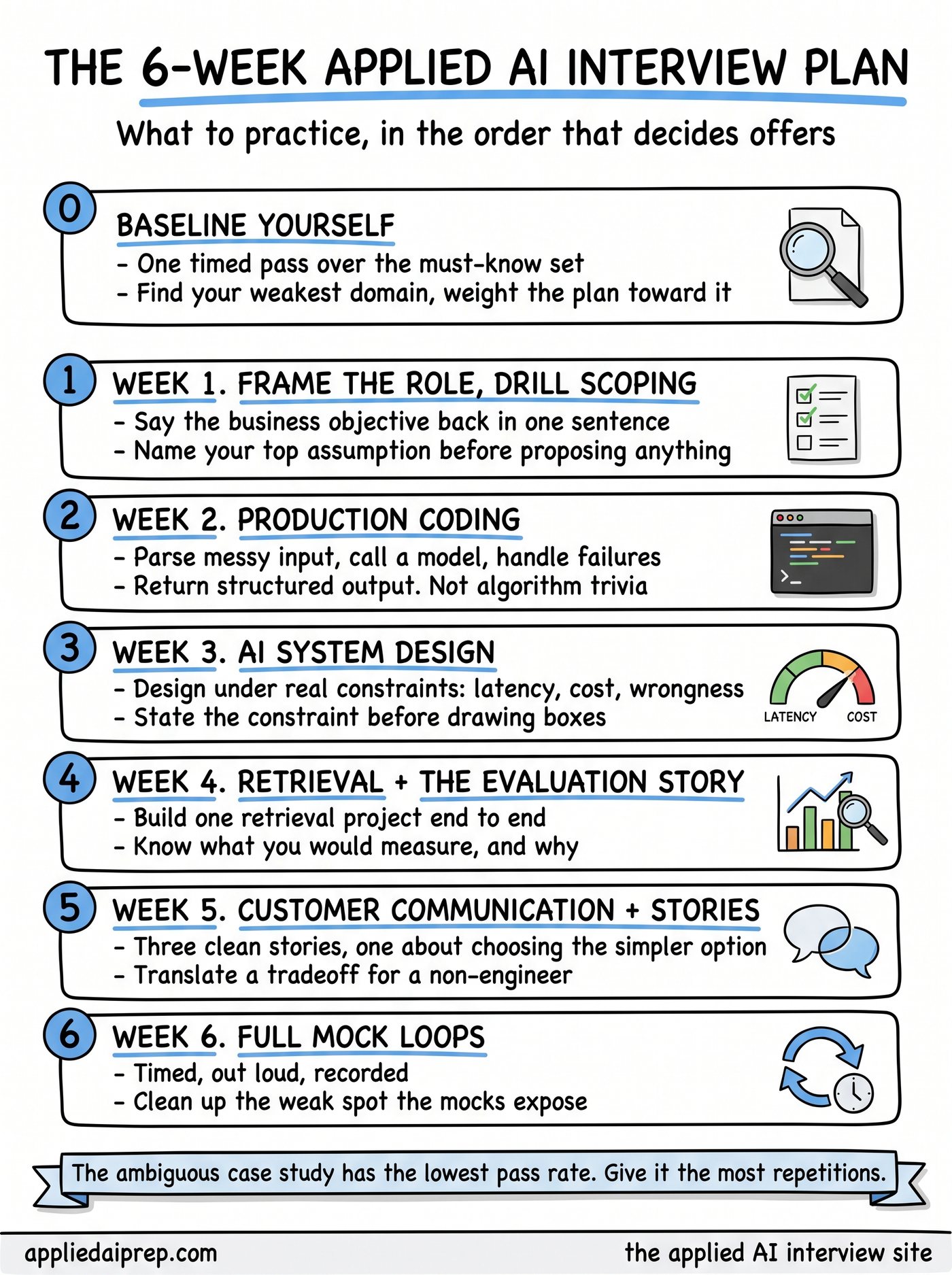
A realistic 6-week plan for an Applied AI Engineer interview spends roughly one week framing the role and baselining your gaps, two weeks on production coding and AI system design, one week on retrieval and evaluation, one week on customer communication and behavioral stories, and a final week on full mock loops. The plan is built around the three things that actually decide the offer: how you handle ambiguity, whether your engineering survives production constraints, and whether you can carry a customer through a hard conversation. Spread the work so the lowest-pass-rate round, the ambiguous case study, gets the most repetitions. Below is the week-by-week version with what to practice and where.
Before week one: baseline yourself honestly
Do one timed pass over the must-know question set before you plan anything. The point is not to score well. It is to find which of the three domains is weakest, so you can weight the six weeks toward it instead of spreading effort evenly. Most strong software engineers discover the gap is scoping and communication, not coding. Read the interview process overview once so you know which rounds you are training for and in what order they usually come.
Week 1: Frame the role and drill scoping
This week is about the ambiguity domain, because it is where the loop is won or lost. The signature round hands you a vague customer problem and watches how you decompose it.
Practice the reflex of clarifying before architecting. For each prompt, write the business objective in one sentence, list three assumptions, and name the one question whose answer most changes your design. Then, and only then, sketch a plan.
Work through the behavioral and customer-judgment questions that involve undefined problems. Aim for five scoping reps by Friday. Record yourself on at least one and listen back for the moment you jumped to a solution too early. That moment is the habit to kill.
Week 2: Production coding, not algorithm trivia
Shift to the engineering domain. The coding round in an Applied AI loop rarely looks like a classic algorithm puzzle. It looks like integration work: read a messy file or API response, call a model, handle the failure cases, and return clean structured output.
Spend one focused session refreshing core data structures so nothing trips you up, then put the rest of the week into realistic tasks. Pull from coding and DSA for the fundamentals and treat each problem as if it were a customer integration. Add retries, timeouts, and a sane error path every time, because that is the signal interviewers grade.
By the end of the week you should be able to wire a small end-to-end script: input, model call, validation, output, with the failure modes handled out loud.
Week 3: AI system design under real constraints
Still in the engineering domain, now at the architecture level. The modal Applied AI design round is a retrieval or agent system with hard constraints: a private VPC, a tight latency budget, a fixed cost ceiling, or a compliance boundary.
Go deep on RAG and agent system design. For each design prompt, force yourself to state the constraint first, then defend a specific choice: chunking strategy, when to add an agent loop versus a single call, how you keep a vector database fresh, where the latency budget gets spent. Practice naming the trade-off you are accepting, not just the option you picked.
Pair this with a quick refresher on the underlying LLM and GenAI fundamentals so you can answer the "why" follow-ups, like why a particular retrieval choice helps or hurts grounding.
Week 4: Retrieval depth and the evaluation story
This week makes your week-three designs credible. Anyone can draw a retrieval pipeline. The candidates who pass can prove it works.
Build or extend one real project: a small retrieval system over a document set you care about, with an honest evaluation harness. Define what correct means, assemble a tiny labeled set, and measure. Be ready to explain what you would do when the eval score is mediocre but the demo looks impressive, because that follow-up comes up constantly.
Keep working RAG and agent questions, but bias toward the evaluation and failure-analysis ones. An evaluation story you actually ran beats any amount of theory.
Week 5: Customer communication and behavioral stories
Now the communication domain gets its dedicated week. Half the loop is judgment, and this is where strong coders most often lose the offer.
Prepare four or five stories using the behavioral and customer-judgment prompts. Each should show one of: scoping an undefined problem, owning an outcome end to end, handling a customer who wanted the wrong thing, or making a trade-off call under pressure. Drop vague team narratives. Use stories where you owned the result.
Then practice defending a technical trade-off to a non-technical stakeholder in plain language. If you cannot explain why you chose a smaller model to a budget-conscious executive in three sentences, keep rehearsing.
Week 6: Full mock loops and weak-spot cleanup
The final week is integration. Run two or three full mock loops that chain a case study, a coding task, a design discussion, and a behavioral round back to back, because fatigue and context-switching are part of the real test.
After each mock, return to the must-know set and your weakest category and patch the specific gap the mock exposed. Do not learn anything new this week. Polish what you have and rehearse your scoping opener until it is automatic.
The one-line version
Six weeks is enough if you weight them by what the loop actually grades: most reps on scoping ambiguity, real production engineering instead of algorithm trivia, a retrieval project you can defend with a real evaluation, and customer stories where you owned the outcome. Train the rare combination, not the easy half.
Turn it into offers. Work the real questions and concepts this maps to:
FAQ
For an engineer already working in software or ML, yes. Six weeks of focused practice across scoping, production coding, and communication is enough to be competitive. If you are starting from no production AI exposure, plan for eight to ten weeks and spend the extra time building one retrieval or agent project end to end.
Discussion (5)
The single highest-leverage habit in this whole plan is the one most people skip in week one: before you propose any solution, say the business objective back in one sentence and name your top assumption. Interviewers are listening for exactly that reflex.
Agreed. I tell people to literally start the case study with 'Before I design anything, let me make sure I understand what success looks like for this customer.' It buys you credibility and thinking time at once.
One addition to week four: when you build your evaluation story, write down what you would do if the eval score is mediocre but the demo looks great. That tension is a favorite follow-up and most candidates have no answer ready.
If you are time-boxed, do not try to do all six weeks at half intensity. Cut scope instead. A candidate who has genuinely mastered scoping, one solid project, and three clean stories beats one who skimmed everything.
This. Depth on the case study round and one real project will carry a loop further than broad shallow coverage of ten topics.