
A Day in the Life of an Applied AI Engineer
What the work actually feels like: customer calls, building integrations, running evals, travel, and constant context-switching. An honest hour-by-hour look at a real Applied AI Engineer's day.
BY MEI LIN · APPLIEDAIPREP EDITORIAL · UPDATED JUNE 21, 2026 · 9 MIN READ
A typical day for an Applied AI Engineer is roughly half building and half everything else: customer calls, scoping ambiguous problems, running evals, and switching context far more than a standard engineering role. You are not heads-down in one codebase. You are moving between a customer's messy environment, your own product code, and the people on both sides who need the deployment to work. The work feels less like solving a clean problem and more like steering a real outcome through real constraints. This is an honest, hour-by-hour picture of what that actually feels like, including the parts that are draining. For the formal scope of responsibilities, see what an Applied AI Engineer does. This piece is about the texture of the day.
Morning: triage before you build
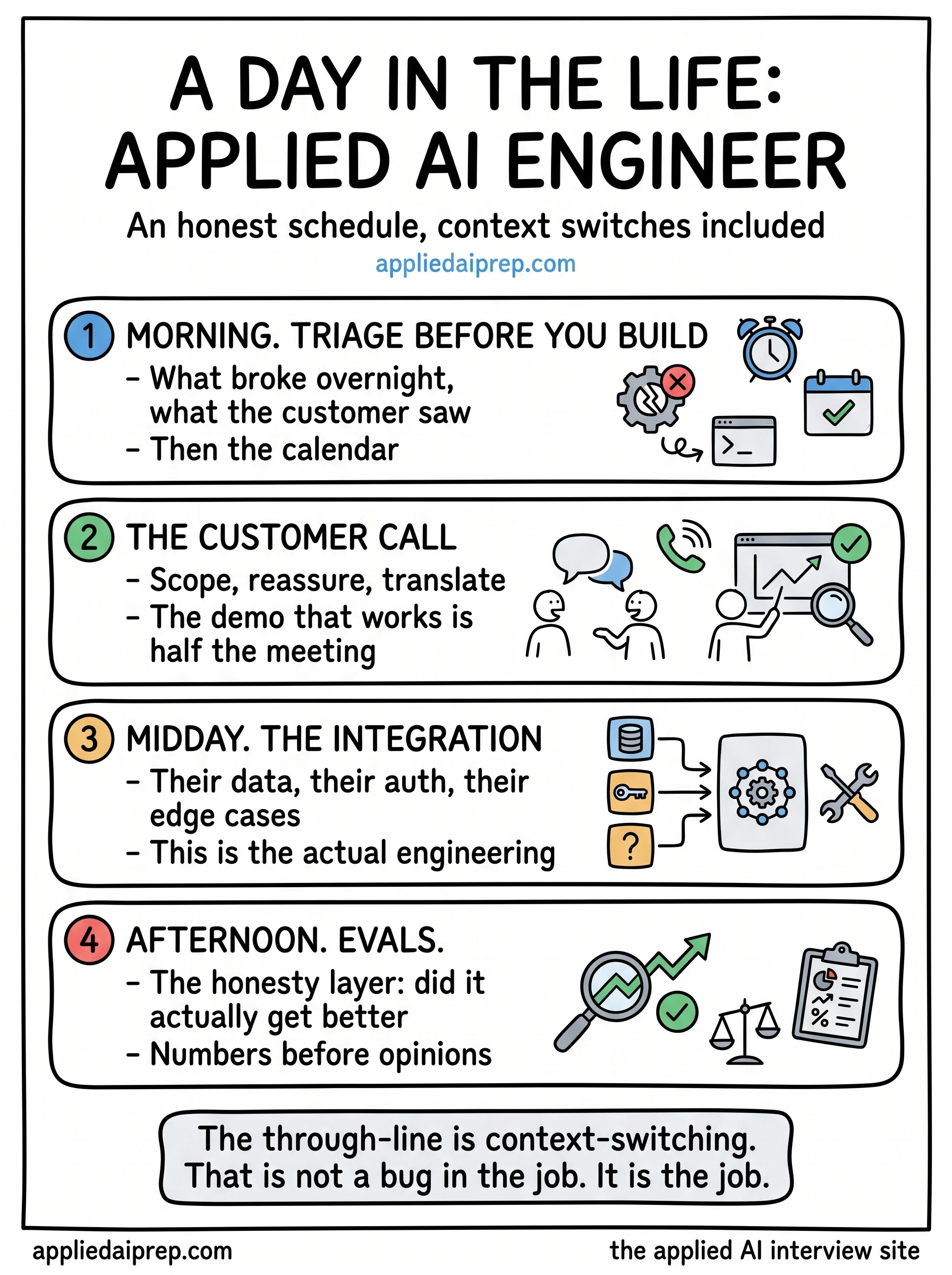
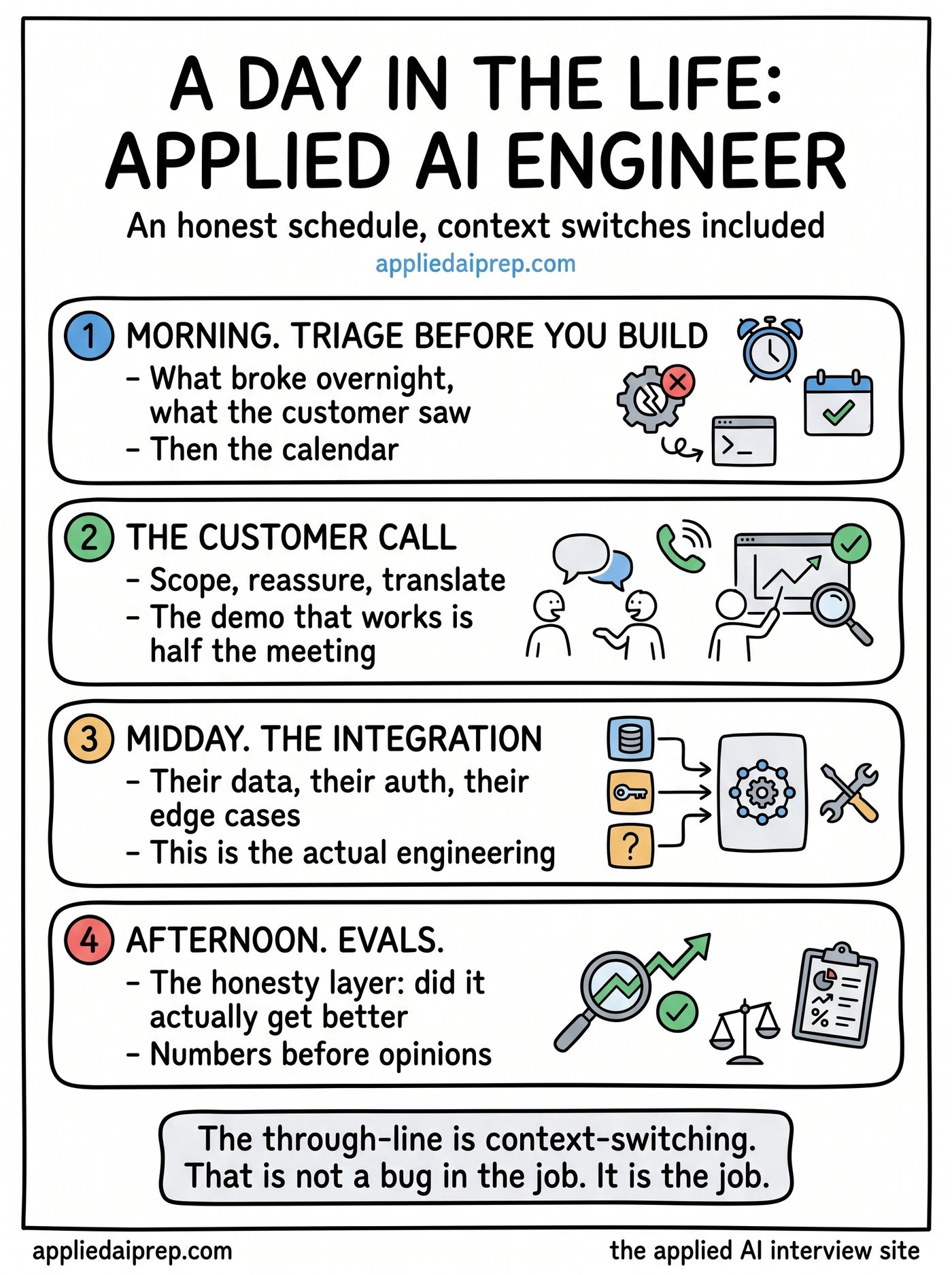
The day usually starts with triage, not code. Overnight a customer's pipeline may have failed, a model update may have shifted your eval scores, or an account may have sent a list of issues. Before you open your editor you are scanning channels, deciding what is urgent versus loud, and protecting whatever deep-work block you can salvage.
A useful habit that experienced Applied AI Engineers share: keep a short state note per account. Two lines, what is true now and what the next action is. When you return to a thread four hours and three fires later, you are not re-deriving the whole situation. This sounds trivial and it quietly saves the day, because the role's real tax is not any single problem, it is the cost of reloading context.
Late morning: the customer call
Most days include at least one customer call, and it is where the job differs most from standard engineering. Sometimes it is a working session with the customer's engineers, mapping their identity and access rules or untangling why a system that was never meant to expose data needs to. Sometimes it is a screen share where you watch them use the product.
That screen share is often the most valuable half hour of the week. Every awkward workaround a customer has quietly invented is a roadmap item. Watching where their mouse hesitates tells you more than their written feature requests. Plenty of planned features die after one of these sessions, which is a good outcome: you avoided building the wrong thing.
And some calls are hard. A customer is frustrated, a deadline is slipping, and you have to hold the relationship steady while solving the technical problem underneath it. Staying sharp while the temperature is high is a real skill, and it is learnable, but it is part of the work rather than an exception to it.
Midday: building the integration
This is the block that looks like classic engineering, and it is the part many people picture when they imagine the role. You are wiring the product into the customer's environment: connecting to systems that were never designed to talk to each other, handling their auth model, making retrieval work against their actual documents instead of a clean demo corpus.
The work rewards production thinking over algorithm trivia. You care about idempotency and retries because the customer's network is flaky. You care about latency budgets because their users will abandon a slow response. You care about embeddings and chunking choices because their documents are weirder than any benchmark. Realistically this is 40 to 60 percent of the day, and it shrinks in a heavy customer week. People who expect to code most of the day are the ones who burn out, because the calendar fights them.
Afternoon: evals, the honesty layer
A recurring afternoon task is evals: building and running the evaluation that proves the system actually works for this customer, not just in a demo. This is the part that separates a deployment from a science project.
You assemble a representative set of the customer's real inputs, define what a correct answer looks like for their use case, and measure against it so that when a model or prompt changes, you can see whether quality moved. A model update that looked like a free upgrade can quietly drop your accuracy on the customer's edge cases, and the eval is how you catch it before they do. Treating evaluation as a first-class deliverable, not an afterthought, is one of the clearest markers of a strong Applied AI Engineer.
The through-line: context-switching is the job
If there is one feeling that defines the day, it is context-switching. You might hold three accounts in your head at once, each at a different stage, while also shipping product code that generalizes across all of them. This is energizing for some people and exhausting for others, and it is worth knowing which you are before you take the role.
The engineers who sustain it build systems for it rather than relying on willpower: tight per-account notes, ruthless prioritization of urgent versus loud, and a few protected hours of deep work that they batch around the customer chaos. The ones who struggle try to be reactively available to everyone all day, which is the fast path to fried.
Travel and where you sit
Travel varies more than any other part of the role. At deployment-heavy firms in the Palantir lineage, on-site time can run several days a month, sometimes a full week embedded at a strategic account. At the AI labs and many scaleups, it is mostly remote with occasional on-sites for kickoffs or escalations. There is no single answer, so ask about the expected cadence in the interview. The same title can mean home-office-most-weeks or living-out-of-a-bag depending on the company's model.
What the day adds up to
By evening, a good day means a customer is a little closer to depending on your system, you shipped something real, and you protected enough focus to do it well. The work feels like steering an outcome through constraints rather than solving a tidy problem, and the satisfaction is proportionally different: less the elegance of the code, more the fact that a real workflow now runs on something you built and owned end to end.
If that rhythm appeals to you, the fastest way to prepare for the interview is to work the questions that mirror it. Start with the must-know set, then go deep on RAG and agent system design and the behavioral and project deep-dive rounds, which test exactly the judgment this day demands. To see how the daily work maps to the formal role, the responsibilities guide is the companion to this piece.
The one-line version
Half building, half everything else, with context-switching as the constant. The job is steering a real customer outcome through real constraints, and the people who love it are the ones who find that more satisfying than a clean codebase.
Turn it into offers. Work the real questions and concepts this maps to:
FAQ
Roughly half, often less in a heavy customer week. A common split is around 40 to 60 percent building and debugging, with the rest going to customer calls, scoping, evals, and internal coordination. People who expect to code most of the day are the ones who burn out fastest, because the calendar fights them constantly.
Discussion (5)
The thing nobody tells you: the most valuable hour of my week is usually not coding, it is the 30 minutes watching a customer use the thing on a screen share. Every painful workaround they have quietly invented is a roadmap item. I have killed entire planned features after one of those sessions.
Strongly agree. I started recording those sessions (with permission) and replaying them for my team. It cut our build-the-wrong-thing rate noticeably. The customer's mouse hesitation tells you more than their feature requests.
On context-switching: the single best habit I picked up was writing a two-line state note before I close any customer thread. What is true now, what is the next action. When I come back four hours later after three other fires, I am not re-deriving the whole situation from scratch. Sounds trivial, saves the day.
This is underrated. I keep mine per-account in one doc. The compounding benefit is that it doubles as your renewal-time evidence of everything you shipped for them.
Worth saying plainly for people considering the role: if a customer being upset on a call ruins your afternoon, this job will be rough. The calls where someone is frustrated are not the exception, they are part of the work, and staying technically sharp while the temperature is high is the actual skill. It is learnable, but go in expecting it.