
Prep Mistakes That Cost Strong Engineers the Applied AI Offer
Strong engineers fail Applied AI loops for predictable reasons: over-indexing LeetCode, jumping to a solution before scoping, ignoring evaluation, and having no customer-empathy stories. Here is how to avoid each trap.
BY ADAM REYES · APPLIEDAIPREP EDITORIAL · UPDATED JUNE 21, 2026 · 9 MIN READ
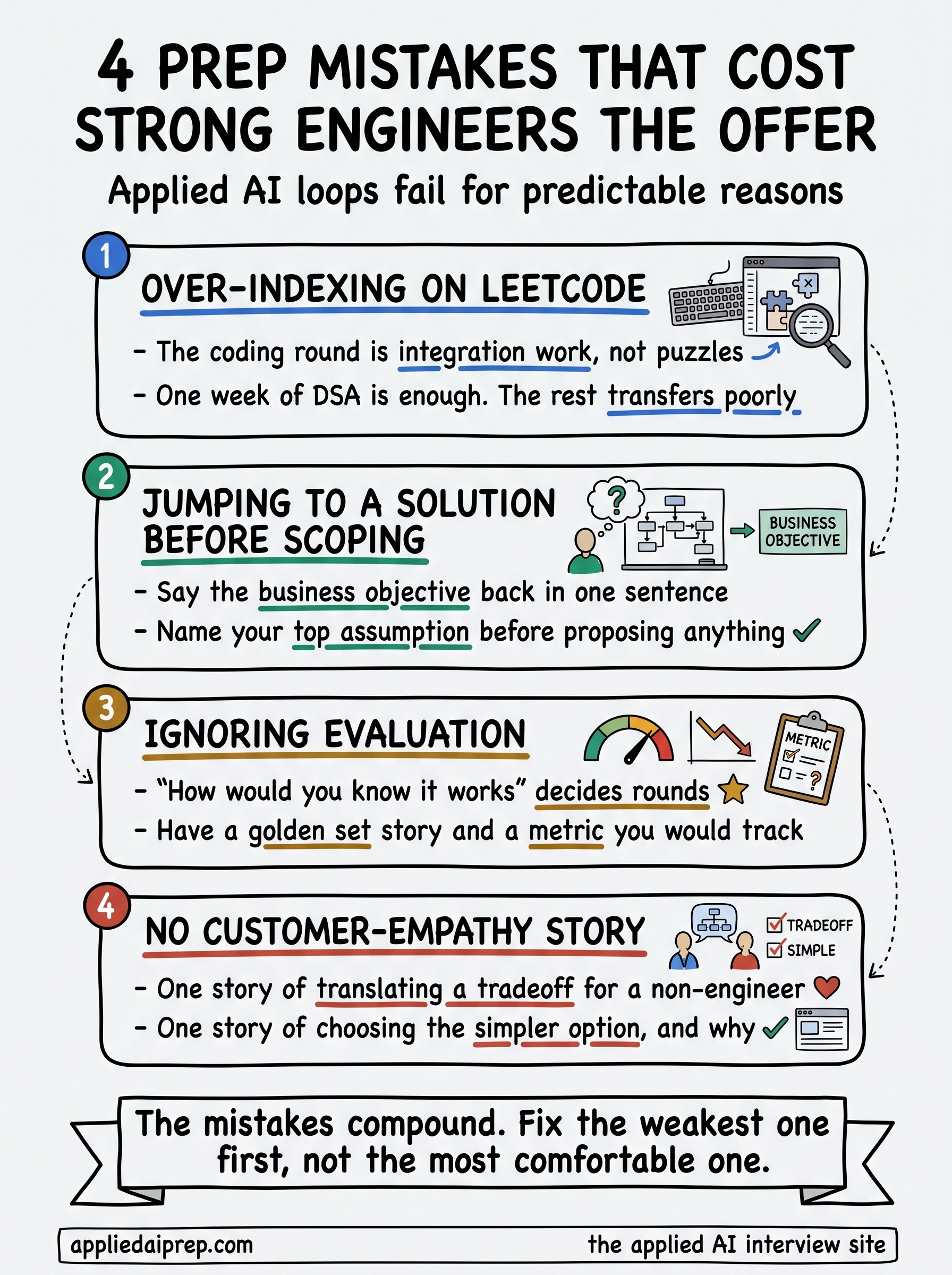
Strong engineers lose the Applied AI offer for a short list of predictable reasons, and almost none of them are raw coding ability. The four that cost the most offers: over-indexing on LeetCode at the expense of scoping practice, jumping to a solution before understanding the customer problem, ignoring evaluation and confusing a demo with a deployment, and walking in with no customer-empathy story. Each one is avoidable once you can name it. This piece walks through the four traps, why each is fatal in this specific loop, and what to do instead.
Mistake 1: over-indexing on LeetCode
The most common preparation error is treating an Applied AI loop like a standard software loop and pouring weeks into competitive programming. The coding round here usually does not look like a graph puzzle. It looks like integration work: parse a messy API response, call a model, handle the failure cases, and return clean structured output.
You still need a baseline. Fumbling basic data structures will sink you. But past that baseline, every extra LeetCode hour returns less than an hour spent elsewhere. Spend enough time in coding and DSA to be fluent and unflustered, then stop. The candidates who allocate ten hours to algorithms for every one hour on scoping have it exactly backwards.
The fix is allocation. Treat coding fluency as a prerequisite to clear, not the event itself, and move your marginal hours to the rounds with the lowest pass rates.
Mistake 2: jumping to a solution before scoping
This is the single most expensive habit, because it fails the round that carries the most weight. The signature Applied AI stage is an ambiguous case study: a hypothetical customer hands you a vague problem and the interviewer watches how you decompose it. Strong coders fail it by hearing two sentences and immediately proposing an architecture.
The trap has a subtle version too. Some candidates do ask clarifying questions, but they ask about technical details like chunk size or vector dimension before they have established what success means for the customer. Asking sharp implementation questions while skipping the business objective still reads as diving in too early.
The fix is a fixed opener. Before proposing anything, say the business objective back in one sentence, name your top assumption, and ask the one question whose answer most changes your design. Practice it against the open-ended prompts in behavioral and customer-judgment until it is automatic. Read the interview process breakdown to see how heavily this round is weighted.
Mistake 3: ignoring evaluation
Proving a system works is the core of the job, so a prep plan that never touches evaluation leaves the most important muscle untrained. A candidate who designs a clean retrieval pipeline but cannot describe how they would measure whether it answers correctly is signaling the exact gap the role exists to close: confusing a demo with a deployment.
This shows up as a missing step. The candidate designs a system, then says "and then I'd ship it" with nothing in between. There is no offline eval set, no notion of what correct means, no plan for the case where the eval score is mediocre but the demo looks great.
The fix is to build one real evaluation story before the loop. Take a small retrieval or agent project, define correctness, assemble even fifty labeled examples, and measure. Work the evaluation and failure-analysis questions in RAG and agent system design so you can talk about grounding, hallucination, and regression honestly. An eval you actually ran beats any amount of theory.
Mistake 4: no customer-empathy story
The role runs on a rare combination of strong engineering and real customer judgment, and the behavioral round is where the judgment half gets tested. The mistake is arriving with only team-level narratives: "we decided," "the team shipped," with no moment of personal ownership and no customer in the frame.
A customer-empathy story is specific. It is a moment where you understood what a customer actually needed versus what they literally asked for, and you acted on the gap. Maybe you talked a stakeholder out of the feature they requested because it would not solve their real problem. Maybe you shipped something smaller and unglamorous because it was what the customer could actually adopt.
The fix is to prepare four or five of these from the behavioral prompts, each showing ownership of an outcome rather than participation in a project. If your strongest stories have no individual customer in them, that is the gap to close before the loop. A pure big-company background can read as a wait-for-the-spec reflex, and a concrete ownership story is the cleanest way to counter it.
How the four mistakes compound
These traps reinforce each other. Over-indexing on LeetCode steals the hours you needed for scoping. Skipping scoping practice means you also never built the evaluation instinct, because both come from thinking about the customer's real goal. And without that customer focus, your behavioral stories stay generic.
The throughline is the same one the job is built on: the model is the easy part, and the hard part is everything around it. Prep that ignores that lens optimizes the wrong half of the loop.
How to recalibrate fast
Do one honest timed pass over the must-know set, then look at which trap you are closest to. If your scoping reps are thin, fix that first. If you have no eval you actually ran, build one this week. If your stories are all "we," find the moments where it was "I."
The goal is not to be perfect on every axis. It is to stop losing offers you should win, by retraining the half of the loop that strong engineers reliably neglect.
Turn it into offers. Work the real questions and concepts this maps to:
FAQ
Usually not for coding reasons. They fail the ambiguous case-study round by jumping to a solution before scoping the customer problem, and they fail behavioral rounds by having team-level stories with no personal ownership. The technical bar is real but rarely the deciding factor for an already-strong engineer.
Discussion (5)
The most expensive version of the scoping mistake is subtle: candidates do ask a clarifying question, but it is a technical detail like vector dimension, not the business objective. Clarify what success means for the customer first. The implementation questions come after.
Yes. I have seen people ask five sharp technical questions and still fail because none of them established why the customer wanted the thing in the first place.
On evals: the tell is when a candidate says 'and then I'd ship it' with no measurement step. Even a rough offline eval set of fifty examples shows you think like someone who has been burned by a great demo that fell apart in production.
Counterpoint worth stating: do not swing so far from LeetCode that you fumble a basic coding task. The bar is 'clean, correct, handles failures', not 'never touched an algorithm.' Baseline fluency still matters.
Fair. The point is allocation, not abandonment. Get to a solid baseline, then move your hours to the rounds that actually decide it.