
Graph Engineering: What the Viral Agent Pattern Gets Right, and When One Good Loop Beats a Fleet
Graph engineering is the trending name for running agents as a dependency graph instead of a chain: fan out the independent work, verify on clean context, isolate the workers. Here is what is real, what is hype, and how interviewers actually ask about it.
BY ARJUN MEHTA · APPLIEDAIPREP EDITORIAL · UPDATED AUGUST 8, 2026 · 8 MIN READ
Strip the branding and "graph engineering" is one idea: most multi-step agent work is drawn as a line, but a lot of it was never actually a line. Step two often does not read step one's output. Those are independent jobs queuing behind each other, filling one context window, while the agent slowly forgets what it was doing. The fix is to model the work as a dependency graph: real edges where output feeds input, parallel fan-out where there are no edges, verifiers gating the results, and isolated workspaces so parallel workers cannot trample each other.
That is the whole trick. The name is new and currently doing viral numbers on X. The mechanics are dependency analysis and DAG orchestration, which data pipelines have run on for a decade, now applied to fleets of coding agents by tools that recently made it cheap to do.
Here is what is genuinely worth learning from the trend, what deserves skepticism, and how the same material shows up in interviews under older names.
The four ideas worth keeping
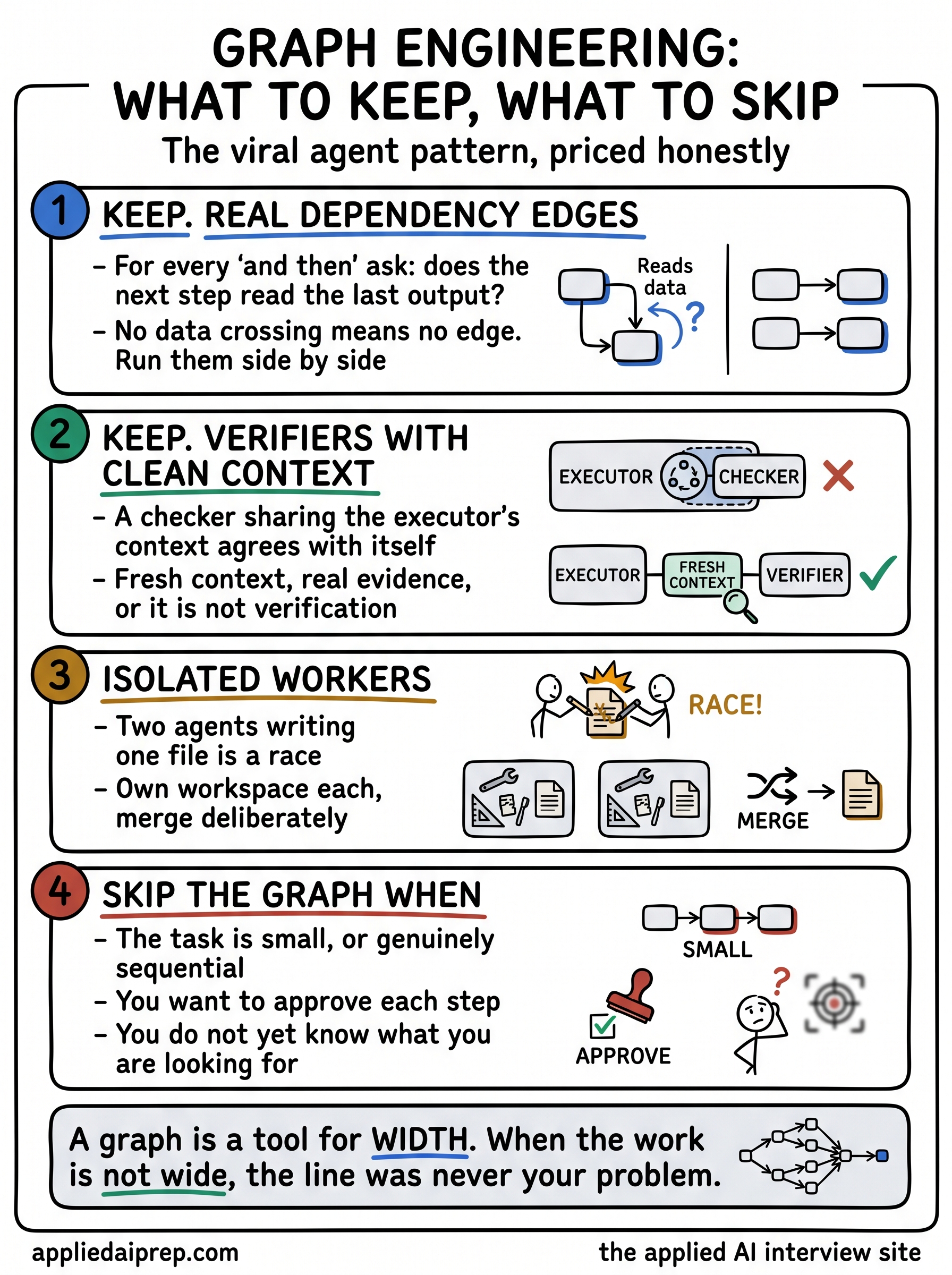
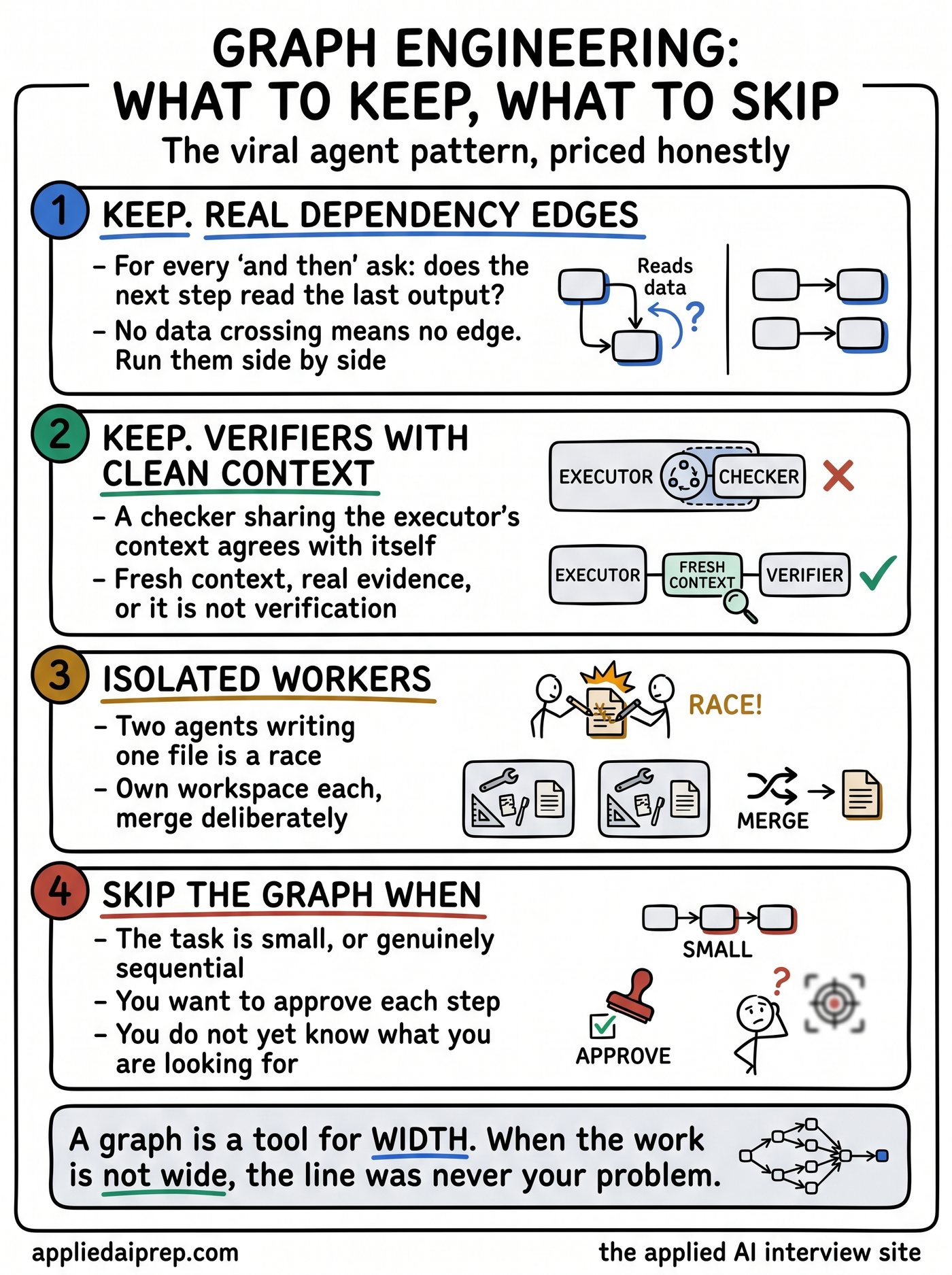
1. Interrogate every "and then." The habit that starts everything: for each step in your chain, ask whether the next step actually reads the previous step's output. "Summarize this file and then tell me the weather" contains no edge; the weather does not read the summary. If no data crosses between two steps, they are independent, and independence is what a graph exploits. If every step genuinely reads the last one's output, you have a real chain, and forcing a graph onto it buys nothing but coordination cost.
2. Verifiers need clean context. When an agent checks its own work inside the conversation that produced it, it goes easy on itself. Models prefer their own outputs, and a checker sharing the executor's context is agreeing with itself in a different font. The verifier that earns the name is a separate run with fresh context, checking evidence rather than the executor's account of the evidence. This is the same failure mode we cover in evaluating agent trajectories, and it does not go away because you drew more boxes.
3. Parallel workers need isolation. Two agents writing the same file is a race. The publicized failures of this pattern are exactly that: parallel workers sharing a workspace, overwriting each other, and the run failing operationally rather than intelligently. The fix is structural, not clever prompting: each worker gets its own isolated copy, and results merge deliberately. Before fanning out, you should be able to answer three questions: where does each worker work, how do results merge, and what happens when two disagree.
4. Anchor on things that cannot be argued with. A network of agents confirming each other, none of them touching anything real, fails exactly like a single self-congratulating loop, just with more moving parts. The graph stays honest only where it touches fixed points: tests that actually ran and passed, verifiers reading evidence, and rules the agents are never allowed to tune. That last one is Goodhart's law wearing an orchestration costume: any target a system can optimize, it will optimize, including the ones that were supposed to be the check.
The honest version of the scale story
The case everyone cites is real: a public project ported roughly 535,000 lines of Zig to over a million lines of Rust in eleven days, running around fifty workflows with a reported peak of 64 agents in parallel. Simon Willison's writeup of the port is the sober source worth reading.
The parts the viral threads underweight: the reported usage bill was around $165,000, a human designed and supervised the whole run, and the result drew public criticism over whether that much machine-authored code can be meaningfully reviewed. So the ceiling is genuinely high, and it is staffed and paid for. "A thousand agents from one prompt" describes a tool's configured maximum, not a method you deploy because a chain felt slow.
The other claim to price correctly: coordination through code instead of chat handoffs does save context, because intermediate results live in a script's variables rather than in every agent's window. But the workers themselves still cost full usage. The saving is in coordination, not in the work.
When the graph is the wrong choice
This part of the trend is underrated, because the viral framing sells width and most tasks are not wide.
Skip the graph when the task is small or isolated; a workflow wrapped around a one-file fix is pure overhead. Skip it when you want to read and approve each step before the next runs, because the entire point of a graph is running wide without you, which is precisely what tight oversight forbids. Skip it for exploratory work where you do not yet know what you are looking for; discovery wants one steerable agent, not a fleet committed to a plan you have not validated. And skip it when the steps genuinely depend on each other, where the agent-versus-workflow judgment you would apply to a single loop applies unchanged.
The pattern underneath all four: a graph is a tool for width. When the work is not wide, the line was never your problem.
How this shows up in interviews
No interviewer worth joining will ask "do you know graph engineering." They ask the questions the buzzword is made of, and they have been asking them since before the name existed:
When would you use more than one agent, and what does each one own? How do you split work so the pieces stay independent? What crosses the boundary between orchestrator and worker? What happens when two workers disagree, and how do you attribute a failure? Those are the load-bearing parts of multi-agent orchestration, and the strongest answers use the ideas above: real dependency edges, verification on fresh context, isolation before fan-out, and anchors the system cannot argue with.
If you want the material in order rather than as a trend response, the multi-agent module of the Agent Engineering course builds exactly this judgment, including the lesson on where coordination stops paying, which is the question the next viral thread will be about.
Names rotate. The engineering underneath them is stable, and it is the part an interview can actually test.
Turn it into offers. Work the real questions and concepts this maps to:
FAQ
It is the circulating name for structuring agent work as a dependency graph rather than a linear chain: identify which steps genuinely depend on each other's output, run the independent ones in parallel, verify results with agents that have fresh context, and give parallel workers isolated workspaces. The name is new. The mechanics are dependency analysis and DAG orchestration, which data engineering has used for a decade.
Discussion (2)
The detail I would pull out of every viral thread on this: the isolation point is not optional polish. Two agents writing the same file is a race, full stop. The teams that ship this pattern give every parallel worker its own workspace and merge deliberately, and the ones that skip it discover the failure operationally, which is the expensive way.
Worth saying that the honest version of the scale story includes the price tag. The public case everyone cites ran for eleven days with a human designing and supervising the whole time, and the usage bill was reported in six figures. That is a real capability and also not a thing you reach for because a chain felt slow one afternoon.